Across the world, many women are leading in ways that are deeply influential. They are developing people, strengthening ministries, and helping communities imagine new possibilities. Jasmine is one of those leaders. She serves as Asia Director for Project Video.

Through her role she leads a ministry that raises up local teams to create gospel-centered media in their own languages. The ministry’s focus is clear: empowering local teams, not just producing outside content for them.
Jasmine describes the goal as "seeing locals with the capacity to create whatever evangelistic or discipleship video resources are needed to reach their own people." The process begins with mentorship, grows into partnership, and aims toward the long-term sustainability of fruitful and effective Christian media teams. That vision continues to deeply motivate her even after 14 years of service with the organization.
A camera, a calling
Jasmine did not begin with a plan to become a ministry leader. She explains, “I was trained as a graphic designer. I was a creative.” Looking back, she adds honestly, “I wouldn’t say I was prepared to be a ministry leader.” Her leadership developed as she tried to be faithful in helping others be effective in their work.
Over the years, Jasmine has walked alongside people who were discovering their media abilities for the first time. Many started with uncertainty, especially those who had not been given many opportunities before. She remembers with joy what it has been like to see those shifts happen. People who once felt intimidated by cameras or editing tools began to realize “I can actually do this!”
Helping people understand their priceless worth and dignity before God.
For Jasmine, those moments still matter for her. The work is not just about helping people to develop media skills. It is also about helping people understand their priceless worth and dignity before God as they grow in their confidence and calling.
When stories reach the unreachable
The content created through Project Video varies widely. Some teams produce worship videos. Others create documentaries, teaching videos, dubbed productions, or full-length films shaped by their own culture and language. What matters is not the format, but the reach. Where physical access is difficult, media can go places where people cannot.
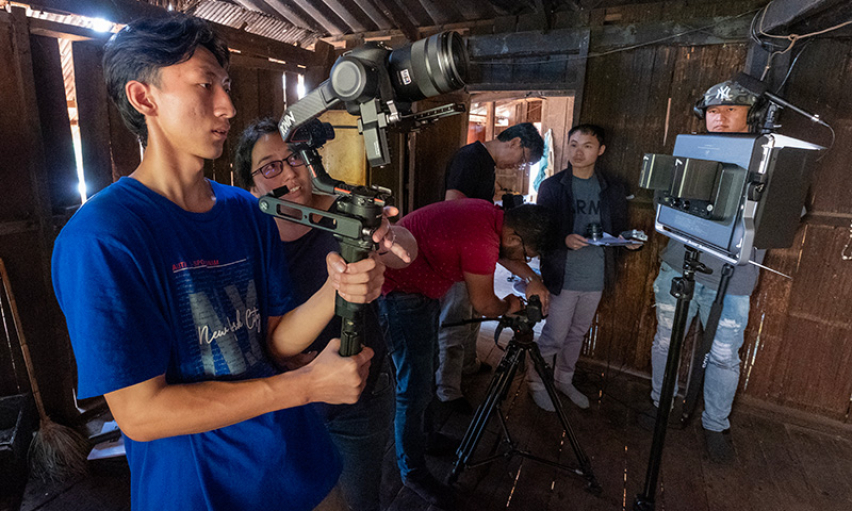
Jasmine recalls one story that continues to stay with her. A simple testimony video was uploaded online. It was not flashy. It was direct, personal, and local. In a neighboring country, someone from an unreachable tribe watched it and responded. Despite heavy persecution, that response spread and impacted a people group where there had never been Christians or a church before. Over time it became part of what God used to bring hundreds in that community to Christ. Now that tribe is starting to create their own gospel-centered media.
It is not just a media story. It is a mission story.
For Jasmine, this is one of the clearest examples of why the ministry matters. Video became part of reaching people who were, in her words, “completely unreachable physically.” It is not just a media story. It is a mission story.
Work behind the lens
Behind every success story is a team, and Jasmine has spent years learning what healthy teams need. She has seen that the strongest teams often combine younger members with energy and tech savviness, alongside mature leaders who can provide pastoral wisdom and direction. She has also seen how quickly growth can happen when younger team members are free to concentrate on the work.
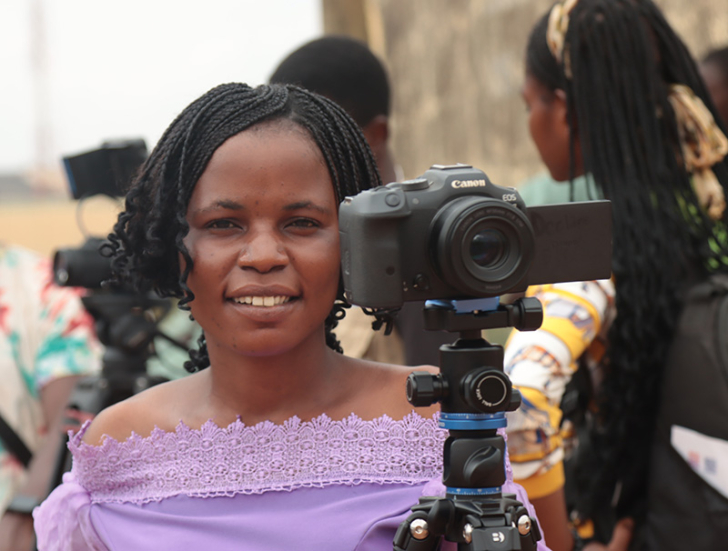
At the same time, one area remains especially close to her heart. Jasmine is genuinely encouraged when she sees girls and women taking part. She admits that many teams are still heavily male, but she has learned something important. She believes that, “if you have the skills, that supersedes the gender issue.” She hopes more girls and women will participate and use their gifts in Christian media in the future.
Kitchen table to international center
The ministry did not begin with polished systems or large facilities. It began simply. In the early days, work happened around a kitchen table. Jasmine describes those beginnings almost like a freelance setup. Everything was informal and flexible. Over time, though, the work outgrew the space.
She recalls, “The video equipment started piling up in my living room.” Then came a moment of conviction. During prayer, Jasmine realized the need for change. She sensed God telling her to make a space for staff.
That became a major transition point for the ministry. It marked the move from a work-from-home initiative into a shared ministry environment. What followed was not instant, but it was significant. Today, the ministry has an International Training Center, including room for larger gatherings and production work. It houses a vibrant multicultural team of almost twenty staff and interns. It also includes housing for people who visit.
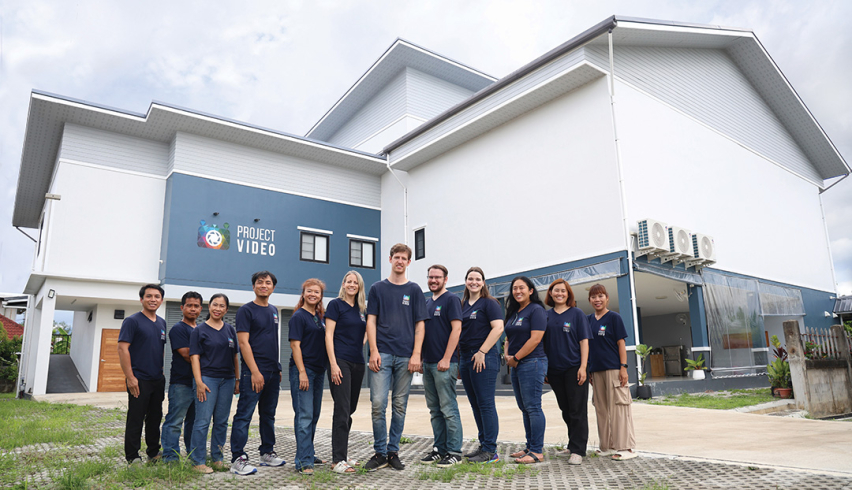
Leaders kept responding faithfully to what was needed next.
It is a picture of growth, but also of resilience. The ministry did not expand because everything was easy. It expanded because leaders kept responding faithfully to what was needed next.
Immersion program for fellow creatives
One important expression of that growth is Project Video’s one-year immersion program, which helps creatives explore how their gifts can serve God’s mission. Jasmine is passionate about that invitation, especially for people who never imagined there was a place for them in ministry.
She has met many creatives who want to serve but assume mission belongs only to preachers, Bible teachers, or medical workers. When they begin to see that media, design, photography, and storytelling can also be part of God’s work, something begins to open within them, and many new things become possible.
Lessons along the way
Jasmine’s leadership has also been shaped by hard lessons. Early on, she admits, she approached work with a strong efficiency mindset. She wanted results. But over time, her understanding changed. “I know the journey is as important to God as arriving at the final destination,” she says.
That insight feels central to her leadership now. She is still purposeful, but she has learned that perceived interruptions are not distractions to the mission. They are part of it.
“Listen not to what people say, but what their actions say".
She has also learned the importance of discernment and boundaries. Looking back, one lesson stands out clearly to her: “Listen not to what people say, but what their actions say.”
She had a difficult situation with someone who stole her car. Looking back, she realizes there were signs before this happened, but she kept listening to the person’s words more than considering small behaviors and actions that were revealing a different story.
Growing as a leader often means becoming less naïve. She realizes that stronger boundaries earlier would have saved her many headaches.
And perhaps that may be one of the clearest lessons we can take from Jasmine’s story: strong leadership is not only about vision and skill. It is also about endurance, discernment, humility, and the willingness to keep growing.
A picture of leadership that is steady, resilient, and deeply rooted in purpose.
Jasmine's journey is still unfolding. But already it offers a picture of leadership that is steady, resilient, and deeply rooted in purpose. And beyond the camera, her work continues to help others find both their voice and their place in God’s mission.
To learn more about Project Video and the work Jasmine and these teams are doing you can visit the following links:
- Website: https://www.project-video.org/
- Immersion: https://www.project-video.org/immersion/
- Facebook: https://www.facebook.com/projectvideoasia
- Instagram: https://www.instagram.com/projectvideoasia
Benjamin (Ben) Mudahera is a Guest Writer at the Women’s Institute at William Carey International University. Ben is a development practitioner and writer who is currently completing a Master of Arts in Development Studies, specializing in Global Women’s Empowerment. Ben has over 15 years of experience serving across humanitarian and development organizations in Rwanda. His experience spans education, refugee affairs, WASH, and community development, with a strong focus on supporting women, youth, and marginalized communities. Through his writing, Ben brings a people-centered, reflective, and faith-informed perspective, seeking to amplify stories of dignity, leadership, and transformation.
Mary Lederleitner has a MA in Intercultural Studies from Wheaton College and a PhD in Educational Studies from Trinity Evangelical Divinity School (TEDS). She has taught as an Adjunct Professor in the graduate programs at both institutions, and currently in the D.Min. Program at TEDS. Mary served for twenty years in a variety of global leadership roles with Wycliffe Global Alliance and SIL Global. She has authored books including Women in God’s Mission: Accepting the Invitation to Serve and Lead which won a book-of-the-year award from Christianity Today in the Missions / Global Church Category. Mary now serves as Associate Professor and Director of the Women’s Institute at William Carey International University.
William Carey International University (WCIU) seeks to provide innovative distance education to enhance the effectiveness of scholar-practitioners as they serve with others to develop transformational solutions to the roots of human problems around the world.