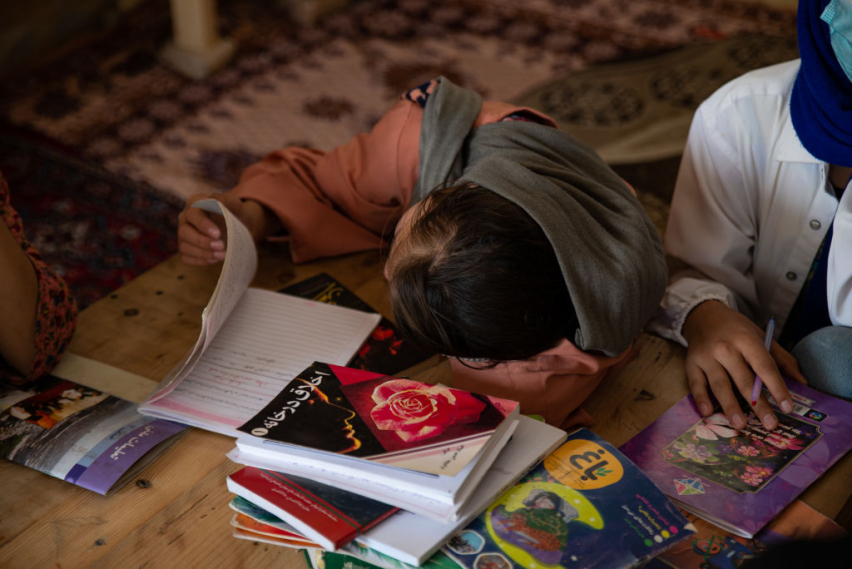
Afghanistan remains the only country in the world where girls are shut out of school beyond the sixth grade, and where women are barred from university. Five years into that ban, new research suggests the classroom doors closed but the learning did not stop.
Findings from 2,612 Afghan respondents, released Tuesday (Sept. 8) on International Literacy Day, describe girls and young women studying through private courses, online lessons, borrowed phones and small study circles organized among friends. The research was presented by Benazir Poya, head of Anar Academy, at a global virtual event hosted by the International Society for Human Rights (ISHR) and moderated by its secretary general, Dr. Matthias Boehning.
Poya was careful to say the alternatives are not a substitute. Informal learning "can preserve hope," she said, but it cannot restore the right to an education.
The event, "Denied the Right to Learn: Educational Continuity, Human Rights and Human Security in Afghanistan," also drew speakers from Human Rights Watch and UNICEF, along with Afghan students who joined from inside the country on weak connections.
Rapid decline following Taliban take-over
The Taliban took control of Afghanistan in August 2021 as United States forces completed their withdrawal. Within weeks, girls were barred from returning to secondary school. In December 2022, universities were closed to women as well.
The Taliban's then education minister, Nida Mohammad Nadim, defended that decision at the time, saying women had failed to observe strict dress requirements and that certain fields of study did not fit Afghan tradition. "Girls should learn, but not in areas that go against Islam and Afghan honor," he told an Afghan broadcaster, according to reporting by The Associated Press. He said universities would reopen for women once the concerns were addressed. They have not.
Further restrictions followed: on employment, on travel without a male relative, on public parks, gyms and bathhouses.
Improvised education
Anar Academy, based in Germany, gathered its responses in the second half of March 2026 from 30 provinces, with most respondents inside Afghanistan and a smaller group who had left. Poya said the picture that emerged was not one of empty days but of improvised ones.
Girls have turned to language classes, tailoring and skills courses, and above all to whatever can be delivered over a phone, she said. Some reported no learning at all.
Nearly all respondents said they had a phone or laptop. Far fewer said their connection was dependable. Online study keeps a rhythm going, Poya said — contact with a teacher, subjects to work through, other students to talk to — but it produces no diploma, no route into a university, and no guarantee of a quiet or private place to sit and work at home.
She pointed to consequences that reach well past the syllabus. Learners described stalled futures, shrinking social contact and steady psychological strain. The effects touch household income, health and dignity, she said, not only schooling.
Poya asked that the persistence documented in the survey not be misread as a sign that the situation is tolerable. Resilience, she said, "is not evidence of adequacy. It's evidence of agency."
Anar Academy's recommendations begin with the unconditional reopening of secondary schools and universities to girls and women. Beyond that, Poya called for safeguards protecting online learners' privacy and safety; recognition by universities abroad of accredited online study, including transcripts and admission pathways; and funding committed over several years rather than in short grants. She noted that respondents were reached through the internet, so the survey speaks for connected learners rather than for the country as a whole.
The briefing paper is the first of a planned series. Anar Academy and ISHR intend to track the same questions over time.
'It will not stay in Afghanistan'
Fereshta Abbasi, a researcher in the Asia Division at Human Rights Watch, addressed the event by pre-recorded video.
Afghanistan has signed both the Convention on the Rights of the Child and the convention on discrimination against women, Abbasi said, and the Taliban as de facto authorities are bound by those commitments. She described the education ban as one part of a wider pattern that Human Rights Watch identified in a September 2023 report as the crime against humanity of gender persecution. The organization called on the International Criminal Court to investigate; the court issued arrest warrants for Taliban leaders on gender persecution charges last year.
Abbasi warned against treating the situation as ordinary. "What is happening in Afghanistan will not stay in Afghanistan," she said, arguing that the rollback of women's rights in one country weakens them everywhere.
The women affected are not an abstraction, she said. Some were months from finishing school in August 2021; others were already teaching or earning. Many now live with depression, anxiety and post-traumatic stress.
Abbasi set out a series of steps for governments and United Nations bodies, from humanitarian funding to accountability mechanisms. But her closing appeal was aimed at what individuals can do: Talk about Afghan women and girls, she said, and do not let the rest of the world forget them.
Education among wider decline in human rights
The restrictions on education sit within a broader legal shift. Christian Daily International reported in February, republishing coverage from The Christian Post, that the Taliban's supreme leader, Hibatullah Akhundzada, had signed a new criminal procedure code that divides Afghan society into ranked categories and prescribes different punishments for the same offence depending on a person's status.
Legal analysts and rights groups quoted in that reporting said the code's language distinguishing free persons from slaves amounts to treating slavery as a lawful category, and that it strips out basic protections such as access to a lawyer.
United Nations officials described the code as part of a system of gender apartheid.
A rights crisis and a learning crisis
Tomoko Shibuya, senior adviser for education at UNICEF, joined from Nairobi and set the survey findings against national figures. UNICEF estimates that 3.8 million girls aged 7 to 18 were out of school in 2024, including more than 2.6 million adolescents, she said.
She added a second problem that receives less attention. A 2025 assessment found that 93% of Afghan children, boys as well as girls, cannot read and understand a simple age-appropriate sentence by the end of primary school. Afghanistan, in Shibuya's words, is dealing with a rights crisis and a learning crisis at the same time.
That combination matters for what comes next, she said. Girls pushed into informal study have often had only a few years of foundational schooling to build on, which limits how far self-directed learning can carry them.
Shibuya cautioned against admiring the resilience without acting on it. "Girls should not have to shoulder the risk and responsibility of their education," she said.
Only the de facto authorities can lift the ban, she said. In the meantime, she set out three priorities: Afghan-led community learning spaces that include psychosocial support and practical skills; investment in early and primary education so children gain at least seven years of solid schooling; and digital learning designed for low bandwidth and offline use, so that poor connectivity does not exclude girls a second time.
Marco Mantovanelli of the Global Partnership for Education addressed the financing side, noting that education has historically received only a small share of humanitarian funding worldwide — roughly 2% to 4% — and that continuity cannot be sustained on short grants. His organization works through partner agencies on the ground rather than through the Taliban administration, he said, directing funds to community-based and remedial classes.
Boehning closed by asking Poya what keeps her from concluding that Afghanistan's girls are a lost generation. Poya, who completed a master's degree before the restrictions and now lives in Germany with two young children, said she treats the education she received as an obligation to those denied it. Her students, she said, should not be left with the impression that no one is on their side.