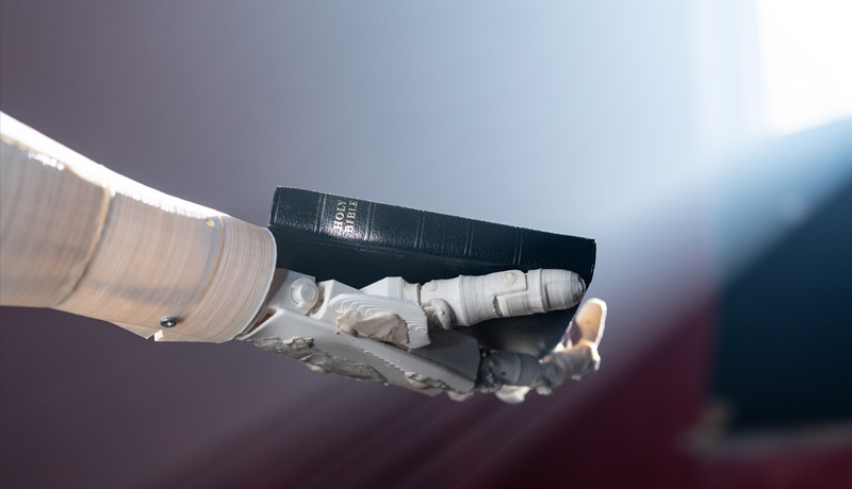
We are no longer waiting for artificial intelligence to change our daily lives. It already is, often in ways we don’t even realize.
It’s shaping how people form beliefs, how they process information, how they decide what is true, and even who they trust. For church leaders and church planters, this moment is not about technological curiosity. It’s about spiritual responsibility.
A call to lead.
This is not a call to panic. It is a call to lead.
At Gloo, we envision a future where leaders actively guide how AI is used to disciple, reach, and engage people without replacing the relationships and humanity at the heart of ministry. But this kind of future must be shaped, not assumed.
Church leaders do not need to become technologists. But they do need to practice discernment.
What makes this moment different from past technological shifts is the removal of barriers. It is now possible to generate software, websites, sermons, devotionals, graphics, and theological reflections in minutes. Tools such as Claude Code and Replit allow users to build full applications without traditional training. What once required teams of developers and weeks of work can now be assembled in an afternoon.
Synthetic content is flooding the internet.
We are entering an era overwhelmed by what many technologists have begun to call “AI slop.” Synthetic content is flooding the internet. Digital AI images are indistinguishable from genuine photographs. Devotional posts circulate with quotes that were never spoken. Theological reflections are generated without authorship. Even seasoned leaders increasingly struggle to determine what is real.
Industry forecasts predicted that by 2026, the overwhelming majority of online content could be generated by artificial intelligence. The digital environment forming our congregations is rapidly becoming synthetic.
Refuse to let it replace the relationships that God made us to live in and through.
This is where the conversation becomes spiritual. AI has the potential to do more than just confuse us. If we let it, it might also isolate us. Ministry will play a critical role in making sure people use AI wisely and refuse to let it replace the relationships that God made us to live in and through.
AI can generate prayers, but it cannot pray with someone through grief. It can summarize scripture, but it cannot sit in silence with a struggling church planter. It can provide counsel, but it cannot embody covenant.
AI companionship may increase feelings of isolation.
There is already early research suggesting that AI companionship may increase feelings of isolation rather than reduce them. At the same time, pastoral burnout and loneliness were already at concerning levels before this technology boomed.
Church planting, for instance, is one of the most isolating callings in ministry. Pastoring requires emotional resilience and relational depth. But if we are not intentional, AI will quietly replace conversations we once had with trusted friends, mentors, or even God Himself.
It is easier to ask a chatbot for direction than to wait in prayer. It is easier to generate an answer than to wrestle for discernment. But formation does not happen through convenience.
Confident does not mean correct.
Artificial intelligence models are trained on vast amounts of data. They recognize patterns in language. They do not receive revelation. They do not carry doctrinal accountability. When AI translates, summarizes, or explains scripture, it is pattern matching. This means it’s simply looking for the most probable answer based on statistical patterns in data. That may sound accurate. It may feel confident. But confident does not mean correct.
This is why discernment must become part of pastoral leadership in this generation.
Language models can distort theology subtly.
We must understand that language models can distort theology subtly. Flattened doctrine, loss of context, and hallucinated citations are documented realities in large language models. Leaders must test what sounds right against what is true.
Most importantly, we must use AI in ways that point people back to people and connection.
We know that artificial intelligence can be helpful for organizations, research, summarizing notes, drafting communications, and freeing up time. It can improve efficiency. There is a role for thoughtful, accountable AI tools that support human flourishing.
That’s why at Gloo we built Ministry Chat, an AI assistant designed to help church leaders quickly research Scripture, prepare ministry resources, and answer complex questions, so they can spend less time searching and more time shepherding people.
The best technology cannot replace the work of the Holy Spirit.
At the same time, even the best technology cannot replace the work of the Holy Spirit or ministry or presence. The measure of a tool is not how impressive it appears. The measure is whether it strengthens or weakens human connection.
Leadership in this era includes modeling discernment and restraint. It includes teaching congregations how to evaluate technology. It includes asking questions such as: Is this forming us? Is this replacing something sacred? Is this drawing us toward deeper community or further into isolation?
Being faithful is (the goal).
Being first to adopt a tool is not the goal but being faithful is.
The future of ministry will not be decided by technology alone. It will be shaped by leaders who choose wisdom over convenience and presence over efficiency.
Artificial intelligence will shape the world our congregations inhabit. The question is not whether it will influence ministry. It already is.
The question now is: will church leaders help shape how it’s used from here on out?
Brianne Shaw is the Director of Church Marketing at Gloo, a leading technology platform for the faith and flourishing ecosystem. She also serves as a bi-vocational pastor at Vineyard Church in Los Angeles, California.