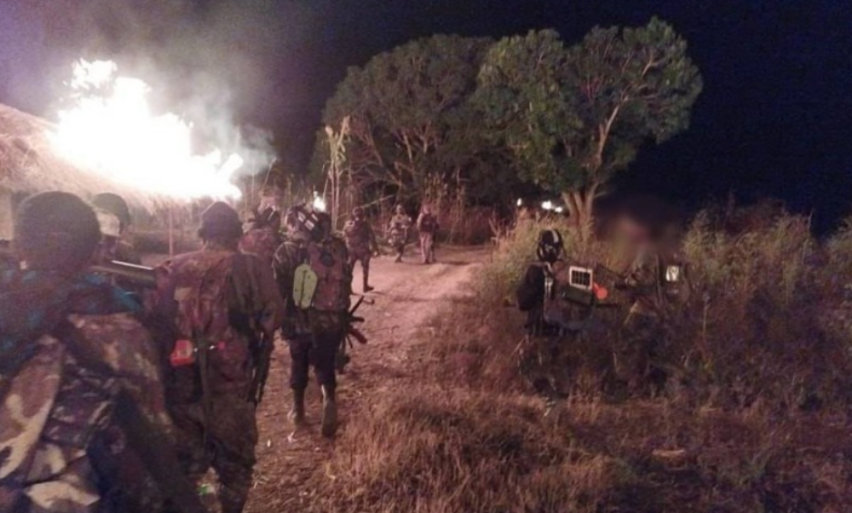
Fresh attacks linked to Islamist militants in northern Mozambique have left at least nine people dead and several churches destroyed, according to church groups and religious aid organizations monitoring the violence in Cabo Delgado province.
The latest violence took place in Ancuabe District, an area that has seen repeated militant raids in recent years as insurgents tied to the Islamic State group continue expanding operations across northern Mozambique.
According to Barnabas Aid, five Christians were killed in the village of Namecala on May 9 during an attack claimed by Islamic State Mozambique, also known as IS-M. The group reportedly burned a church building and more than 160 homes during the assault.
The organization also reported that two Christians were captured and beheaded near Namecala on May 8, while another believer was killed near Nanoni village a day earlier. Other villages in Ancuabe District were also attacked, with houses and churches set on fire.
The attacks come amid growing concern over the targeting of Christian communities in Cabo Delgado, a northern province that has been at the center of a violent Islamist insurgency since 2017.
In recent propaganda messages, Islamic State Mozambique has reportedly referred to Christians who refuse to convert or submit to extremist rule as “combatants,” language that analysts and church groups say reflects an increasingly direct threat against Christian civilians.
The violence has not received widespread international attention, but church agencies, conflict monitors and humanitarian groups say attacks have intensified again in recent months.
Earlier this month, militants attacked the historic St. Louis de Montfort Church in Meza village in Cabo Delgado, burning the church building, a missionary residence and a kindergarten operated by the Catholic Church, according to Vatican News.
Bishop António Juliasse Ferreira Sandramo of Pemba described the attack as “a scene of genuine terror,” saying churches and chapels in the region have faced repeated destruction for nearly nine years.
The insurgency in Cabo Delgado began in October 2017 when armed militants launched attacks on police stations in Mocímboa da Praia. The group, locally known as al-Shabaab though unrelated to the Somali extremist organization of the same name, later pledged allegiance to the Islamic State group and became known internationally as Islamic State Mozambique.
Since then, thousands of people have been killed and hundreds of thousands displaced as militants carried out raids on villages, beheadings, kidnappings and attacks on churches, schools and government facilities.
According to conflict and humanitarian groups, the insurgency has been fueled by poverty, weak state control, youth unemployment and long-standing frustrations in Cabo Delgado, one of Mozambique’s poorest provinces despite its vast natural gas and mineral wealth.
The conflict escalated sharply between 2020 and 2021, when militants briefly seized strategic towns including Palma, an area near major natural gas projects led by international energy companies. The violence forced foreign companies to suspend operations and triggered a regional military response involving troops from Rwanda and southern African countries.
Although military operations helped retake several towns, attacks have continued in rural communities across Cabo Delgado.
Christian organizations say Christians have increasingly become targets. Open Doors, a group that monitors persecution against Christians worldwide, says militants in northern Mozambique have burned church buildings, destroyed homes and killed civilians in attacks directed at Christian communities.
Mozambique’s Christian population has long played an important role in the country’s social and political life. Churches were heavily involved in peace and reconciliation efforts during Mozambique’s civil war, which ended in 1992 after nearly 16 years of fighting.
But the rise of Islamist violence in Cabo Delgado has placed many Christian communities under renewed pressure, especially in remote northern districts where security remains weak.
Humanitarian agencies say the conflict has displaced more than 1 million people over the last 9 years, while many villages remain vulnerable to sudden attacks.
Despite regional military support, analysts say militants have adapted by carrying out smaller raids on isolated communities instead of trying to hold major towns.
Recent attacks in Ancuabe suggest the insurgency remains active and capable of targeting civilians despite years of military operations.
Local church leaders have continued calling for international attention and humanitarian support for affected communities.
“We ask for attention and solidarity,” Bishop Sandramo said following the destruction of the Meza church earlier this month. “The faith of these people will never be destroyed.”