
A bill that could let India’s government seize the schools, hospitals and hostels built by faith-based charities over generations will not come to a vote just yet.
The government on Wednesday (Aug. 12) moved the Foreign Contribution (Regulation) Amendment Bill, 2026, commonly called the FCRA Bill, to a Joint Parliamentary Committee (JPC) rather than pushing it through the Lok Sabha, India’s directly elected lower house of Parliament.
The bill has been building toward this moment for months. When it was introduced in March, the government said it would not spare those using foreign funds for forced religious conversion, alongside its stated aims of transparency and national security. Hindu nationalist groups have regularly accused Christian organizations specifically of using foreign donations to fund conversions, a charge Christian leaders reject; the government, for its part, insists the bill targets no single community.
Union Home Minister Amit Shah, the minister responsible for India’s internal security, was originally listed to move the motion himself; in the end Minister of State for Home Affairs Nityanand Rai placed it before the House.
It sends the bill to a 31-member panel, 21 from the Lok Sabha and 10 from the Rajya Sabha, Parliament’s upper house. The committee must report back by the first week of the Winter Session, expected in November.
Christians make up roughly 2.3 percent of India’s population nationally, according to the last full census, but form large majorities in northeastern states including Mizoram, Nagaland and Meghalaya. Those states’ chief ministers have been among the most active in lobbying ahead of the referral.
Christian bodies that had spent months opposing the bill cautiously welcomed the move.
“Legislation with consequences of this nature deserves careful examination, meaningful consultation and the fullest parliamentary scrutiny,” the Evangelical Fellowship of India (EFI) said in a statement released the same day. “The referral is an important step. It is the beginning of scrutiny, not the resolution of concerns about the bill in its present form.”
The Catholic Bishops’ Conference of India (CBCI) welcomed the referral in similar terms, calling it consistent with democratic process and signaling openness to working with the committee toward what it described as a balanced framework.
The National Council of Churches in India (NCCI), which represents Protestant and Orthodox churches, was more effusive.
“We thank the Honorable Home Minister and the Government of India for heeding to the request of the Christian Community,” said the Rev. Asir Ebenezer, NCCI’s general secretary, in a statement, adding that NCCI looked “forward to engage with the JPC as they prepare the report for the Winter session.”
Opposition parties were far less satisfied, and the motion passed over loud protest on the floor. Congress MP K.C. Venugopal told the House the bill targets Non-Governmental Organizations run by minority communities even as “the RSS is collecting donations from foreign countries,” and demanded it be withdrawn.
The RSS, formally the Rashtriya Swayamsevak Sangh, is a Hindu nationalist paramilitary organization at the center of a wider network of affiliated groups. Its cadres helped establish the Bharatiya Jana Sangh, predecessor of the Hindu nationalist Bharatiya Janata Party (BJP), and the RSS remains the BJP’s principal ideological influence. The BJP is the dominant party in India’s governing coalition.
The RSS’s ideology and organizational model have long been examined by scholars in relation to European fascism, with some applying the label directly. Historian Benjamin Zachariah has called the RSS “the longest-running continuous fascist movement in the world,” while other scholars have argued that fascism is an imperfect category for a distinctly Indian authoritarian movement.
FCRA, the Foreign Contribution (Regulation) Act, has governed how Indian charities, churches and other nonprofits receive money from abroad since 1976. Any organization receiving foreign contributions must either register with India’s Ministry of Home Affairs or obtain prior permission; FCRA registrations must be renewed every five years.
The law was rewritten in 2010 under the previous Congress-led government, which introduced that renewal cycle, and was tightened further in later rounds, including a more restrictive 2020 amendment under Prime Minister Narendra Modi’s BJP-led government. What changed sharply after the BJP came to power in 2014 was the pace of enforcement: more than 22,000 registrations have been formally cancelled, and roughly 15,000 more deemed to have expired. Media reports have alleged those categories together have cost more than 10,000 Christian organizations their access to foreign funds, including the EFI itself, World Vision India and the Church’s Auxiliary for Social Action.
A 2022 analysis of Ministry of Home Affairs data found that, of religious-category NGOs that had lost FCRA status by that point, more than 72 percent were Christian-aligned, against 11 percent Hindu-aligned and 8.6 percent Muslim-aligned, a pattern church leaders say has continued since.
The 2026 amendment builds on a power that already exists: a vesting provision in Section 15 of the 2010 Act. The bill creates a “designated authority,” with the powers of a civil court, that takes provisional control of an organization’s foreign-funded land, buildings, hospitals and schools whenever a registration is cancelled, surrendered or not renewed in time. If registration is not restored within a set window, control becomes permanent and the authority may transfer or sell the property.
The authority’s orders can be revised within 90 days and appealed to a district judge. But PRS Legislative Research, an independent body that analyzes Indian legislation, notes a sharper gap: neither the Act nor the bill provides any appeal, or even a hearing, against the government’s underlying decision to deny renewal, the very decision that can set the entire vesting process in motion.
The government disputes that this amounts to seizure. In a July 22 backgrounder, the Press Information Bureau (PIB) of the Government of India said roughly 16,200 associations were actively registered in 2024-25, receiving about 22,963 crore rupees ($2.7 billion) in contributions, “hardly the footprint of a prohibition.”
It said vesting is initially provisional, with full restoration if a registration is renewed, that places of worship retain their religious character “by law in all cases,” that many cancellations are administrative rather than punitive, and that courts remain empowered to review any cancellation.
The Rev. Vijayesh Lal, EFI’s general secretary, said the organization’s objection runs deeper than the process questions the government has offered to address.
“We believe the principle of automatic vesting of assets itself needs to be removed,” he said. “FCRA should regulate the receipt and use of foreign contribution; it should not create a continuing State claim over an asset after funds lawfully received have already been used for their authorized purpose. Where there is proven misuse or unlawful activity, the State must act against it, but that is different from automatic vesting. We will seek reconsideration of the vesting principle itself, including the existing Section 15, rather than narrower changes to the powers of the Designated Authority.”
The bill is not the only change churches are contending with. On June 22, the Ministry of Home Affairs separately notified new FCRA Rules that took effect immediately, ahead of any parliamentary vote on the bill itself.
The rules require registered organizations to specify their activities under one of five permitted categories, social, political, educational, cultural or religious, and, within the religious category, they exclude “proselytization” from the purposes eligible for foreign-funded registration. The Rules do not define the term, a gap the CBCI and Amnesty International have separately flagged as leaving broad discretion to local officials.
“The Rules are already in force and have changed what religious organizations may seek foreign funding for, independently of what Parliament ultimately decides on the Bill,” Lal told Christian Daily International. “That raises an important question about how the term proselytization is understood and applied. It should not become so broad as to blur the distinction between improper conversion practices and the ordinary exercise of religious faith, including preaching, teaching, witness and propagation. FCRA regulates access to foreign funding; it does not define the full scope of lawful Christian faith and practice in India.”
EFI has particular reason to be watching closely. Its own FCRA renewal was denied in December 2023, on grounds it would “prejudicially” affect “harmony between religious, racial, social, linguistic, regional groups, castes or communities,” a finding Lal calls a reversal of the truth about a body which, representing evangelicals in India, has long engaged in interfaith and civic partnership, not division.
EFI’s Religious Liberty Commission, tracking violence against Christians since 1998, released its latest annual report on March 25, the day the bill was introduced, verifying 747 incidents in 2025.
“Since late 2023, EFI has continued its work without receiving foreign contributions under an FCRA registration,” Lal told Christian Daily International. “That closed an important channel through which long-standing international partners had supported programmes and ministry and required us to depend much more heavily on Indian resources.”
NCCI raised the alarm around the same time as EFI and the CBCI. In late March, before the bill’s introduction, Ebenezer wrote to every member of Parliament asking that the bill be withdrawn or sent for expert study.
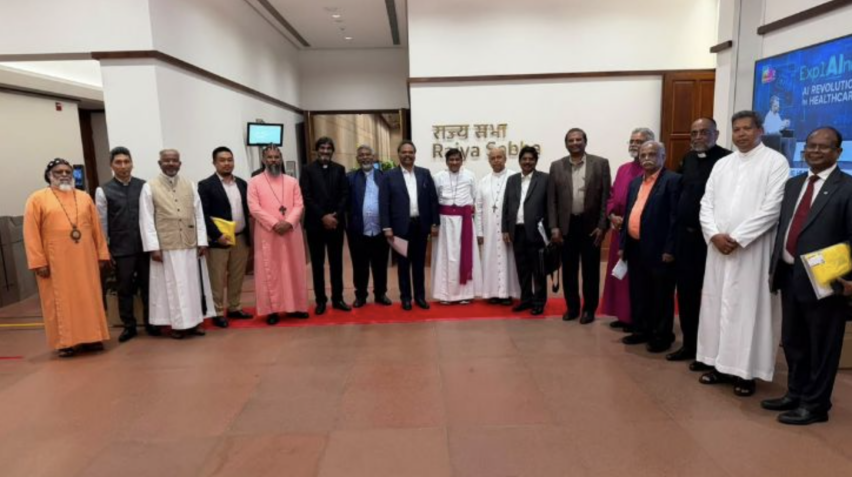
That campaign led to a meeting on Aug. 6, when a delegation representing nearly every major Christian tradition in India met Shah inside Parliament House to submit a joint memorandum. Ebenezer, who attended the meeting, said Shah listened for about an hour and engaged the delegation’s concerns directly.
“He mentioned that the Bill was religion-neutral. We never had any dispute on this anyway,” Ebenezer said, adding that Shah told the group the government had no intention of harassing any faith community.
It was not the first time Shah had made that case with a number attached. On July 10, meeting the CBCI separately, he said Christian organizations receive “a little under 15 percent” of India’s total foreign donations.
By early August, government sources gave the media, a more specific figure: of roughly 17,000 crore rupees ($2 billion) in foreign contributions received nationally the previous year, only about 3,000 crore rupees ($360 million) went to Christian institutions. That speaks to the share of money involved, not the share of enforcement within a category.
The delegation pressed instead for clarity on what triggers “deemed cessation,” what powers the authority would have over seized assets, and whether Section 15 of the 2010 Act itself needs revisiting, a point Ebenezer said Shah appeared open to hearing. Shah invited any organization whose registration had been cancelled without notice to bring its case to him directly.
The pressure was not confined to Delhi. In Mizoram, where Christians form an overwhelming majority, Chief Minister Lalduhoma pressed Shah directly and came away with a promise that the law would not apply retroactively, while hundreds of believers protested in the state capital, Aizawl.
Kerala’s state assembly, home to some of India’s largest Christian-run institutions, passed its own resolution calling the bill unconstitutional. Meghalaya’s Chief Minister Conrad Sangma raised similar objections on his state’s behalf.
Christian leaders have framed this as a fight about civil society broadly, not Christians alone. Amnesty International and other organizations urged Parliament to reject the bill outright, and the Financial Action Task Force, the global anti-money-laundering body, found India only “partially compliant” on nonprofit safeguards in 2024.
The dispute has drawn attention abroad, too. U.S. Congressman Riley Moore of West Virginia warned the bill would let India’s government “take over churches and religious charities.” India’s ambassador to the United States, Vinay Mohan Kwatra, addressed the issue, days later in a “myth vs. reality” thread on X, saying property tied to a place of worship would pass to another FCRA-registered body of the same faith, not to the state.
The stakes are not abstract. In 2017, after its Indian partner organizations were denied FCRA clearance and U.S.-based ministry Compassion International was placed on the government’s Prior Permission list, blocking its fund transfers, the ministry ended its India program entirely. In a farewell message, the ministry said the closure would end its partnerships with 589 churches and support for more than 147,000 children, young adults and mothers.
Asked what he would say to international partners watching this bill, Lal offered a message aimed as much abroad as at Delhi.
“My message to our international partners would be: remain engaged, remain informed, and continue every partnership lawfully and transparently,” he said. “This is not a moment for withdrawal, nor for attempting to work around Indian law.”
He cautioned against reading the fight as being about Christians alone, a point EFI itself had already made in its own statement on the referral.
“FCRA affects a much wider voluntary and charitable sector in India, including institutions working in education, healthcare, development and community service,” Lal said. “Christian institutions are particularly affected because of their historic presence in these fields and their long-standing international partnerships. But the larger question concerns Indian civil society as a whole: how far should regulation of foreign contribution extend into the ownership, management and continuity of lawful Indian institutions?”
Churches in India, he added, are “deeply rooted in this country and increasingly sustained from within,” even as international partnership continues to matter. “We would ask our friends abroad to remain with us in prayer, solidarity and responsible partnership while Parliament examines these serious questions.”
For now, the bill moves from the floor of Parliament to a committee room. Both its supporters and its critics expect the argument to return before the year is out.








