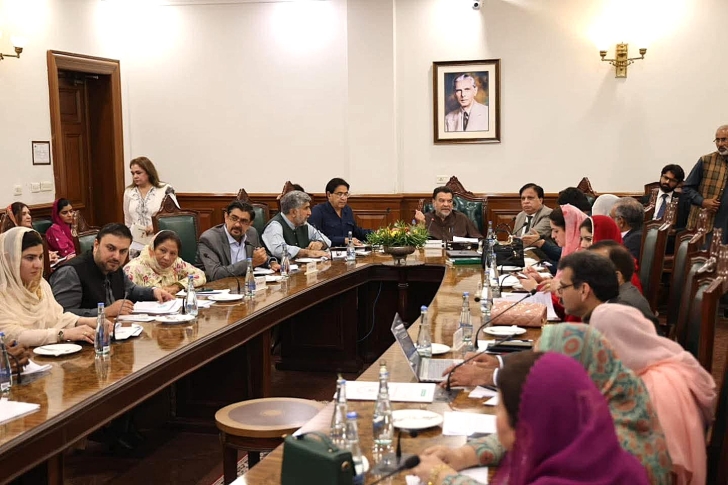
A key committee of Pakistan’s Punjab Province Assembly on Monday (April 13) reportedly approved legislation that would help protect Christian and other minority-religion girls targeted for forced conversion and illegal marriage.
The Punjab Assembly’s Standing Committee on Local Government and Community Development approved the Punjab Child Marriage Restraint Bill 2026 despite objections from some members, including its chairperson, according to media reports. Punjab Gov. Sardar Saleem Haider promulgated the ordinance on Feb. 11, putting it into force for 90 days, and without parliamentary approval it is set to lapse in May.
The committee, chaired by Pir Ashraf Rasool, reviewed the Punjab Child Marriage Restraint Ordinance 2026, and following its endorsement, the draft bill has been referred to the provincial local government secretary to finalize implementation rules. It will subsequently be presented before the Punjab Assembly for approval.
During deliberations, committee members said the proposed law aims to curb underage marriages, eliminate gender-based disparities and strengthen child protection mechanisms in the province.
Rasool and committee member Zulfiqar Shah, however, opposed the bill, arguing that it contravenes constitutional guarantees of religious freedom. In a written submission, Rasool said the legislation conflicts with provisions allowing citizens to freely practice their religion. He also maintained that, under Islamic jurisprudence, marriage is permissible upon reaching puberty and called for exceptions to be included in the law, citing socio-economic pressures on low-income families.
“Poor parents often marry their daughters early due to lack of resources and concerns about their safety,” Rasool told Dawn newspaper.
Other committee members rejected the proposed exceptions, warning that such provisions could open the door to abuse and undermine the law’s intent. Rasool said he intends to challenge the bill in the assembly by introducing amendments.
Criminalizing Child Marriage
The Punjab Child Marriage Restraint Bill 2026 proposes raising the minimum legal age of marriage to 18 for both males and females, replacing provisions of the nearly century-old Child Marriage Restraint Act of 1929, which set the age at 18 for men and 16 for women.
The bill classifies child marriage as a cognizable, non-bailable, and non-compoundable offense. Individuals who contract, facilitate, or promote such marriages could face up to seven years’ imprisonment and fines of up to 1 million Pakistani rupees ($3,500).
Marriage registrars, or nikah khawans, would be prohibited from registering marriages involving minors. Violations could result in up to one year in prison and fines of 100,000 rupees ($357).
Adults who marry minors would face two to three years’ rigorous imprisonment and fines of up to 500,000 rupees ($1,787). Cohabitation resulting from a child marriage would be treated as child abuse, punishable by five to seven years in prison and a minimum fine of 1 million rupees, regardless of purported consent.
The legislation also criminalizes child trafficking linked to marriage and imposes liability on parents or guardians who facilitate or fail to prevent underage marriages. Such offenses carry penalties of two to three years’ imprisonment and fines of up to 500,000 rupees.
All cases under the proposed law would be tried in Courts of Session and concluded within 90 days, a measure aimed at expediting justice.
Advocacy groups have long called for raising the legal marriage age for girls to 18, arguing that the previous legal framework discriminated on the basis of gender and exposed adolescent girls, especially those from vulnerable Christian and Hindu minority communities, to forced marriages and abuse.
Efforts to reform the 1929 law have faced resistance from some religious leaders and political actors. The Council of Islamic Ideology, a constitutional advisory body, has previously opposed setting a statutory minimum age, arguing that Islamic law does not prescribe a fixed age aligned with modern legal standards.
In April 2024, the Lahore High Court, in a ruling by Justice Shahid Karim, struck down the gender-based age distinction in the 1929 law as unconstitutional, declaring the provision setting 16 as the minimum age for girls to be without legal effect. The court directed the provincial government to amend the law accordingly.
Subsequent reform proposals, including stricter age-verification mechanisms through national identity records, were debated through 2025 but were not enacted prior to the promulgation of the ordinance earlier this year.
Pakistan, a Muslim-majority country, ranked eighth on Open Doors’ 2026 World Watch List of the countries where it is most difficult to be a Christian.