
Lots of churches in the Global North are cerebral, shaped by the impact of the Enlightenment on culture. Other churches (non-white, Global South) are often more ‘spiritual,’ prayerful, and expectant. Wouldn’t it be wonderful if we could all learn from each other’s strengths and find more common ground? It’s just possible that this book could help us do that.
Meanwhile, I’ve always struggled to understand how people can make decisions as if Truth didn’t matter. Wouldn’t you want to know where the bus or train was going before you got on it? Wouldn’t it matter whether the medicine was helpful or harmful before you took it?
I’ve also increasingly understood that lots of problems in churches stem from poor character formation in my life and in the lives of those around me.
I’m not qualified to comment on the neuroscientific content of this book, so I don’t know how true it is that certain brain functions (which complement those that analyze truth) can also build character.
But it emphasizes historical biblical truths about community that might offer help to those of us wanting to go deeper with God. In fact, its central themes are the vital importance of relationships and character—a much-needed correction to so much thinking in every area of life these days.
Being cautious about ‘quick fixes’ and skeptical about ‘how-to’ books with steps designed to solve everything, I am still hesitant about this book, but it’s, at the very least, stimulating.
In Michel Hendricks’ words, “As John, Bob, and I listened to Jim explain the role our brains play in spiritual formation, we looked at each other and realized, ‘We are half-brained Christians.’” He argues that we have neglected the brain development that grows loving attachments, joy, emotional development, and identity.
The author’s core argument is this: “You will see a pattern in this book. Recent findings in neuroscience are strongly supported in Scripture” (p. 86).
“Ignoring right-brain relational development creates Christians who believe in God’s love but have difficulty experiencing it in daily life, especially during distress.”
“I do not want to imply that truth and choice are unimportant. The error is believing that thinking (by itself) forms character.”
“When the right brain and left brain work in harmony, character transformation becomes commonplace in our communities.”
Might the lessons of this book not only explain the disconnect I observe in others between daily decisions and Truth, but also illuminate my own spiritual struggles? (See page 31.)
Blockages to growth are discussed on pages 42 and 44.
Discussion in a group, based on the questions at the end of each chapter, would be one way to test the author’s various theses.
There’s an interesting chapter on joy, suffering, trauma recovery, narcissism, gratitude, and what the author calls ‘joy substitutes.’ You’ll need to read it to see all the connections made and how “joy helps us regulate our emotions and endure suffering,” and that “joy is relational.”
The chapter on the significance of the Hebrew word hesed for community emphasizes healthy attachment and speaks of modeling life intergenerationally: the value of imitation while sharing meals, weaknesses, and struggles. “There is a reason why some communities stay weakly attached—to protect themselves from pain” (p. 96).
The chapter on group identity and the brain, with its emphasis on healthy identity and warnings against toxic group identity, contains one of my favorite quotes in the book: “Jesus was not boring and two-dimensional” (p. 120).
The chapter on neuroscience and shame sheds new biblical light on the theme. I would love to include friends from shame-based cultures in any group discussion about this chapter to see how they feel about its conclusions.
Sadly, the chapter on narcissism in church leadership—defined as being “unable to metabolize shame in a relational way”—rings true. Read the chapter to see whether you agree. In the book’s own words: “I have been saving articles on church-fueled narcissism gone very bad. I have a long list.” He then lists a few. “The perpetrators in these negative headlines suffer from the effects of half-brained Christianity, like the rest of us.” The group work at the end of this particular chapter may be the most challenging (or even threatening?) in the book—but it could also be the most redemptive.
The exercises in the appendices may help Christians to “work out your own salvation with fear and trembling” (Philippians 2:12).
Finally, another quote from the last chapter: “Unlike most Christian leaders, the relational pastor stays small.”
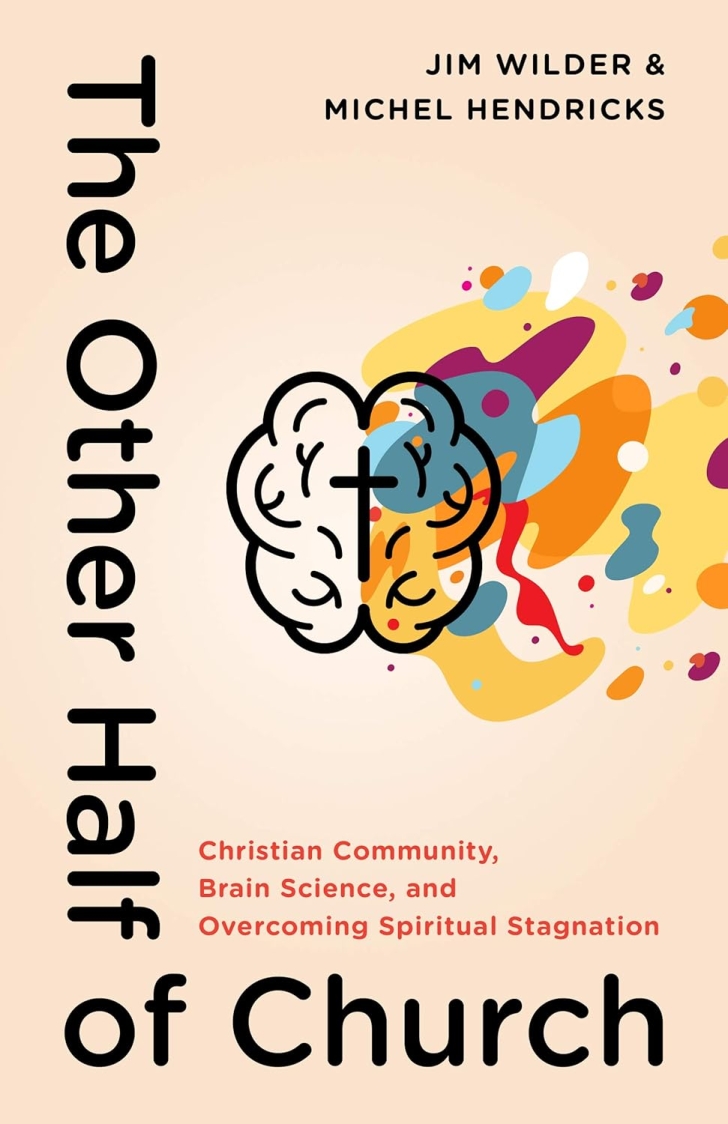
The Other Half of Church. Christian Community, Brain Science, and Overcoming Spiritual Stagnation, Jim Wilder and Michel Hendricks, Moody Publishers, LCCN 2020011241 (print), LCCN 2020011242 (eBook), ISBN 9780802419637, ISBN 9780802498557 (eBook)








