
Authorities in China this month arrested six Christians on charges including “organizing minors to carry out activities disrupting public order” for ordinary church activities, according to religious rights watchdog Bitter Winter.
The charge was based on the Christians in Kaili City, Guizhou Province, Qiandongnan Prefecture holding Sunday school, sharing the gospel with children and allowing families to worship together, reported Bitter Winter, citing human rights group Weiquanwang.
“The charge of ‘organizing minors to disrupt public order’ has traditionally been applied only when minors are incited to fight, steal or engage in conduct that genuinely threatens public safety,” Bitter Winter reported. “Although minors are prohibited from entering churches in China, children attending religious activities with their parents is a basic expression of family life and freedom of belief, and does not fall within the scope of the offense.”
Charged were Wei Yongqiang, He Jinbao, Quan Xiaolong, Long Jian, Cheng Yongbing and Zhou Guixia, according to Weiquanwang.
“The case has drawn attention because of its legal novelty,” Bitter Winter reported. “Prosecutors proceeded with the arrest decision without hearing any of the legal opinions submitted by the lawyers retained by the families.”
Officials approving all the arrests at once indicates authorities intend to aggressively prosecute, the group noted.
“For many observers, the charges illustrate how legal categories originally designed to protect public safety are being stretched to criminalize peaceful religious practice, particularly when minors are present,” Bitter Winter noted.
The six Christians were also charged with fraud. In 2021, a court sentenced a Seventh-day Adventist preached identified only as Zhang to 12 years in prison on fraud charges, asserting that tithes and offerings he collected were “illegal income,” Bitter Winter reported.
“That ruling, unprecedented at the time, opened the way for similar prosecutions across China, where pastors and lay leaders have increasingly been charged with fraud for receiving voluntary donations,” the group stated. “The new use of the public order provision involving minors now appears to be another first at the national level.”
Kaili City has been a hotspot of persecution of Christians, and new legal tools in religion regulations of the past few years are expanding actions against routine church activity, the group asserted.
In China’s recently revised Public Security Administrative Punishments Law, amendments adopted without public consultation place “illegal religious activities” on the same level as participation in a “cult” spreading heterodox teachings (xie jiao), Bitter Winter stated.
“Since the revision, preachers in several provinces have already been subjected to administrative detention,” the group reported. “In some areas, local authorities have further expanded the scope of enforcement, intensifying tensions between religious communities and the state.”
‘Sinicization’ Training
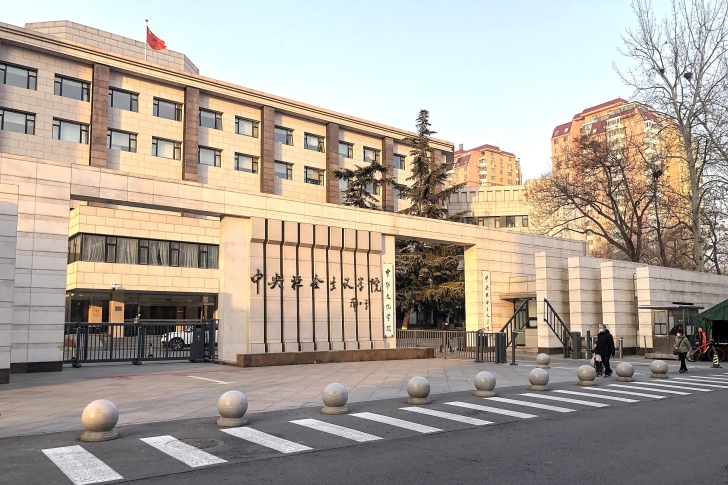
At the Central Institute of Socialism in Beijing on April 12-18, top Catholic leadership in China told 50 clergy members to “learn deeply and understand thoroughly” President Xi Jinping’s statements and let “socialist core values” guide their preaching and pastoral work, according to Bitter Winter.
“What was not mentioned – again – was any document of the Vatican or the Pope,” the group’s online magazine reported. “Not a single reference to magisterial teaching appeared in the program, despite the Sino‑Vatican agreement, which Beijing regularly cites as proof of its goodwill.”
The purpose of national training session on the “Sinicization of Catholicism” was to ensure the clergy’s intellectual and spiritual priorities were reordered so that Communist Party ideology stands above ecclesial authority, according to Bitter Winter. Members of the Catholic Patriotic Associations and the Catholic Bishops’ Conferences of China from all provinces, autonomous regions, and municipalities participated.
Bishop Li Shan, chairman of the Patriotic Association, opened the session with a statement that the “general program” of the “religious work in the new era” is to implement Xi’s directives, strengthen the rule‑of‑law governance of religion and ensure that Catholicism reflects “Chinese characteristics,” reported Catholic Church In China, official publication of the Chinese Catholic Patriotic Association (CCPA) and the Bishops’ Conference of the Catholic Church in China (BCCCC).
Participants at the training studied Xi Jinping Thought, Xi’s statements on religious work, his ideas on rule of law, and the Party’s program for “strict governance of religion.”
“They also received instruction on managing online religious activity and on the ‘social functions’ of religion within the framework of national goals,” Bitter Winter reported. “The only ‘tradition’ emphasized was the one that reinforces cultural nationalism and political loyalty.”
At the closing ceremony, representatives from Jiangsu, Hubei and Guizhou provinces pledged to “raise political standing,” “inherit the patriotic tradition” and “advance Sinicization in depth and substance,” the group stated.
“They promised to build a ‘theological system with Chinese characteristics’ and to translate their learning into concrete measures for the Party’s vision of modernization and national rejuvenation,” Bitter Winter noted. “What emerges is a model of Catholicism whose primary mission is not evangelization, sacramental life, or fidelity to the universal Church, but disciplined service to the Party’s agenda.”
The Vatican’s 2018 agreement with the regime has not changed state control of religion, the group asserted.
“The state-controlled Patriotic Church remains self-referential and understands its mission as a CCP propaganda branch for Chinese Catholics rather than as part of global Catholicism,” it concluded.








