
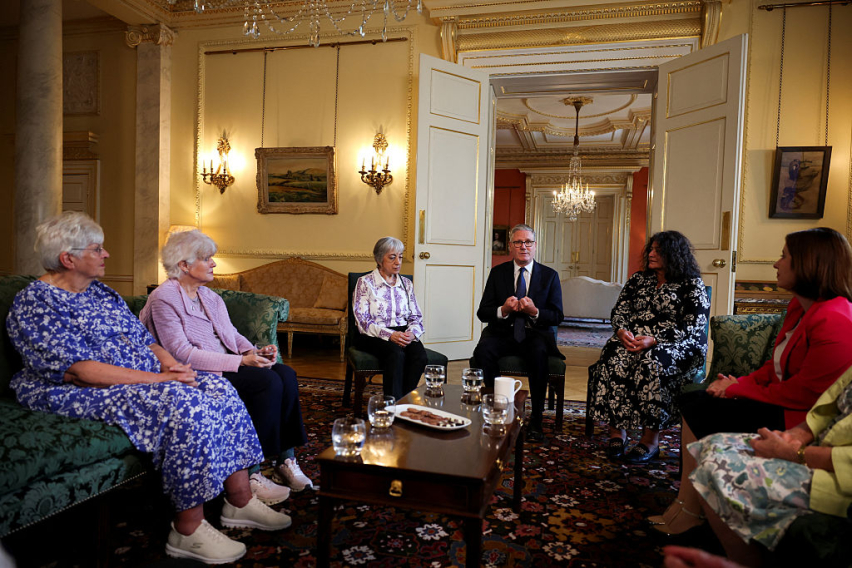
A Christian charity has called for "meaningful action" from the British government after Prime Minister Keir Starmer apologised for historic forced adoption practices in England.
On Thursday (July 2), Starmer issued a formal state apology in the House of Commons in London for the government's role in the historic forced adoption of children born to unmarried mothers. The apology covered 1946 to 1979 and beyond, when the state took away about 185,000 babies from unmarried mothers because of the social stigma at the time.
In his statement to Parliament, watched from the public gallery by some of the affected mothers and adult adoptees, the prime minister called the adoptions a "stain on our history" and added, "It should never have happened."
"They are the most remarkable women, and I know the whole House will want to join me in paying tribute to the extraordinary courage with which they have shared their harrowing testimonies and fought for the truth, time and again," said Starmer.
Mothers — many young, vulnerable and without support — were coerced, bullied or misled into feeling they had no choice but to have their children taken from them, said Starmer. He said these were not isolated or accidental acts.
"They were practices embedded within systems across local authorities, across voluntary and faith-based institutions, and in health and social care services, including parts of what is now the NHS [National Health Service]," said Starmer.
"All institutions… operated with power over people's lives, yet they did so without compassion, without consent, and without dignity or proper safeguards."
Starmer recalled how some women, including those placed in Mother and Baby Homes and other institutional settings, were cut off from their families, relationships, education and employment and subjected to harsh and isolated conditions.
"Some experienced treatment that amounted to exploitation and abuse," he said, adding that many bore the burden of feeling ashamed.
"Children grew up believing they were unwanted," said Starmer. "Young mothers were told they were immoral — and that their babies were better off without them."
The prime minister acknowledged that his apology would not lift the suffering completely but hoped "it will help a little."
"But I say this," he said to the survivors. "The shame is not yours. The shame was never yours. The shame is ours. And I say that on behalf of the whole country, I say it to every single person impacted, we are deeply and profoundly sorry."
Starmer addressed his apology to the mothers, to adoptees who were taken from their families and denied their identities, to fathers given no voice and to those who suffered racism, as well as wider families affected.
"To those who grew up believing they were unwanted, some of whom were even told directly that they were second class," the prime minister continued.
"To those who have experienced lifelong uncertainty, loss, or questions around identity and belonging, or whose mental and physical health, relationships, and sense of self across their lives has been affected.
"To each and every one of those affected, we say a deep and heartfelt sorry," Starmer said. He also acknowledged a "systemic failure" by previous governments.
The prime minister promised to fund a national online resource to help those affected find and keep their birth records for 100 years. Virtual, peer-led support groups will also offer trauma-informed help, and a testimonials project will share the stories of those affected publicly.
"Through all of this and more, we will continue to meet regularly with those with lived experience, guided by them to get this support right, to learn from our past — and ensure that nothing like this can ever happen in this country again," said Starmer, adding that similar measures are being taken in Northern Ireland, Scotland and Wales.
Meanwhile, Home for Good and Safe Families issued a statement on Friday (July 3) calling for further action.
"For too long, mothers, fathers, and children affected by these practices have carried the weight of lifelong trauma," said the charity. "This apology is long overdue and serves as a stark reminder of a dark chapter in our nation's history, in which institutions, including churches and other trusted bodies, were complicit. They were wrong, and acknowledging this truth matters deeply to those who continue to live with its consequences."
Forced adoption practices caused profound and enduring trauma for both parents and children, the charity said.
"The legacy of separation, secrecy, and stigma has shaped identities, relationships, and wellbeing across generations. Today's apology must be accompanied by a commitment to listening to those with lived experience and ensuring that such injustices can never be repeated."
Home for Good and Safe Families worked with Adoption UK to provide the joint secretariat for the All-Party Parliamentary Group on Adoption and Permanence.
Earlier this year, the group published its Adoptee Voices inquiry report. More than 300 adoptees ages 13 to 25 contributed their experiences across three themes: education, health and wellbeing, and identity.
"Led and shaped by the adoptees themselves, the report highlighted that while adoption is lifelong, understanding and support too often fall away as young people grow older," said the charity.
"Many adoptees described significant struggles with identity, belonging, and access to appropriate mental health support. Their voices underline the need for a system that listens, adapts, and provides sustained support into adulthood."
Attitudes to adoption today are "very different" from the era of forced adoptions, but challenges remain, including a continuing need for adoptive parents. The charity said between 9% and 10% of children who leave care do so through adoption. Open adoption arrangements have also risen, with many children maintaining safe and meaningful contact with members of their birth family.
"However, while there remains a need for adoptive parents, there is also an urgent need to recruit more foster carers and develop high-quality options for teenagers and young adults," said the charity.
Latest data shows 38% of children in care are ages 10 to 15, and 27% are 16 or older. Some 67% of children in care live with foster families, yet the number of approved carers continues to fall, dropping 12% since 2021.
"These figures demonstrate a system under immense pressure," said the charity. "With more older children entering care and fewer foster carers available, too many young people face instability, unsuitable placements, or being moved far from their communities."
The charity called on the state to provide high-quality, age-appropriate help for teenagers preparing for adulthood, with a particular aim of expanding supported lodgings — a safe and stable home for young people not yet ready to live independently.
The charity described the government's apology as both significant and necessary but pressed for further action.
"It must fully recognise the pain and harm caused, including the lifelong impact of forced adoption on those affected. Any apology must also be followed by meaningful action and appropriate support for survivors.
"It must also act as a catalyst for a renewed and sustained commitment to children and young people currently in the care system. Home for Good and Safe Families stand ready to work alongside government, local authorities, churches and communities to ensure that every child, whether through fostering, adoption or supported lodgings, can grow up in a stable and loving home where they are able to flourish."








