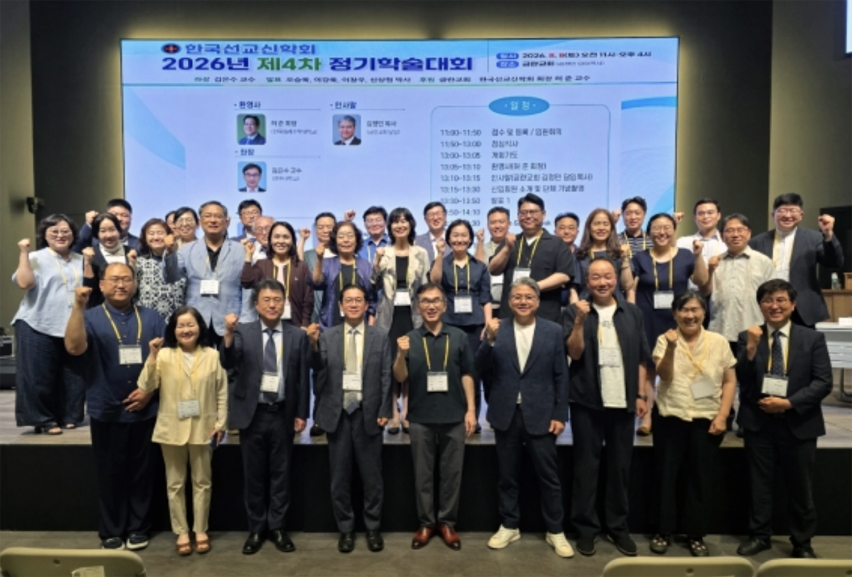
A group of Korean mission theologians gathered in Seoul to examine how shifts in global Christianity are reshaping the field of missiology, with papers ranging from the growth of Pentecostalism in the Global South to a proposed new research framework for studying local faith communities.
The Korea Society of Mission Theology held its 2026 Fourth Regular Academic Conference on Aug. 8 at Geumnan Church in the Jungnang district of Seoul, according to Christian Daily Korea. The conference, themed "Trends in Contemporary Mission Theology Research," featured four scholars presenting research on Pentecostalism, Korean diaspora mission, the 19th-century American Restoration Movement and what one presenter called "narrative missiology."
Pentecostalism's global reach — and its contradictions
Dr. Oh Seung-wook of Yonsei University opened with an analysis of Pentecostalism as a lens for understanding World Christianity, a theological paradigm that has grown in prominence as Christianity has declined in the West and expanded in Africa, Latin America and Asia.
Citing data from the Center for the Study of Global Christianity led by Todd M. Johnson, Oh said Pentecostal adherents worldwide numbered approximately 664 million as of 2025 — more than one-quarter of all Christians globally.
He argued that early Pentecostalism carried an egalitarian impulse, crossing boundaries of race, class and gender through what its adherents understood as the freedom of the Holy Spirit. But he said that ideal frequently did not survive institutionalization. The Apostolic Faith Mission of South Africa, he noted, practiced racial segregation in worship and ministry; a formal apology and declaration of integration came in 1996, though he said traces of discrimination persist.
On women's leadership, Oh pointed to figures such as Lucy Farrow and South Korea's Pastor Choi Ja-shil as examples of women who played formative roles in early Pentecostal movements, only for their successors to be gradually sidelined as churches became more structured organizations.
Oh described a similar tension in Pentecostalism's social posture. Early leaders including William Seymour and Frank Bartleman championed Christian unity, he said, yet in practice maintained skepticism toward ecumenical dialogue — a posture that has softened in recent decades as engagement with the Catholic Church and other denominations has grown. He said early Pentecostalism also showed concern for racial discrimination, war and economic inequality, even as the tradition later tended to focus narrowly on individual salvation.
He concluded that individual soul salvation, social service and structural transformation should be pursued together under what he called a holistic mission framework.
Korean diaspora reframed as senders, not just recipients
Dr. Lee Gang-wook of Juan University argued that Korean diaspora churches have been misunderstood as peripheral to global mission, when they should be recognized as missional agents in their own right.
Drawing on data from the Overseas Koreans Agency and South Korea's Ministry of Justice, Lee said the theological significance of Koreans living abroad had been undervalued — particularly as attention has shifted toward immigrants arriving in Korea. He said growth in domestic immigrant ministry should not become a reason to reduce support for diaspora mission.
Using the ASEAN Korean diaspora as a case study, he suggested that diaspora networks could evolve beyond individual congregations into what he called a "community of missional communities," shaped by shared identity, transnational connectivity and intercultural mediation.
Lee urged Korean seminaries, denominations and mission organizations to treat both domains — ministry to immigrants entering Korea and mission through Koreans living abroad — within a single, integrated theological framework, and called for empirical comparative research on the two contexts.
Restoration Movement's missional roots, and how they faded
Dr. Lee Chang-woo of Seoul Christian University examined the ministry of Barton W. Stone from the 1790s through the 1830s, arguing that the 19th-century American Restoration Movement originally placed gospel proclamation and world conversion above restoration and church unity as organizing values — and that later generations reversed that hierarchy.
Lee said restoration and unity in Stone's framework were means toward a missional end, not ends in themselves. As the movement developed, he argued, restoration gradually became a marker of church identity rather than a tool for evangelism.
He raised the possibility that the Churches of Christ in Korea inherited a more defensive, identity-focused version of restorationism — shaped by early 20th-century American theological conflicts — rather than Stone's original missional vision. Reexamining Stone's early work, Lee suggested, could serve as a theological reference point for missional renewal among Korean Restoration Movement and evangelical churches.
A new framework for studying how local churches tell their story
Dr. Shin Sang-hyeon of Presbyterian University and Theological Seminary offered a preliminary proposal for what he termed "narrative missiology" — a research methodology designed to analyze how local faith communities form, transmit and express the gospel through stories, rituals and cultural production.
Shin said World Christianity studies already emphasizes the translatability of the gospel and the agency of local churches, but that existing methods do not adequately capture how those dynamics play out in practice. Narrative missiology, he proposed, would examine sources including written documents, oral accounts, liturgical practices, film, art, music and digital content.
He said the approach could be applied comparatively across churches in Asia, Africa and Latin America, enabling intercultural dialogue by tracing how different communities have translated the gospel within their own cultural frameworks. He also proposed it as a tool for Korean churches to critically interpret their own history and explore what missional continuity might look like for the next generation.
Christian Daily Korea reported that the conference closed with question-and-answer sessions and open discussion following the four presentations. The society also noted the recent Korean publication of a translated volume — The Doctrine of Good Works: Reclaiming a Neglected Protestant Teaching — authored by Thomas McCall, Caleb Friedeman and Matt Friedeman, translated by society member Prof. Ryu Jae-seong and published by the Christian Literature Crusade.