
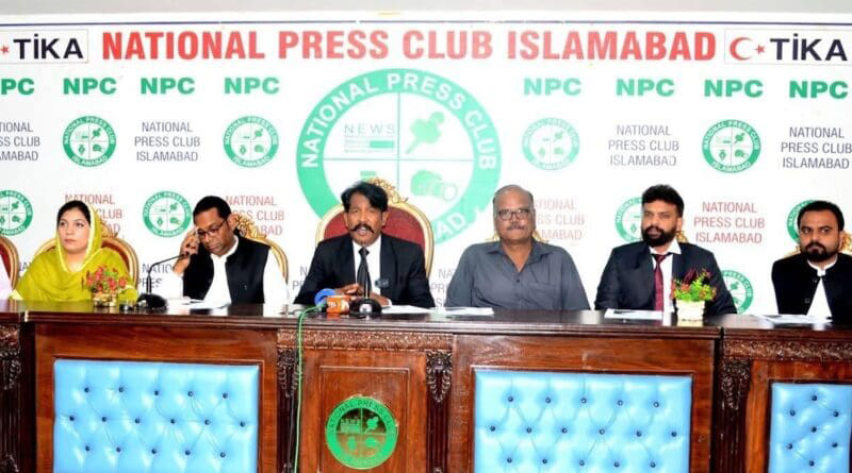
Christian rights organizations have called on Pakistan’s federal government to introduce a series of constitutional reforms aimed at strengthening protections for religious minorities, women and children as part of the proposed 28th Constitutional Amendment Bill.
Addressing a press conference at the National Press Club in Islamabad on May 21, representatives of the Minorities Alliance Pakistan (MAP) and its allied groups presented a package of proposals that they said were necessary to ensure equal citizenship, democratic representation and stronger constitutional protections against discrimination for religious minorities.
Speaking at the event, MAP Chairman Advocate Akmal Bhatti said Pakistan could not credibly claim to be a pluralistic democracy while constitutional provisions continued to bar non-Muslims from holding the offices of president and prime minister, and while minority communities remained excluded from direct democratic representation.
“The time for symbolic gestures is over. What is needed now is structural reforms that guarantee equality before the law and equal opportunity for all citizens,” Bhatti said.
He said the proposals should be incorporated into the government’s anticipated 28th Constitutional Amendment Bill, which is expected to be introduced in parliament in the coming months.
One of the central proposals presented by MAP was a recommendation to prohibit the religious conversion of any person under the age of 18 unless free and informed consent is formally recorded before a judicial magistrate. Rights advocates said such a constitutional safeguard was necessary to address persistent concerns surrounding forced religious conversions and child marriages involving girls from religious minority communities, particularly Christians and Hindus.
Human rights organizations in Pakistan have repeatedly raised concerns over cases in which underage girls from minority backgrounds are allegedly abducted, converted to Islam and married, often amid disputes over their age and consent.
The MAP chairman also called for amendments to Articles 41(2) and 91(3) of Pakistan’s Constitution to remove religious qualifications for the offices of president and prime minister, arguing that the existing restrictions undermine constitutional guarantees of equality and reinforce the exclusion of religious minorities from national political life.
Bhatti further proposed amendments to Articles 51 and 106 to introduce direct elections for seats reserved for non-Muslims and women in the National Assembly and provincial assemblies.
Under Pakistan’s Constitution, 10 seats are reserved for non-Muslims in the National Assembly under Article 51(4), while Article 106 allocates 24 minority seats across the four provincial assemblies — nine in Sindh, eight in Punjab, four in Khyber Pakhtunkhwa and three in Balochistan. An additional four seats are reserved for minorities in the Senate.
At present, reserved seats are distributed among political parties in proportion to their share of general seats in parliament and provincial legislatures, provided they meet the required electoral threshold. Critics of the system argue that it enables political party leaderships to nominate minority lawmakers rather than allowing minority communities to directly elect their own representatives.
Another proposal presented at the press conference called for a constitutionally guaranteed minimum five percent quota for religious minorities in federal and provincial government services and public educational institutions through amendments to Article 27 of the Constitution.
The MAP leader said the proposals were consistent with constitutional protections related to religious freedom, equality and minority rights under Articles 20, 25, 35, 36 and 37 of the Constitution. He added that the reforms were also in line with Pakistan’s international obligations under treaties, including the International Covenant on Civil and Political Rights (ICCPR), the Convention on the Rights of the Child (CRC) and the Convention on the Elimination of All Forms of Discrimination Against Women (CEDAW).
“These proposals impose no new financial burden and can be implemented through existing institutions,” Bhatti said.
The MAP chairman also urged the Parliamentary Committee on Constitutional Reforms to hold broader consultations with minority communities, legal experts and civil society organizations before finalizing the amendment package.
“Constitutional reform without the voices of those most affected will only deepen alienation,” he emphasized.
Christian activists, including Rwadari Tehreek Chairman Samson Salamat, former Punjab lawmaker Tahir Naveed Chaudhry and Robin Daniel, also addressed the press conference and endorsed the proposals presented by MAP.
The speakers emphasized that Pakistan’s religious minorities were looking toward the state to ensure protection of their constitutional rights and equal participation in public life.
They said reforms addressing forced conversions and democratic representation could contribute to greater equality of citizenship under the law and strengthen confidence among minority communities in state institutions.
“Reforms aimed at preventing child marriage should include stricter procedures for age verification before marriages are registered,” Salamat said, stressing that documentary proof of age, including computerized national identity cards, birth certificates issued by the National Database and Registration Authority (NADRA), and other officially recognized records, should be made mandatory in marriage registration cases.
Christians make up 1.37 percent of Pakistan’s 241.5 million population, according to the 2023 national census. Rights activists say the community continues to face multiple challenges, including alleged undercounting in census data, misuse of blasphemy laws, social discrimination, and cases of forced conversions and marriages, making effective political representation and constitutional protections increasingly important for minority communities in the country.








