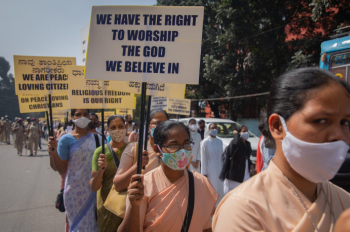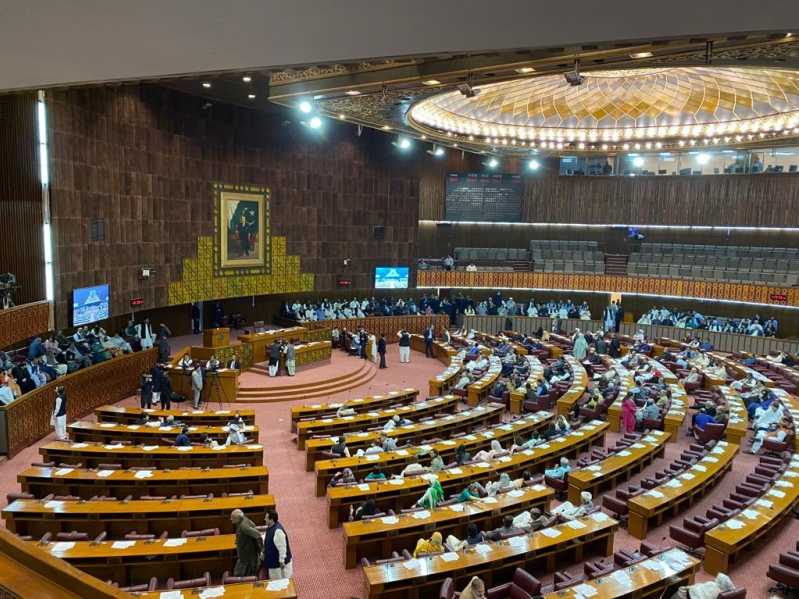
Christians in Pakistan have renewed calls for reforms to the country’s electoral system for religious minorities, arguing that the current mechanism for filling reserved seats deprives them of meaningful democratic representation in provincial and national legislatures.
Community leaders say the existing framework, under which political parties nominate minority lawmakers to reserved seats based on their overall electoral performance, amounts to a “selection” system that sidelines minority voters.
Christians make up 1.37 percent of Pakistan’s 241.5 million people, according to the 2023 national census. Activists say the community faces a range of challenges, including undercounting in population data, misuse of blasphemy laws, and cases of forced conversions and marriages, making effective political representation increasingly critical.
In Pakistan’s 78-year history, three different electoral models have been used for non-Muslim voters, each introduced following demands from minority groups.
“Our biggest concern is the undemocratic and unfair adoption of the selection system for reserved seats, whether in national or provincial legislatures or at the local government level,” said Samson Salamat, chairman of Rwadari Tehreek (Movement for Equality). “The right to elect one’s own representatives is fundamental to meaningful democratic participation.”
In November 2025, Salamat and leaders of two other faith-based rights organizations, Christian’s True Spirit and Human Friends Organization, filed a joint constitutional petition in the Lahore High Court seeking reforms to the minority representation system. According to Salamat, the court has held four hearings so far. The activists have announced plans for a hunger strike outside the Lahore Press Club on Feb. 28 to press their demands.
“The selection system in political parties practically takes away the democratic powers and rights of minority voters to elect their parliamentarians,” Salamat told Christian Daily International. “Minority representatives handpicked by major political parties are often unable to effectively protect the interests of their communities,” he added.
The debate has also reached the Punjab Provincial Assembly. Christian provincial legislator Falbous Christopher submitted a resolution calling for reforms to the minority electoral framework.
Christopher’s resolution urges the government to consider either restoring a separate electorate system or introducing a dual-vote system for religious minorities to ensure what it describes as “true and effective” representation. Christopher himself entered the provincial assembly on a reserved seat allocated to his party, the Pakistan Muslim League-Nawaz (PML-N), under the proportional representation formula.
According to the Election Commission of Pakistan’s 2022 data, there are 3.63 million registered minority voters nationwide, including 1.64 million Christians. More than 1 million Christian voters reside in Punjab province, around 200,000 in Sindh, with smaller numbers in Khyber Pakhtunkhwa and Balochistan.
Under Pakistan’s Constitution, 10 seats are reserved for non-Muslims in the National Assembly under Article 51(4), and 24 seats in the four provincial assemblies under Article 106 — nine in Sindh, eight in Punjab, four in Khyber Pakhtunkhwa and three in Balochistan. Four seats are also reserved for minorities in the Senate.
Reserved seats are distributed among political parties in proportion to their share of general seats in the assemblies, provided they meet a minimum threshold. Critics say this arrangement allows party leaderships to nominate minority lawmakers, rather than enabling minority communities to directly elect their own representatives.
Azam Mairaj, a Christian social scientist, advocates a dual-voting model that would allow minority voters to cast ballots both for general candidates and for candidates contesting reserved minority seats.
“The dual-vote system would give Christians and other minorities an effective voice in national politics while safeguarding their religious identity and civil rights,” Mairaj said.
He criticized what he described as an elite segment within the Christian community that benefits from the current arrangement and supports its continuation. At the same time, he cautioned against calls to revive the separate electorate system, under which minorities voted only for minority candidates.
“That system has been tested in the past and led to political marginalization and social isolation,” he said, arguing that integration into mainstream politics, while preserving religious identity, is essential. “The dual-vote system offers a balanced, constitutional solution.”
Riaz Anjum, president of the Christian Lawyers Association of Pakistan, said Article 36 of the Constitution obliges the state to safeguard the legitimate rights and interests of minorities.
“The Constitution requires that state affairs be conducted through representatives chosen through democracy,” he said. “When minorities were deprived in 2002 of the right to directly elect their representatives to reserved seats, it contradicted democratic principles and the spirit of the Constitution,” Anjum said.
The 2002 changes were introduced during the tenure of former military ruler General Pervez Musharraf, who restructured the electoral system.
According to Anjum, when a community cannot directly elect its representatives, its participation risks becoming symbolic rather than substantive.
“Religious minorities have long demanded a comprehensive constitutional package in light of Article 36,” he said. “This should include the right to directly elect representatives to reserved seats and an increase in the number of those seats in proportion to their population.”
He added that the demands are framed as a matter of constitutional reform and democratic inclusion rather than partisan politics.