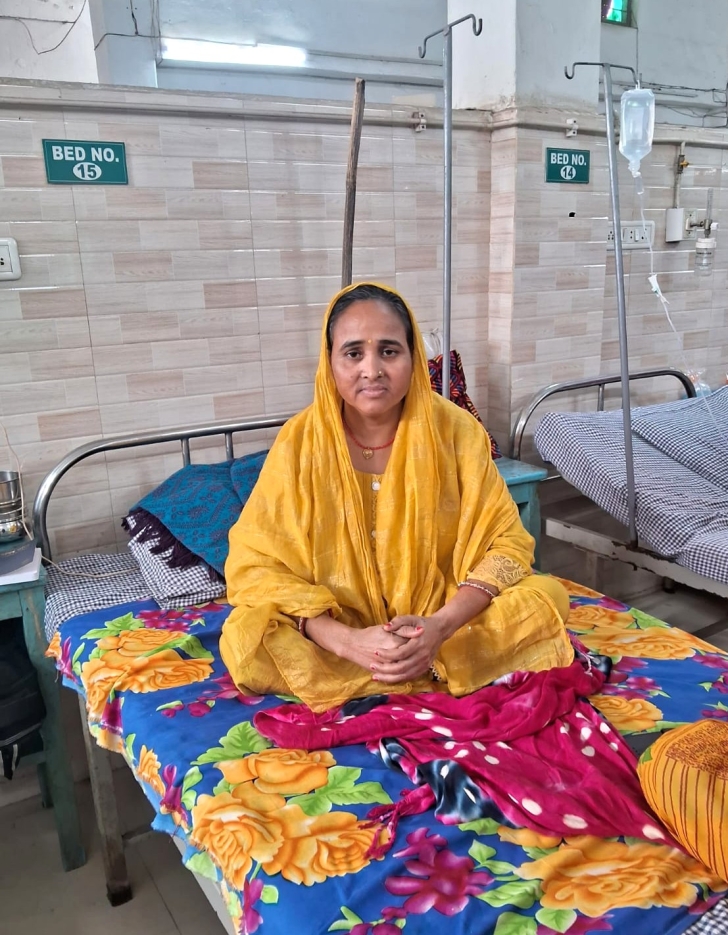
A Christian woman in India jailed for 86 days on false accusations of fraudulent conversion was diagnosed with cancer in October, sources said.
Sheela Devi, 45, of Dubey ka Purva village, Uttar Pradesh state, was released on bail on Oct. 14 and has been hospitalized at Kachhwa Christian Hospital since Oct. 20.
After several tests, doctors confirmed cancer of the uterus on Nov. 21, and she underwent a hysterectomy on Wednesday (Nov. 26), said a staff member of the Evangelical Fellowship of India (EFI), which along with other partners is providing for all her personal and medical expenses since her release on bail.
The mother of three grown sons and a daughter led a fellowship in her house for two years attended by 30 to 35 people from her village and nearby areas. Brahmins in her village had objected to the fellowship and once reported her to police, who issued her a warning.
Devi said she couldn’t stop the gatherings as those attending would have been deprived of spiritual food.
“I told the Lord, if I stop this church fellowship, these people would scatter here and there, get lonelier, and walk in their sickness,” Devi told Morning Star News. “They find peace and healing when they come to church.”
Devi continued the fellowship, and during their Sunday worship on July 20, a large group of police intruded into her home where the church met. Female police led the way followed by male police, said Devi. They interrogated Devi about why the gatherings were taking place and alleged that she was fraudulently converting people.
“They confiscated all the Bibles, the cross, song books, a 10 Commandments poster that hung on my wall and the amplifier,” said Devi, who is illiterate. “They took my cell phone, which was my only source, to listen to God’s Word [through a Bible app].”
They put her into a police vehicle and also detained seven men from her church. Six out of seven were first-time visitors to the church, including Ram Chandra Verma, 71. Verma, nearly bedridden due to prolonged illness, came to the church seeking healing prayer. His wife, Rajpati, the only follower of Christ in her household, had been attending the church for the past 18 months.
“My husband had stepped into a church for the first time in his life,” she told Morning Star News. “He was picked up by the police randomly from amongst the congregants.”
A case was registered against Devi, Ram Chandra Verma, Rajendra Verma, Ram Saroj, Ashok Saroj, Kaltu Saroj, Mukesh Saroj, Sunil Saroj and unidentified people for “common intention” under Uttar Pradesh’s anti-conversion law against forcible/fraudulent conversion and under the Bharatiya Nyaya Sanhita (BNS) 2023.
They were presented before the magistrate the same day at 4 p.m. and were sent to Pratapgarh jail.
Suffering in Jail
Devi was sent to the women’s barrack, where 55 women prisoners were housed. She initially faced scorn, ill-treatment and discrimination.
“A murderer was treated better than me. They called me ‘the one who converts,’” said Devi.
The prisoners were presented before the jailer every Saturday, and he would often try to persuade Devi to return to her Hindu faith.
“Why do you believe in Jesus, who Himself was crucified and died on the cross? Why did you abandon your deities?” the jailer said, according to Devi.
She observed that women inmates were very distressed and wept day and night.
“Each woman in jail missed her family, especially her children, but the worst affected were those who had stopped getting visitors,” Devi said. “They thought that their families had forgotten them, and that they belonged nowhere now.”
Visiting a family member in jail means a great financial burden for relatives, as they must give 5,000 to 10,000 rupees [$60 to $120] every week so prisoners can sustain themselves, she said.
“With this money the member in prison would purchase their toiletries, food, fruit and snack,” she said. “The jail food does not taste good and is very low on quality. Half-cooked rice, watery lentil soup and half burnt chapattis [Indian bread] is what we were given.”
Devi said she was the only Christian in jail. At times she felt alone and discouraged but spent much time in prayer. A week later, four Christian women were arrested under the same anti-conversion law from Kunda, Pratapgarh District, 50 kilometers (31 miles) from Pratapgarh city, and sent to jail.
“Initially when I saw the sufferings of the women inside the jail, I broke down completely. I was so overwhelmed with their constant crying and hopelessness, but then the Lord sent four believer women to the jail,” Devi said. “I was very encouraged to meet them, and we started to pray together.”
Her son visited her regularly and gave her money, which helped her survive.
“I am so grateful that my son continued to visit me thrice a week and would give me weekly money to pay for my needs,” said Devi, who made payments so she did not have to work, while the other four Christian inmates lacked resources and had to work. They were given “the dirtiest jobs of cleaning the jail toilets because they were Christians,” she said.
Soon she began to fall ill, her health deteriorating from constant bleeding and lack of nutrition. A time came when she was not able to move her hands and feet.
“I became immobile and could not stand or walk; I lost my speech,” she said. “The guards on duty instructed everybody including the Christian women to maintain distance from me. They knew I was dying and feared I might have a disease that could infect other inmates.”
Devi lay on a floor mattress and prayed.
“I silently cried to the Lord, ‘Don’t let me die here. If it is my time to go, let it be outside the prison. If I die inside the jail, your name will be maligned. They have seen me pray to you all the time. They will scorn your name, if I die,’” she said.
As she prayed, she saw “the light of the Lord” shining on her in her cell, Devi said. She felt strengthened in her body and was able not only to stand but also to walk out to the garden where the other women were working.
“Looking at me, the women whispered and said to each other: We left her to die; she is a walking miracle. I told them that the Lord had healed me, and that I am able to speak, stand and walk,” she said.
Devi started to wake at 3 a.m. and would spend an hour seeking God’s purpose for taking her to jail and healing her in a miraculous way, she said. On Aug. 24, after finishing her daily prayer, Devi went back to lying on her mattress on the floor when she suddenly sensed a very bright light in the barrack.
“I opened my eyes to see from where is that brightness coming, and I saw Jesus, who stood at the gate,” Devi told Morning Star News. “I slithered on the floor, dragging myself towards Him. The radiance of His light was so bright that I could not see His face. I spoke to Him for a very long time. This was the first time I saw the Lord.”
Things changed for Devi from that day on.
Victory
The months that followed were the most memorable and precious time, said Devi, adding, “I have received more love in prison than outside.”
One of the Christian women obtained bail, and many inmates noticed. Some of the non-Christian women approached Devi and asked her to pray for them. Then another Christian woman was bailed out, and more women noticed and started to come for prayers.
Things began to change rapidly, with the attitude of the guards and inmates changing completely towards her.
“Many women got bailed out, many were healed. Policewomen on duty got healed. They discussed their family problems with me and requested me to pray for them,” said Devi. “My inmates would press my legs to give me rest; the guards would bring home cooked food from their homes for me. They all loved me so much that I have not received as much love even in my own house.”
An inmate who had been incarcerated for 16 months had given up hope of ever being bailed out. After Devi prayed for her, she began attending prayers every day and finally won bail on Oct 13.
“She danced in the entire jail and proclaimed with shouts of joy that ‘Jesus Christ has bailed me out,’” Devi said.
Most women in jail had never heard about Christ. When they heard about Him from Devi, they “experienced a lot of peace,” she said.
The day she obtained bail, she told the Lord that she was available and expressed desire that He continue to use her to change the lives of her fellow inmates.
“I told the Lord my work here is not over and asked Him to extend my stay,” Devi said. Her case papers somehow got misplaced after the court ordered her bail and reached the jail only 15 days later, thus giving her more time to minister.
Since she was still somewhat unwell and jail had been physically challenging, the EFI took Devi to a hospital for a check-up. Doctors confirmed the cancer on Nov. 21.
Devi was still recovering in the hospital at this writing. She requested prayers for herself and for all the women in the jail, and she gave thanks to the Lord that she was able to share the redemptive power of Christ with the prisoners.
“Suffering is included in the package, if we want to follow the Lord,” Devi said. “So, I am very grateful to God for the initial suffering in jail, for the joy that I experienced the next two months and now for the successful surgery.”
The hostile tone of the National Democratic Alliance government, led by the Hindu nationalist Bharatiya Janata Party, against non-Hindus has emboldened Hindu extremists in several parts of the country to attack Christians since Prime Minister Narendra Modi took power in May 2014, religious rights advocates say.
India ranked 11th on Christian support organization Open Doors’ 2025 World Watch List of the countries where it is most difficult to be a Christian, up from 31st in 2013 before Modi came to power.