
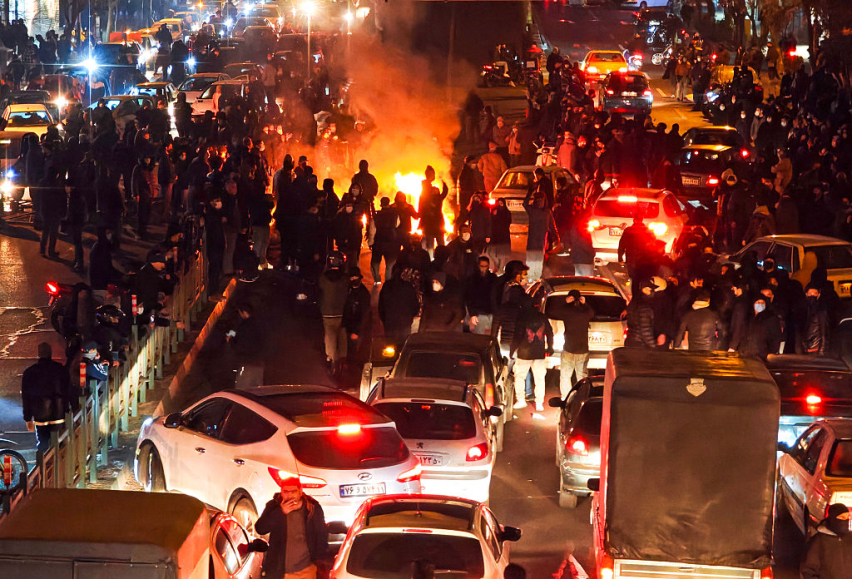
As protests intensify across Iran amid economic collapse and mounting political unrest, Christians inside the country are facing heightened fear, isolation and uncertainty, according to testimonies shared with Christian Daily International by a ministry that works with Iranian Christian refugees. The individuals spoke anonymously because of security concerns, citing widespread internet shutdowns, reported killings and arrests, and growing anxiety about the vulnerability of religious minorities.
Several Iranians connected to the ministry said they have lost contact with relatives and friends for days as authorities have cut internet and phone access nationwide. Others reported hearing of deaths among acquaintances as protests over living conditions and long-standing grievances against the Islamic Republic continue.
“Because of the recent situation in Iran and the intensification of protests, the security and emotional conditions for us and our family have become extremely difficult,” said one Iranian Christian identified as Brother S. “During this period, several of our friends and acquaintances have sadly lost their lives.”
The testimonies align with international reporting describing widespread demonstrations, severe restrictions on communications and an increasingly forceful response by Iranian security forces. While the Iranian government has downplayed the scale of unrest, human rights groups and foreign media have reported mass arrests and significant casualties, figures that remain difficult to independently verify due to limited access.
Another Iranian Christian, Brother R, described protests driven by economic desperation as well as broader demands for political change. He cited soaring prices, shortages of basic services and deep frustration with what he described as systemic injustice.
“People do not have electricity, gas and water,” he said. “Some cities are snowy and stormy and very cold. Unfortunately, the internet and telephone are down and we have no access to the interior of Iran. In addition, the situation of the Christian people in Iran is not good.”
Others emphasized the emotional toll of isolation. Brother M said the communication blackout has left families “in the dark” as economic and psychological pressures mount. “Almost all families, including mine, are suffering unprecedented economic, emotional and humanitarian hardship,” he said, adding that many feel powerless to help relatives inside the country.
The loss of contact has been particularly distressing for Iranian Christians living abroad. Brother A said he had not been able to reach family members for four days. “No phone, no internet, nothing else,” he said. “We do not know what is happening in Iran, nor about our family.”
Iran’s deepening economic crisis has compounded the unrest, several sources said. The sharp decline of the Iranian rial over the past year has reduced purchasing power and left many families struggling to afford essentials such as food, medicine and medical care. Businesses have closed, livelihoods have been disrupted and poverty has worsened, they said.
“The tables of the poor class of society have been left empty,” Brother A said. “Families cannot afford to buy meat or even milk for their young children.”
Beyond economic grievances, the protesters’ demands reflect broader opposition to Iran’s ruling system, according to those who spoke with the ministry. While the current demonstrations were sparked in part by economic pressures, several described them as part of a long-running movement seeking fundamental political change.
“The main issue is beyond economic problems,” Brother A said. “The people want to change this oppressive government and eliminate the oppression of the Islamic Republic.”
As unrest has continued, concerns have grown about the government’s response. Several Iranians said that confrontations appeared to intensify following the communication blackout, though details remain difficult to confirm.
“According to the limited news we hear, more than a thousand people have been killed and thousands have been arrested,” Brother A said, adding that security forces were reportedly using heavy weapons against protesters. Christian Daily International is not able to independently verify casualty figures.
A pastor connected to the ministry, identified as Pastor A, said the near-total shutdown of communications has left churches and believers unable to assess conditions inside the country.
“We are very worried and have no idea what is happening inside Iran,” he said. “The only way we have to communicate is through television and foreign news sites, which also have very little information.”
While it remains unclear how the current unrest will affect Iran’s underground church in the long term, the pastor said Christians already face severe persecution, with many believers imprisoned under existing laws restricting religious activity.
“What is happening now is that Christians are severely persecuted and a lot of Christians are currently in prison,” he said. “In the current situation, the church is praying and waiting, and is also expressing its protests legally and in solidarity with the people of Iran.”
A Christian leader who works closely with Iranian refugees warned that legal mechanisms used by the Iranian state could further endanger minorities during periods of unrest. He pointed to the use of moharebeh — a charge often translated as “waging war against God” — which is embedded in Iran’s Islamic Penal Code and carries punishments ranging from execution to exile.
Although rooted in Islamic jurisprudence, moharebeh has functioned in practice as a legal tool to criminalize acts viewed as threats to public order or regime stability, the leader said. During previous protest movements, individuals have been executed under such charges for actions such as blocking roads or clashing with security forces.
He said Christians, who are often portrayed by hard-line elements as aligned with Western powers, risk becoming scapegoats during periods of national crisis. Reports of arrests of Christians in early January have heightened those concerns, he added.
Iran’s Christian population is estimated to range from several hundred thousand to more than a million in a country of roughly 93 million people, including historic Armenian and Assyrian communities as well as a growing number of converts from Islam, who face the greatest risk of prosecution.
Despite the uncertainty, those connected to the ministry emphasized prayer and solidarity. “We know that God is in control,” Brother A said. “We stand in prayer for the people of our country.”
Pastor A echoed that sentiment, thanking the international community for paying attention. “I am grateful that we are not forgotten,” he said. “Being able to speak about the situation in Iran and the Christians in Iran helps us stay connected to the world.”








