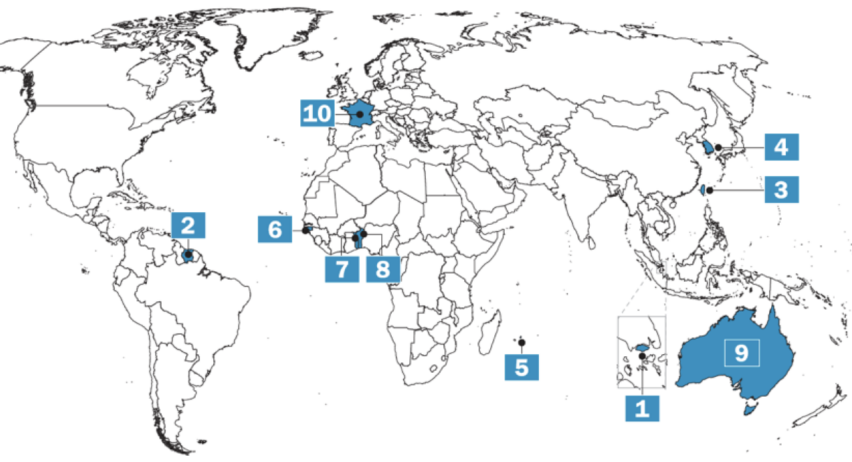
Singapore is the most religiously diverse country in the world, while the United States ranks first in religious diversity among the world’s most populous nations, according to a new analysis by the Pew Research Center.
The report, part of Pew’s Global Religious Futures project, examines the religious composition of 201 countries and territories as of 2020. It divides populations into seven categories — Christians, Muslims, Hindus, Buddhists, Jews, adherents of other religions and the religiously unaffiliated — and calculates a Religious Diversity Index (RDI) score based on how evenly those groups are represented in each country.
For Christians worldwide, the findings highlight both opportunity and challenge: while Christianity remains the majority faith in many regions, believers increasingly live in religiously plural societies where engagement with neighbors of other faiths — or none — is part of daily life.
Singapore tops diversity index
With an RDI score of 9.3 out of a possible 10, Singapore comes closest to an even distribution of the seven religious categories analyzed, Pew reported.
Buddhists make up 31% of Singapore’s population. The religiously unaffiliated account for 20%, Christians 19%, Muslims 16%, Hindus 5%, and adherents of other religions 9%. No single group holds a majority.
Suriname ranks second in overall religious diversity and is the only Latin American country in the top 10. About 53% of its population identifies as Christian, alongside significant Hindu (22%), Muslim (13%) and unaffiliated (8%) minorities.
Other countries in the top 10 are concentrated in the Asia-Pacific region — including Taiwan, South Korea and Australia — and sub-Saharan Africa, including Mauritius, Guinea-Bissau, Togo and Benin. France is the only European nation among the 10 most diverse, with a population that is 46% Christian, 43% religiously unaffiliated and 9% Muslim.
Although the United States ranks 32nd overall, it leads in religious diversity among the 10 most populous nations, each with at least 120 million residents.
U.S. most diverse among largest countries
Among the world’s largest countries, the United States has the highest RDI score at 5.8, followed by Nigeria, Russia, India and Brazil, according to Pew.
Christians make up an estimated 64% of the U.S. population as of 2020. Religiously unaffiliated people account for about 30%, while Muslims, Hindus, Buddhists, Jews and adherents of other religions together comprise roughly 6%, with each group representing about 1% to 2%.
Nigeria, Africa’s most populous country, is the second-most religiously diverse among the 10 largest nations. Christians and Muslims each account for more than 40% of the population, making Nigeria one of the countries most evenly divided between two major religious groups.
By contrast, Pakistan — where Muslims represent about 97% of the population — is the least religiously diverse among the 10 largest nations, with an RDI score of 0.8.
Together, the 10 most populous countries account for nearly 60% of the global population, underscoring the significance of religious dynamics in shaping global Christian witness and interfaith relations.
Most countries still religiously homogeneous
Despite examples of pluralism, Pew found that in most countries a single religious group forms a majority.
In 194 of the 201 countries and territories analyzed, at least 50% of the population belongs to one religious category. In 43 places, at least 95% of residents adhere to the same religion. These countries are predominantly Muslim (25), Christian (17) or Buddhist (1).
The least religiously diverse countries in the world are Yemen, Afghanistan and Somalia, where Muslims account for 99.8% or more of the population. Timor-Leste and Moldova are also among the least diverse, with populations that are almost entirely Christian.
Only seven countries have no single religious majority: the United Kingdom, Mauritius, South Korea, Australia, France, Ivory Coast and Singapore.
For Christian leaders and churches, these findings reflect a global landscape in which most believers live either as clear majorities within national contexts or as part of significant religious pluralities requiring careful navigation of interfaith relationships.
Regions vary widely in diversity
Regionally, the Asia-Pacific area is the most religiously diverse, with an overall RDI score of 8.7. No single religious group constitutes a majority across the region. The largest group — the religiously unaffiliated — accounts for about one-third of the population.
Three regions fall into the “high diversity” category: North America (RDI 6.0), sub-Saharan Africa (5.9) and Europe (5.6). In each of these regions, Christians form a majority of the overall population. The second-largest group is the religiously unaffiliated in North America and Europe, and Muslims in sub-Saharan Africa.
Latin America and the Caribbean rank as moderately diverse (RDI 3.1), with a strong Christian majority and a smaller unaffiliated population.
The Middle East and North Africa is the least diverse region studied, with an RDI score of 1.3 and a population that is 94% Muslim. The region includes five of the 10 least religiously diverse countries.
Where Christians live
According to Pew’s analysis, Christians are geographically the most widely distributed religious group in the study.
Most Christians live in countries with moderate levels of religious diversity. However, many also reside in highly diverse nations such as the United States, Nigeria and Ethiopia.
Globally, just 1% of people live in countries with very high religious diversity. Nineteen percent live in highly diverse societies, while the majority live in moderately diverse contexts. Smaller shares live in low (9%) or very low (12%) diversity environments.
These patterns suggest that for many Christians, ministry and public life unfold in settings where multiple faith traditions coexist, and in some cases where populations are closely divided between Christians and Muslims or between Christians and the religiously unaffiliated.
Modest changes over decade
Between 2010 and 2020, religious diversity levels remained relatively stable worldwide, Pew reported.
However, in roughly two dozen countries, RDI scores changed significantly, largely due to religious disaffiliation among Christians. In places where a large Christian majority shrank and the unaffiliated population grew from a small base, diversity scores rose. In countries where the unaffiliated were already numerous and expanded further, diversity scores sometimes declined.
In the United States, the religious diversity level rose from “moderate” to “high” over the decade as the Christian share of the population declined by 14 percentage points to 64%, while the number of religiously unaffiliated Americans increased.
Ireland also moved from low to moderate diversity as its Christian majority declined by 11 points to 81%. By contrast, the Netherlands shifted from “very high” to “high” diversity as its unaffiliated population grew to 54% and its Christian population continued to fall.
Pew’s researchers emphasized that changes in religious composition do not always alter overall diversity levels, especially when two large groups effectively exchange positions in relative size.
For churches and Christian organizations, the report offers a statistical portrait of a world in which Christianity remains globally significant but increasingly situated within complex and varied religious ecosystems — from highly plural city-states like Singapore to evenly divided nations such as Nigeria, and to regions where a single faith dominates public life.