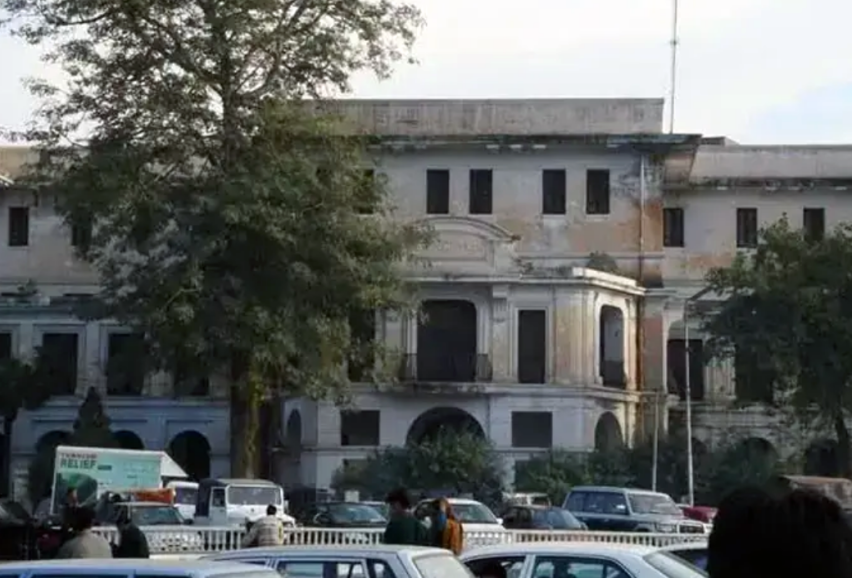
The management of Pakistan's only church-run chartered university secured temporary relief on June 18 (Thursday) after the Lahore High Court (LHC) restrained the Punjab provincial government from taking further action regarding Ewing Hall, a historic hostel building belonging to the Forman Christian College University (FCCU).
The ruling comes amid growing concern among rights advocates, alumni and heritage conservationists over the provincial government's takeover of the century-old property, which they say forms an important part of both the university's legacy and Lahore's architectural heritage.
Built in 1916 by missionaries of the Presbyterian Church USA on 1.69 acres of leased land, the two-story Ewing Hall served as a student hostel for Forman Christian College, which was founded in 1864. Named after Dr. James Caruthers Rhea Ewing, the influential educator who played a pivotal role in the institution's development, the building once housed 117 students before being vacated in 2018 due to concerns over its structural stability.
Justice Ahmad Nadeem Arshad issued the order while hearing a petition filed by FCCU Registrar Nayyar Fardows challenging the government's repossession of the property. The court suspended the operation of a Punjab Board of Revenue (BoR) decision cancelling the lease, sought a detailed response from the provincial government and barred authorities from taking further action until the next hearing.
The dispute emerged last week after the Punjab government assumed control of the building, prompting criticism from civil society groups and former students. Provincial authorities have maintained that FCCU's lease had expired and that substantial lease payments remained outstanding.
During proceedings on June 17, FCCU's counsel argued that the Board of Revenue's decision to cancel the lease was unlawful and that the government's takeover of the property on June 11 lacked legal justification.
The university contended that the land, located in Lahore's historic Neela Gumbad area, was originally leased to the college in 1915 and that the lease was extended in 2018 until 2048. FCCU requested restoration of possession and an injunction preventing further government action pending a final decision on the matter.
Representing the provincial government, an additional advocate general challenged the petition's maintainability, arguing that FCCU had failed to pay lease dues since 1975, thereby violating the terms of the agreement.
The government further alleged that the property, originally leased for educational purposes, was being used for commercial activities and urged the court to dismiss the petition.
During the hearing, Justice Arshad observed that if the government intended to recover outstanding lease payments, it should first have issued a formal notice to the university before taking coercive action.
After hearing arguments from both sides, the court granted interim relief to FCCU and adjourned further proceedings.
In a statement posted on Facebook on June 11, FCCU Rector Dr. Jonathan Addleton said university officials received a telephone call a day earlier informing them that Ewing Hall would be taken over on June 11. According to Addleton, authorities subsequently directed the university to remove generators, furniture and historical artifacts from the premises within 24 hours.
The controversy intensified amid reports that the structure could be demolished as part of a broader urban redevelopment initiative. However, on June 14, the Lahore Heritage Areas Revival Board (LHAR) denied those reports, stating that Ewing Hall would be preserved and restored rather than demolished.
The dispute has attracted widespread attention from rights organizations and heritage conservation advocates.
The Lahore Conservation Society Collective and the Human Rights Commission of Pakistan (HRCP) have urged the Punjab government to reconsider any plans involving the acquisition, demolition or irreversible alteration of the building. Both organizations noted that Ewing Hall is a protected heritage structure under the Punjab Special Premises (Preservation) Ordinance, 1985.
While supporting government efforts to revitalize Lahore's historic districts, the Lahore Conservation Society Collective said redevelopment initiatives should adhere to internationally recognized conservation principles that prioritize restoration and adaptive reuse over demolition.
The group also highlighted the historical significance of the broader Neela Gumbad-Anarkali precinct, which includes landmarks such as the Valmiki Mandir, Holy Trinity Church, Neela Gumbad, Mayo Hospital, FCCU's original campus and the former campus of University of the Punjab.
It proposed the creation of a "Heritage and Interfaith Harmony Corridor" to showcase the contributions of Muslim, Hindu, Sikh, Christian and colonial-era institutions to the development of modern Punjab.
Separately, HRCP questioned the transparency of the takeover process and warned against any action that could result in irreversible damage to a site of significant historical value.
"The physical integrity of Ewing Hall must be protected at all costs," the commission said in a statement.
FCCU was among hundreds of educational institutions nationalized by the Pakistani government in 1972. The college was returned to the management of the Presbyterian Church USA in 2003 during the administration of former military ruler Pervez Musharraf, himself an alumnus of the institution.