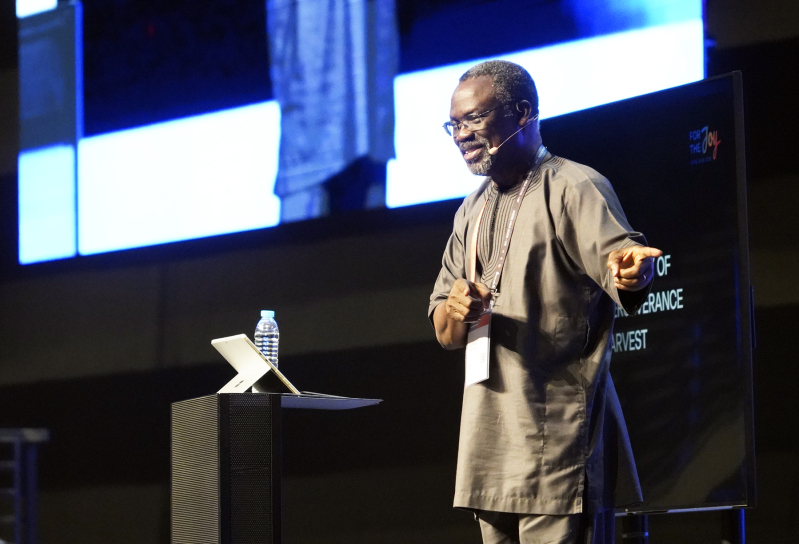
When Joshua Bogunjoko stepped onto the stage at the Arise Asia 2026 Congress in Manila on the morning of July 30, he opened with a question about how people perceive Africa: "When you hear the word Africa," he asked participants, "what comes to your mind first?"
The answers came back from around the auditorium: problems, conflicts, poverty. Bogunjoko smiled. He had expected as much.
"What you know of Africa is what others have told you about Africa, not what Africans have told you about themselves," said Bogunjoko, Global Director for Regions of the Lausanne Movement and International Director Emeritus of SIM. "In Africa, we have a saying: the story of victory is always told from the perspective of the hunter, not the perspective of the animal."
He had come to Manila to help participants open their eyes to a different story.
The fourth day's theme was drawn from Hebrews 12: "Looking to Jesus, the author and perfecter of our faith, who for the joy set before him endured the cross, despising the shame."
The joy. Not the pain, not the shame, not the glory that came after — but the joy that made the cross worth bearing. Bogunjoko argued that joy was the only thing that could carry a person through the trials of missions. And Africans, shaped by centuries of endurance and long overlooked by the world and often by the Church, had been quietly learning to run on it.
'That was reserved for those who came from the West'
Bogunjoko did not arrive at that conviction easily. He described his own resistance to it.
When God called him into mission, he told delegates, he sat down and tried to explain to God why it was impossible.
"Every single missionary I had met up to that point had been white people," he said. "And last time I checked, I was an African. So how can an African be a missionary? I thought this was a ministry reserved for those who come from the West — people who had access to resources and money and all kinds of things they can take and go to places and proclaim Jesus. As for us, we receive missionaries. We don't send missionaries."
"Yet, God didn't respond to all my education of Him, " he said with a smile. "He still insisted that someone like me should go and make Jesus known among people who had never known that Jesus came and died on the cross for them."
Bogunjoko traced how African Christianity had, for too long, oriented itself westward. "For too long, Africans looked to the West instead of looking to Jesus. We looked to the West for missionaries. We looked to the West for resources, for intellectual and spiritual development. We've looked to the West even for our theology and our leadership." But the shift toward Jesus rather than toward Western Christianity as its proxy is now well underway across the continent, he said.
He pointed to early landmarks in African-led mission: the indigenous missionary society in Nigeria, founded in 1948 and sending missionaries ever since. Calvary Ministries, which in 1973 mobilized young Nigerians doing national service to carry the gospel to unreached communities in the areas where the government had deployed them. And today, a generation of African mission leaders are stepping into global roles.
What Satan meant for evil, God is using for His Kingdom
Bogunjoko also honestly touched on a reality that many Africans know well, yet offered a different perspective.
He described how Africans are often dismissed and underestimated in international spaces, written off as having little to offer, no financial resources and generally unlikely to be taken seriously. That condescension, he said, has in certain contexts become an unexpected open door.
"If you are from Africa, they just ignore you. They believe you can't do anything." The assumption that Africans pose no threat and carry no influence has, quietly, created room to go where others cannot. "The very thing that Satan meant for evil, racism, God is using for His Kingdom purpose."
Stories from the field
The majority of Bogunjoko's address was dedicated to telling stories of specific individuals whose decisions illustrated what he called "purposeful perseverance in kingdom harvest."
The first was a Nigerian surgeon who completed her residency training in a West African country. While she was seeking God's direction for the next stage of her work, an American colleague, a pilot, was kidnapped by terrorists in the city where she was based. Western and Asian workers were evacuated. What she did next, Bogunjoko said, she described in her own prayer letter.
"I felt called to consider staying back as a general surgeon to serve at the mission hospital," she wrote. "I heard the voice of the Lord saying, 'Whom shall I send? And who will go for us?'" She remains there today, serving as a surgeon. An African staying where foreigners were no longer safe.
Another story Bogunjoko told was about a Nigerian husband and wife who were serving among an unreached Muslim people group in the Sahel in a community with, at the time, only one known believer. On a drive home for the holidays, they took a wrong turn into territory controlled by armed groups. As they reached a checkpoint manned by a gunman and were being interrogated, their young son, sitting in the back of the vehicle, began to sing a Christian song.
"He was terrified," Bogunjoko said. "These were Muslim extremists and the son was singing a Christian song." The soldier was thrown off by the child's voice, distracted mid-interrogation, and simply told the family to go.
They went home. They grieved. They rested. And then, they went back.
"The area where they are working is now totally overrun," Bogunjoko said. Yet, the couple is still there.
He showed two photographs — before and after — of a mission team in that same West African country. In the "before" image, the team showed just a few Africans alongside mostly Western workers. When the security situation forced the evacuation of Western and Asian colleagues, the Africans remained. In the "after" image, the team was entirely African.
"As the Westerners were having to leave," Bogunjoko said, "the Africans were saying, 'We are ready to go.' They are stepping up and carrying forward the work the Lord has committed to them."
He also described a refugee church in a town in South Sudan — meeting under a structure of thatch and sticks, inside a compound where the security briefing on arrival pointed to the only concrete building and said: "If you hear gunshots, run there." That church, in 2018, sent a couple as missionaries to reach refugees in a neighboring country. A year later, they sent one more.
'As long as we have blood'
Finally, he closed with the story of a church in southern Ethiopia that had committed itself to mission prayer — not general intercession, but prayer specifically for unreached peoples. They would gather before dawn and climb a nearby mountain, starting at 2 a.m., praying and fasting through the night and into the next day. They prayed facing the direction of each nation where they knew people were living and dying without hearing of Christ. At the end of the gathering, they would take collections for missions.
Two of that church's members, a husband and wife, went to serve in a neighboring country. The husband fell ill. By the time the evacuation plane reached him, it was too late. He died in the mission field.
The church received his body with honor. At the funeral, his wife stood up and told the congregation she was going back to South Sudan. The elders urged her to mourn, to rest. She entered Bible school, where she eventually met and married a fellow student, who would himself become a missionary. But before any of that, the church made a decision.
"We are going to send another missionary to replace him," the elders told the mission organization’s director in Addis Ababa. "We don't have money right now because it isn't harvest time — we are farmers. So every member of our church is going to go to a local hospital and donate blood. When you donate blood and don't have a patient, the hospital compensates you. We will collect that money and use it to send our next missionary."
As long as we have blood, they said, we have something to give for the gospel.
Among those who came to donate was a pregnant woman. Hospital staff told her she was not eligible. Yet, she refused to leave. "She insisted she had to donate because this was really important," Bogunjoko said.
When they relented and took her blood, she said: "I sold my blood for the one who shed his blood for me."
'Will you join us?'
In closing, Bogunjoko returned to the question with which he had begun: not what do you think of Africa, but what will you do with what Africa is showing you?
He acknowledged that the call to mission is not a call to interesting experiences or even to fruitful labor. "The call to the mission of God is a call to die," he said. "Unless you are willing to die to everything and every ambition, you are unlikely to last."
He told delegates that young Africans are responding to that call in growing numbers. Two years earlier, his team had planned a small mobilization gathering for 40 people — and 110 showed up.
"I can tell you of many other contexts, many other situations, young people of Africa who are thirsty for God, who want to follow God and who want to follow him to the end of the earth," he said. "They need you too," he added, concluding his address with an appeal.
"Africans cannot do it alone, and Africans will not do it alone. Asians cannot do it alone, and Asians will not do it alone. It will take all of us working together to make Jesus known to the world."
He reminded participants that the places in the world that remain unreached are unreached for a reason. They are difficult. Dangerous. Expensive, in ways that cannot be measured in money.
"What price is too high for you? What demand is too difficult? What situation is too challenging? What can you not give for the joy of following Jesus to the uttermost parts of the earth?"
"At this hour, Jesus is asking you: will you join the Africans in the perseverance of the gospel?"
Follow Christian Daily International's full reporting on Arise Asia 2026.