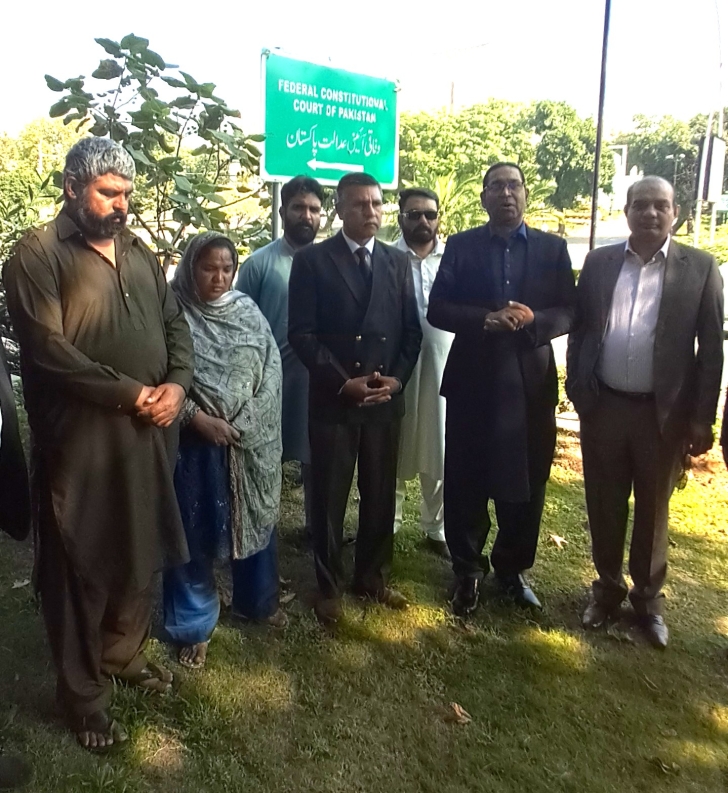
Pakistan’s top constitutional court on Wednesday (Oct. 21) adjourned a hearing on a Christian couple’s petition seeking recovery of their daughter after learning that the Muslim accused of abducting her had not been served a summons because of an “incomplete residential address.”
The Federal Constitutional Court (FCC) reissued the notice to Sheharyar Ahmad, accused of abducting 13-year-old Maria Shahbaz in July 2025, forcibly converting her to Islam and coercing her into marrying him. The adjournment dashed the parents’ hopes of progress in their year-long legal battle to recover their daughter.
Christian rights activists criticized police over failure to serve the summons and called for action to recover Maria.
“We were very hopeful of progress in the case in today’s hearing and were not expecting such a hasty adjournment,” said Safdar Choudhry, chairman of the Raah-e-Nijaat ministry, which is assisting the Masih family in the legal battle with support from legal advocacy group Alliance Defending Freedom International. “The claim of the accused’s residential address being incomplete appears to be yet another mala fide act by the police, as the accused has appeared in the same court on notices in previous hearings.”
Choudhry also criticized the police for failing to arrest Ahmad despite the restoration of the First Information Report (FIR), saying he continued to move freely in his neighborhood.
Samson Salamat, chairman of Rwadari Tehreek (Movement for Equality), also questioned the police explanation, saying Ahmad was reportedly living at the same address for years.
“The police must stop creating hindrances in the recovery of Maria Shahbaz,” Salamat told Christian Daily International-Morning Star News. “Her poor family has been struggling for their child’s recovery for over a year, yet justice continues to elude them despite clear evidence that her marriage was a sham.”
Asher Safaraz, chief executive of Christians’ True Spirit, whose organization is among five groups seeking to be joined as parties to the main review petition, said the abrupt adjournment had left them disappointed.
“We were hoping that the bench would also consider our petitions today, but our counsels were not given a chance to plead our case,” Safaraz told Christian Daily International-Morning Star News. “We all want the constitutional court to address the police and judicial weaknesses in the implementation of child marriage laws, which are clearly reflected in Maria Shahbaz’s case. This matter is not limited to the recovery of one minor child only. It will impact the lives and protection of all minority underage girls who continue to be targeted by sexual predators.”
The case concerns a review petition filed by Maria’s father, Shahbaz Masih, asking the court to reconsider its Feb. 3 judgment upholding a decision that allowed Ahmad to retain custody of the girl based on their purported marriage. The FCC admitted the review petition for hearing on July 24 and ordered notices to be issued to Ahmad, the Punjab advocate general and the attorney general of Pakistan.
The matter was not taken up until Wednesday (Oct. 21), however, when a two-judge bench comprising Acting Chief Justice Hassan Azhar Rizvi and Justice Karim Khan Agha heard preliminary arguments. A court official informed the bench that the summons to Ahmad could not be served because his residential address was incomplete. The court consequently reissued the notice and adjourned the hearing.
During the brief proceedings, Agha said that, because the matter was a review petition, the petitioner’s counsel needed to identify an error in the original judgment.
Muhammad Saqib Jillani, the lawyer representing Maria’s family, argued that the judicial precedents relied upon in the FCC’s detailed judgment had lost their legal force following a landmark 2023 Federal Shariat Court (FSC) judgment in the Ali Azhar case. He said courts were bound to consider child marriage cases in light of the FSC ruling, which rejected physical puberty as the sole criterion for determining whether a person could marry under Islamic law.
Acting Chief Justice Rizvi responded that the FCC had issued its judgment in an appeal against a Lahore High Court decision concerning Maria’s alleged illegal confinement. He said the matter before the court was not directly about the girl’s age but concerned the high court’s ruling, adding that objections regarding her age should have been raised before a family court.
The acting chief justice also noted that Maria and Ahmad had appeared before the court, and that she had stated she was an adult. He said her age had not been raised before the relevant legal forums and questioned the timing of the documents presented to establish it, observing that her birth certificate had been obtained 10 years after her birth and a National Database and Registration Authority (NADRA) certificate eight years afterward.
According to Maria’s family, however, official records and NADRA documents establish her date of birth as Oct. 7, 2012. She was therefore 12 years, nine months and 20 days old when the alleged abduction and marriage occurred in July 2025. The family maintains that Maria was legally a minor and lacked the capacity to enter into a marriage contract independently.
The investigation into the case has also raised questions about the validity of the purported marriage documents. The investigating officer relied on Maria’s statement recorded under Section 164 of the Code of Criminal Procedure and a Nikahnama, or Islamic marriage certificate, to recommend closing the case. The secretary of the relevant union council, however, told a Lahore sessions court that he did not acknowledge the registration or authenticity of the marriage document.
On Oct. 1, Lahore High Court Justice Abher Gul Khan ordered the restoration of the police case against Ahmad, accepting the family’s plea that a magistrate had approved a police cancellation report on March 7 without hearing Maria’s family or their lawyer.
The family’s petition alleged that the investigating officer had withheld material findings from a subsequent police investigation that had restored the FIR and added charges relating to alleged forgery and fraud involving the marriage and conversion documents.
Maria’s case has drawn international attention amid wider concerns over the abduction, religious conversion and marriage of underage girls from religious minority communities in Pakistan. On July 9, the European Parliament adopted a resolution highlighting Maria’s case and urging Pakistan to establish a national mechanism for receiving complaints from families of abducted or forcibly converted girls belonging to religious minority communities.
Open Doors, a Christian support organization, ranked Pakistan eighth on its 2026 World Watch List of 50 countries where Christians face the most severe persecution, citing systemic discrimination, mob violence, forced conversions, bonded labor and gender-based violence. It warned that weak law enforcement and widespread impunity have allowed perpetrators of anti-Christian violence to evade accountability.