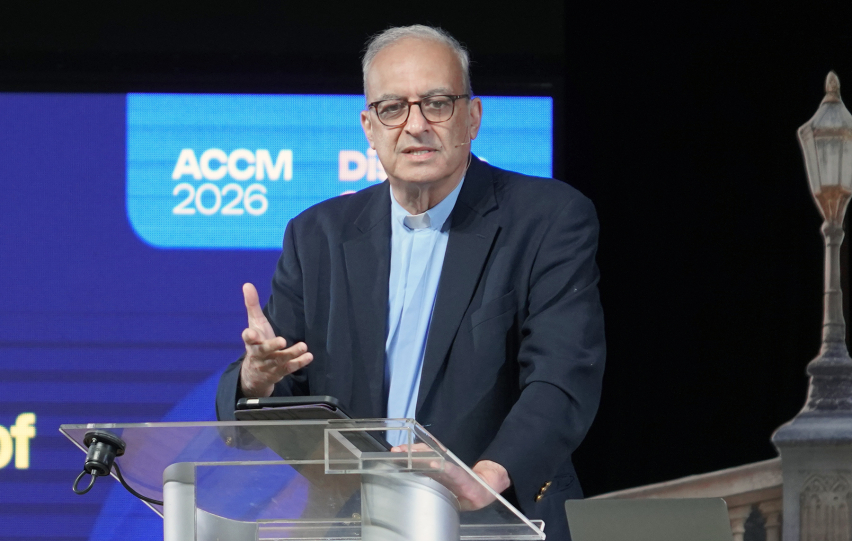
On the evening of June 9, 2026, 210 evangelical leaders from 25 nations gathered in Manila for the opening session of the Asia Conference on Church & Mission (ACCM) 2026. Rev. Botrus Mansour, Secretary General of the World Evangelical Alliance, a global fellowship of some 650 million believers in more than 160 countries, delivered the first keynote address of the conference.
His message was primarily a pastoral argument, grounded in ancient Jewish practice, for why discipleship must be done in community — and what the Church loses when it forgets this.
The risk of losing the center
Mansour opened by highlighting the many pressures bearing down on the Church across Asia and the world: rapid social change, the disruption of AI, rising secularism, nationalistic and religious tensions, economic uncertainty.
What is the Church’s response to these challenges? Reading the Bible, dependence on the Holy Spirit, drawing closer to God in prayer — all of these are right answers, he said. But discipleship integrates all of them. It is the center. "If we lose discipleship, we lose the center of our mission."
He noted that churches that stop intentionally making disciples don't collapse overnight. Programs continue, buildings stay full for a while, activities may multiply — but without discipleship, the church slowly loses its transformative power. Echoing earlier remarks from AEA leaders that evening, he underlined the urgency of disciple making: the church's mandate from Christ is non-negotiable.
“Discipleship is done in community”
Rather than giving a comprehensive theology of discipleship, Mansour said he wanted to make just one important point — an element he believes the evangelical world, shaped by individualism and consumerism, is in danger of missing: "Discipleship is done in a community."
Coming to faith is individual, he acknowledged. No one inherits it. No one comes to Jesus as a group. But the tendency to make discipleship itself a purely individual pursuit — a personal Bible plan, a private spiritual formation program — is where the model breaks down. Western consumerism reinforces this, shaping church attenders who come because they like the worship or the preaching, relating to the church as consumers rather than as covenant community.
"We sometimes think that discipleship is only individual," he said. "But it is done as a group of people."
The dust of the Rabbi
To illustrate this point, Mansour reached back into the first-century Jewish world in which Jesus himself was formed.
Every Jewish child began learning the Scriptures by heart from a young age. The most gifted might aspire to become a talmid (תַּלְמִיד), a disciple, of a distinguished rabbi. If accepted, the talmid didn't simply attend the rabbi's lectures. He lived with the teacher. He traveled with him. He followed closely.
The goal wasn't merely to learn the rabbi's teaching. It was to become like the rabbi — to imitate his character, his way of responding to people, his manner of prayer and problem-solving and conflict resolution. "They observed his habits," Mansour said. "They saw how the rabbi prayed. How he treated people. How he responded to challenges. They lived life with him — all of its parts."
There was a blessing that captured this aspiration. People would say to a talmid: May you be covered with the dust of your rabbi. The roads of first-century Judea were unpaved. To be covered in your rabbi's dust meant you had walked so close to him, for so long, that his journey had become yours.
"Maybe today," Mansour said, "we should tell each other: may you be filled with the dust of discipleship — with the dust of the Lord."
Formation of this kind cannot happen at a distance. It requires proximity. It requires presence, Mansour argued.
The goal of discipleship is to be transformed into Christ’s image
Mansour went on to offer three dimensions of what this looks like in practice.
First: the desire to become like Jesus. Access to teaching has never been easier — any sermon, any passage, any preacher, available on demand. But discipleship is not primarily about information.
"It's not that I want only to know what Jesus taught me," Mansour said. "We need to be transformed to be like him." The question for every believer is not what they have learned, but whether they love like him, serve like him, forgive like him, obey like him. Citing Romans 8:29, he named the goal of discipleship as being conformed to the image of Christ.
Second: every disciple needs another disciple. Scripture is full of this pattern — Moses and Joshua, Elijah and Elisha, Paul and Timothy. Paul's instruction in 2 Timothy 2:2 is explicit: what you have heard, entrust to faithful people who will teach others also. "Discipleship is life shared from one believer to another," Mansour said.
He described his own practice when he returns home from his heavy travel schedule: gathering the men of his church for coffee or a meal. "We're not sitting there telling each other, 'Let's open the Bible and you teach me.' But at least when we share fellowship, we hear each one's challenges. We laugh a little bit." That shared presence, that mutual knowing, is essential to discipleship.
We need, he argued, someone who can encourage us when we are discouraged, challenge us when we are drifting, and walk alongside us through the ordinary stretch of life.
Third: disciples grow in circles of fellowship. "Schools have three things: a teacher, a student, and a curriculum," Mansour noted. "New Testament discipleship is different. It has a teacher, a way of life, and resemblance."
The first disciples didn't just attend Jesus' lectures. They watched him pray, watched him minister, watched him respond to the Pharisees' traps, watched how he treated women and the poor and the outcast. "They learned not only from what he taught, but from what he lived."
That kind of formation happens in relationship — in face-to-face circles where you can see one another's expressions, share one another's tears, and actually know each other. He pointed to the first church in Acts, devoted to both teaching and fellowship, as the model.
"You live the life together. This is discipleship. We carry one another's burdens. We become a spiritual family," he said.
Jesus reversed the selection model by going and calling his disciples
Mansour closed with an observation about how Jesus’ approach to making disciples was decisively different. In the ancient system he described, students applied to rabbis. The distinguished teacher accepted the most gifted candidates. The model was selective and hierarchical.
Jesus reversed it entirely. He did not wait for candidates to apply. He went himself. And he did not choose the distinguished, the excellent, or the highly qualified. He chose fishermen. A despised tax collector. Rough people from Galilee.
"If I wanted to start a team for leadership," Mansour said, "I would not go to those types of people." But Jesus did. "The Lord wants everyone. He goes and gets a team. He works through ordinary people."
Discipleship in the way of Jesus is not a program for the gifted or the spiritually advanced, Mansour said. It is the mode in which the whole church — ordinary people — grows together into the likeness of Christ.
"Iron sharpens iron," he said near the close, "and one man sharpens another. That is the life of the community of discipleship. Not at a distance. But in a relationship."
The church flourishes, he argued, when people walk together toward a common goal: when they are becoming, all of them, slowly and in community, like the rabbi they follow. Covered, in the end, in his dust.
The Asia Conference on Church & Mission 2026 runs June 9–12 at GCF South Metro in Alabang, Metro Manila, organized by the Asia Evangelical Alliance in partnership with the Philippine Council of Evangelical Churches. The conference carries the theme "Disciple or Die 3.0" and is oriented toward a concrete goal: that by 2033, 20 percent of evangelical churches represented by AEA member alliances across Asia will become disciple-making churches.