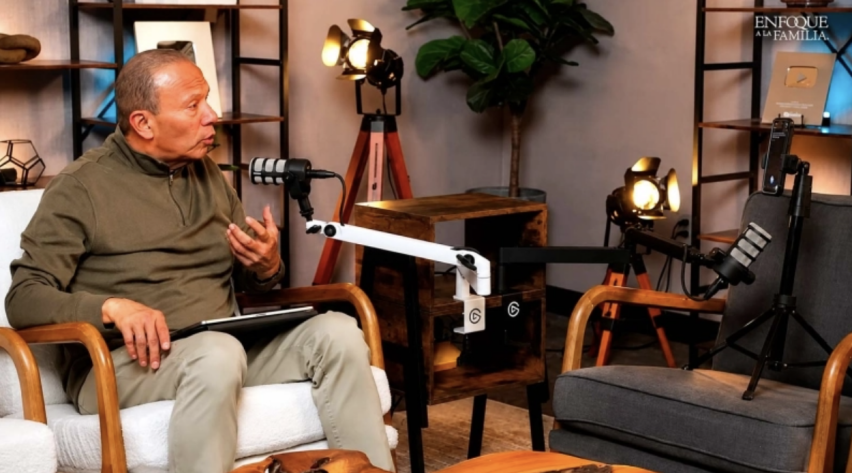
Sixto Porras, regional director of Focus on the Family, sat down with ChatGPT to test what artificial intelligence can and cannot do — and to warn evangelical families not to let algorithms replace spiritual discernment, empathy, or genuine human connection.
The dialogue, broadcast on the ministry's official YouTube channel, covered AI's technical functioning, its lack of moral judgment, and the risks it poses for vulnerable teenagers.
The nature of artificial intelligence and the lack of moral discernment
Porras began by asking the chatbot how it constructs its responses. The bot acknowledged its own limitations:
"I construct responses based on patterns from data I was trained on; I have no consciousness or intention [...]. I have no authority or moral judgment of my own; I only provide information that may be perceived as useful or not depending on the situation."
For Porras, the admission goes to the heart of the danger: families and young people who mistake statistical outputs for truth.
"An AI neither understands nor feels; it only produces responses from data [...]. Let us be careful that no technological advance substitutes our relationship with God," he said.
The risk of automated responses for vulnerable adolescents
Porras pressed the AI further: could a vulnerable teenager take its responses as authoritative guidance?
"The danger lies in the fact that a vulnerable person might not question what I say; they could take a response generated by patterns as personal or moral guidance when it is not," the chatbot replied. "This could reinforce incorrect ideas not adapted to their situation."
Young people in stages of intellectual and emotional development are especially susceptible, Porras said, making intentional parental guidance essential for filtering the flood of digital information.
Studies warn of a growing trend of users — particularly young people — seeking refuge in virtual characters rather than human community. When it comes to depression or self-harm, an algorithm cannot provide what family and community can.
The chatbot agreed: "Artificial intelligence cannot substitute human social interaction; it lacks genuine empathy, emotional closeness, or real affection [...]. Authentic human relationships are irreplaceable."
Porras drew his own conclusion. "When you find yourself in the midst of a crisis, you and I must seek help from a human being who has empathy, who has closeness, who can identify with our emotions," he said.
He also turned the challenge back on parents themselves.
"If my son speaks to me, I must turn off the phone and look him in the eyes, pay attention. Let my son feel that he is more important than technological or virtual contact," Porras said.
Practical principles for responsible technology use in the home
Focus on the Family proposed several guidelines for families. First, establish clear disconnection limits by defining schedules and screen-free spaces, especially during meals or family time. Parents should also foster critical thinking, teaching teenagers to question information found online and not to accept automated responses as absolute truths.
Cultivating the relationship with God — through Bible reading, prayer, and church — should take priority over digital searches and consultations. Finally, families facing complex crises should seek professional and pastoral help from trained counselors rather than entrusting emotional well-being to a virtual environment.
Return to the real world and prioritize faith
Porras closed with the testimony of a family that removed their children's mobile devices to begin a digital detox. The children rediscovered wonder in creation and daily life.
"The child said: 'Mom, I like the real world better; I'm listening to the birds singing... the sky is truly blue.' In that moment the whole family was moved because they realized that, without noticing, we can begin to live in a virtual world," Porras recounted.
He urged churches and evangelical homes not to let technology become an idol or a substitute for communion with God and neighbor.
"It is interesting, but nothing substitutes my relationship with God, and this is crucial: spiritual discernment comes from God. Teach your children to have spiritual discernment; teach your children to seek in the Bible," Porras said.
Original reporting by Diario Cristiano, Christian Daily International's Spanish edition.