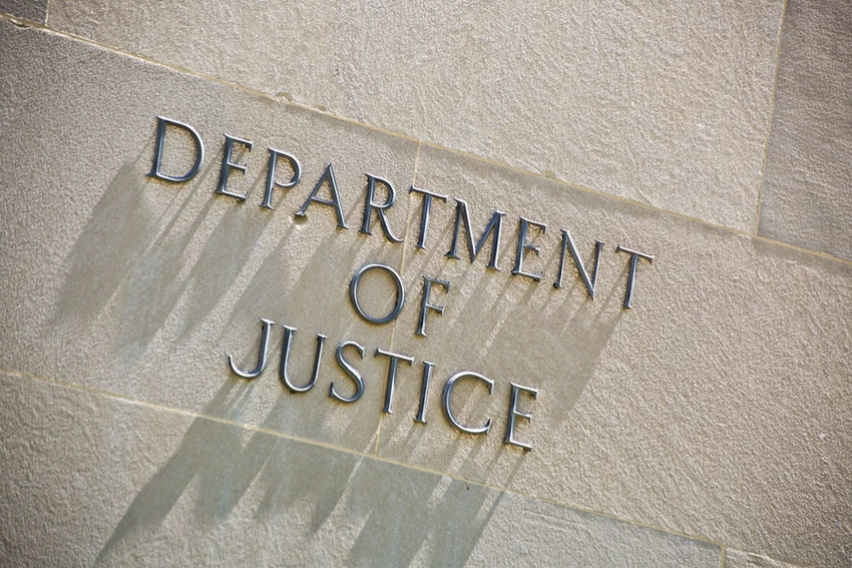
The U.S. Department of Justice has issued updated guidance on religious liberty to executive branch agencies, including a new clarification on parental rights and expanded references to recent U.S. Supreme Court decisions.
The new guidance, released Thursday, updates previous guidance on religious liberty issued by the DOJ in 2017. The revised edition includes a bullet point on parental rights and features multiple references to recent U.S. Supreme Court decisions on religious liberty.
It comes eight days after Acting Attorney General Todd Blanche faced a contentious Senate Judiciary Committee confirmation hearing on his nomination to lead the department, and follows a June recommendation from the DOJ's Religious Liberty Commission that Trump "instruct the Department of Justice to issue guidance clarifying the proper understanding of the Establishment Clause and separation of church and state."
"Religious liberty is one of our nation's founding principles and a fundamental right guaranteed by the Constitution," Blanche said in a statement announcing the release. "It is essential that federal agencies fully respect and protect the ability of all Americans to live out their faith in daily life, including in their interactions with the federal government."
Kelly Shackelford, president of First Liberty Institute, praised the new guidance as consistent with the Trump administration’s “strong efforts to protect America’s first freedom — religious freedom” in a statement Thursday. “This updated guidance will ensure that the federal government will respect the religious liberty rights of all Americans when implementing the President’s policies,” he predicted. “We will continue to fight with the President to ensure that religious liberty is protected for all Americans.”
The new guidance retains the same core principles as the 2017 document, with one new addition declaring that "government may not interfere with parental rights to direct the religious upbringing of their children." The added principle states that "parents have the right to direct the religious upbringing and education of their children."
“This right extends beyond a mere right to teach religion in the confines of one’s home and encompasses the choices parents make for their children outside the home,” the guidance continues. “Government policies that substantially interfere with the religious development of children violate this right. Government may not choose to condition the availability of public benefits, such as public schooling, upon parents’ willingness to surrender their religious freedom.”
Beyond the parental-rights addition, the guidance directs agencies to weigh religious-liberty concerns earlier in the rulemaking, employment, contracting and grantmaking process, rather than waiting until litigation forces the issue.
Like the 2017 guidance, the updated guidance includes a lengthy appendix with references to relevant Supreme Court decisions on religious liberty. Newly referenced rulings include Carson v. Makin, which held that a Maine tuition program could not exclude religious schools, and Kennedy v. Bremerton School District, which sided with a high school football coach disciplined for on-field prayers.
The guidance also cites Fulton v. City of Philadelphia, which ruled against the city's exclusion of a Catholic foster care agency over its opposition to placing children with same-sex couples, and Masterpiece Cakeshop, Ltd v. Colorado Civil Rights Commission, which sided with a Christian baker penalized for declining to bake a cake for a same-sex wedding back in 2012 when gay marriage was illegal in Colorado.
Citing Fulton, the guidance states that "a law is not neutral if, in its application, the government 'proceeds in a manner intolerant of religious beliefs or restricts practices because of their religious nature.'" Citing Masterpiece Cakeshop, it adds that a law is also not neutral if its application is "accompanied by 'official expressions of hostility to religion.'"
Other decisions cited include Mahmoud v. Taylor, which sided with parents seeking to opt their children out of LGBT-related curriculum on religious grounds; Groff v. DeJoy, which sided with a postal worker who quit his job rather than work on Sundays in violation of his faith; and Catholic Charities Bureau, Inc. v. Wisconsin Labor Review Commission, which struck down Wisconsin's denial of tax-exempt status to a Catholic Charities affiliate over claims its work wasn't religious enough.
The guidance further cites Burwell v. Hobby Lobby Stores, Inc., the 2014 ruling establishing that RFRA's protections extend beyond individuals to organizations and at least some for-profit corporations. It points to Hobby Lobby as an example of a business protected under the law.
Principles carried over from 2017 include the classification of religious liberty as "a fundamental right of paramount importance, expressly protected by federal law," alongside protections against government targeting of religious speech or conduct and interference with religious organizations' internal autonomy. Both documents outline protections under the Religious Freedom Restoration Act and Title VII of the Civil Rights Act of 1964.
Originally published by The Christian Post.