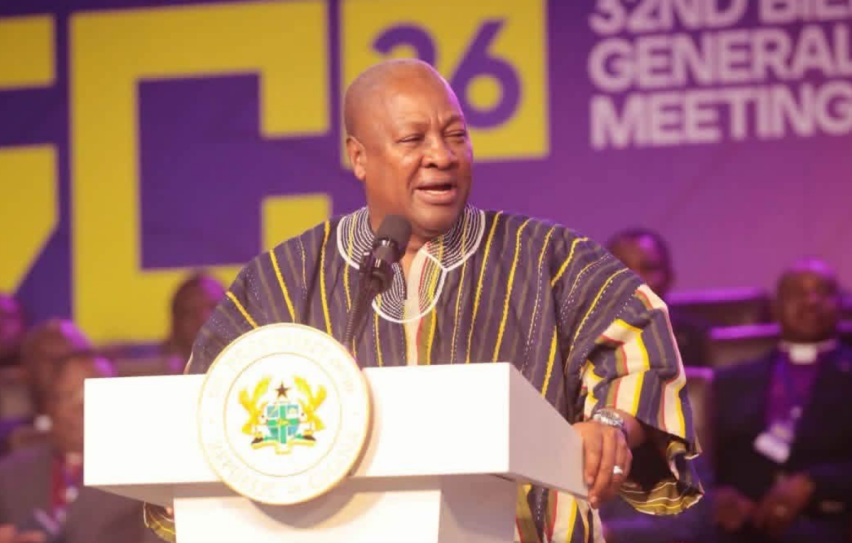
President John Dramani Mahama has warned Ghanaians not to take the country’s tradition of religious freedom and peaceful coexistence for granted after a dispute involving a Christian pastor and a Muslim imam escalated from inflammatory comments to arrests and an assault in police custody.
In his first public comments on the controversy, Mahama told pastors, imams and other religious leaders to exercise restraint in their public statements and on social media.
Speaking at the 32nd Biennial General Council Meeting of the Assemblies of God, Ghana, at the Pentecost Convention Centre in Gomoa Fetteh in the Central Region, on Aug. 20, Mahama said the events were a reminder that Ghana’s tradition of religious tolerance required protection.
“For generations, Christians, Muslims, and people of other faiths have lived together peacefully in Ghana,” Mahama said.
He noted that members of different faiths share families, schools, workplaces, security services and public institutions. He described that peaceful coexistence as one of Ghana’s greatest national assets.
The president’s remarks followed the arrest of two religious figures over separate videos involving comments about Muhammad, the prophet of Islam.
Police said Masud Abdullah, a 35-year-old imam, was arrested over remarks allegedly made during a sermon at a mosque in Ntensere in the Atwima Nwabiagya North District of the Ashanti Region. Police said he was alleged to have made comments urging violence against people who spoke ill of Muhammad.
In a separate case, police arrested Christian cleric Daniel Junior Yaw Adjei, popularly known as Apostle Daniel Adjei, over a video containing what police described as derogatory and offensive comments about Muhammad.
The arrests came as videos of the religious comments circulated online, bringing the dispute beyond the communities where the remarks were made.
The National Chief Imam, Sheikh Osmanu Nuhu Sharubutu, condemned the imam’s alleged inciting comments after they came to his attention. Police said both cases were being investigated and that the suspects would be processed according to law.
The dispute took a more serious turn after video footage emerged showing the Christian cleric, in handcuffs, being slapped while in police custody.
Ghana’s Interior Ministry condemned the assault and said the fact that civilians had gained access to a person being held by the state was a serious concern. The ministry directed the Inspector-General of Police to investigate how the breach of custody occurred, identify civilians involved in the assault and investigate the conduct of officers responsible for the detainee’s custody and supervision.
The ministry also condemned both religious incitement and violence against people because of their faith.
“No allegation of breach of law, however serious, gives any person the right to assault a suspect in police custody,” the ministry said, adding that a person arrested by the state remains entitled to the protection of the law.
The Christian Council of Ghana similarly condemned the assault but also condemned the alleged attack on Islam and the alleged call for violence by the Muslim cleric.
The council said the sequence of events had created a volatile situation involving sections of the Christian and Muslim communities. It called for restraint and warned against escalation.
The National Peace Council also intervened, urging the public to distinguish between the separate incidents rather than treating them as one matter.
Christian-Muslim tolerance
The council said the religious dimension was “extremely sensitive” and called on religious leaders, politicians, civil society groups and media practitioners to avoid inflammatory commentary and premature conclusions. It said accountability, fairness and respect for human dignity were necessary to maintain public confidence and Ghana’s tradition of peaceful coexistence.
Interior Minister Muntaka Mohammed Mubarak met Christian and Muslim leaders in Accra on Aug. 17 following the controversy. He described Christian-Muslim tolerance as a foundation of Ghana’s peace and security and commended religious leaders and police officials for intervening in the dispute.
The National Peace Council later said the Interior Ministry had also engaged the Christian Council of Ghana, the Ghana Catholic Bishops’ Conference and other Christian groups as part of efforts to prevent religious concerns from developing into wider tensions. The ministry had previously engaged Muslim leaders.
Against that backdrop, Mahama said freedom of religion and freedom of expression, both guaranteed by Ghana’s Constitution, did not give anyone the right to insult another person’s faith, incite violence or take the law into their own hands.
“Religious conviction must never become religious provocation,” he said.
He also warned that statements made from church pulpits, in mosques or online could spread rapidly and inflame passions beyond what the speaker intended.
The president called for the law to be applied fairly and impartially and rejected mob action, retaliation and violence. He also urged Christian organizations to continue working with Muslim leaders, traditional authorities and the National Peace Council to strengthen interfaith dialogue, particularly among young people.
Mahama said the recent events should not be allowed to define relations between Christians and people of other faiths in Ghana.
“No one honors God by insulting another person’s faith,” he said. “No one defends the Almighty God by troubling or attacking another human being.”
He urged religious leaders to demonstrate restraint in disagreements and said Ghana’s religious diversity should be treated as a source of strength when grounded in mutual respect.