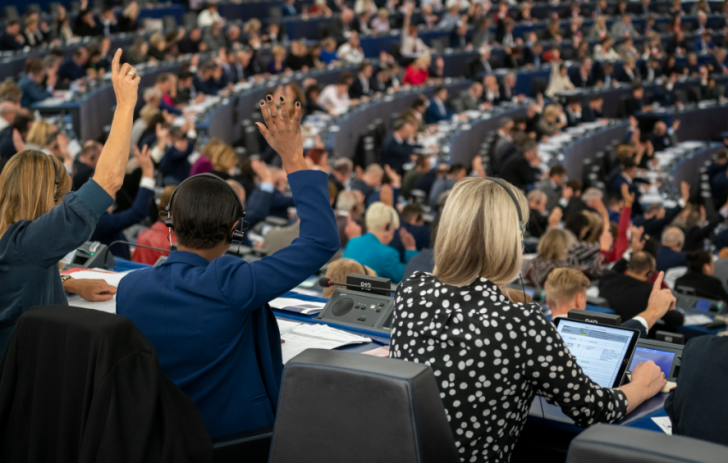
The issue of abductions, forced religious conversions and forced marriages of minor Christian girls in Pakistan is set to come under renewed international scrutiny at the European Union Parliament on Tuesday (July 14).
Lawmakers and human rights advocates will gather in Brussels then for a conference on protection of minority girls. Joseph Janssen, advocacy officer for Jubilee Campaign Netherlands, said the conference is being organized jointly by the European Conservatives and Reformists (ECR) Group and the European People's Party (EPP) Group, with particular attention to the case of Maria Shahbaz in Pakistan.
Pakistan’s Federal Constitutional Court on Feb. 3 upheld the marriage of Maria, a 13-year-old Christian girl, to Shehryar Ahmad, a 30-year-old Muslim whom her family has accused of abducting her. The ruling sparked protests among Pakistan's Christian community, with rights advocates warning that the decision could encourage similar abuses and further endanger minority girls.
“The event will be jointly hosted by Members of the European Parliament Bert-Jan Ruissen of the ECR Group and Matej Tonin of the EPP Group,” Janssen told Christian Daily International.
Speakers will include Ann Buwalda, executive director of Jubilee Campaign; Anna Townsend, author of “Our Sisters”; international human rights advocate Sulema Jehangir; Professor Shahid Mobeen of the Italian Council for Religious Freedom and Dialogue; and Carmen Correas, legal counsel for Alliance Defending Freedom International, which is assisting Shahbaz’s family in challenging the constitutional court’s ruling.
“The event will also feature testimonies from the parents of Maria Shahbaz and other affected families to demonstrate the recurring pattern of abduction, forced conversion and forced marriage of minority girls in Pakistan, as well as the profound emotional and psychological trauma endured by their families,” Janssen said.
Human rights organizations have long documented cases in which minority girls – some reportedly as young as 10 – are abducted, forcibly converted to Islam and married to Muslim men in Pakistan. Advocates say victims are frequently pressured into making statements supporting their alleged abductors, while courts have often disregarded official age records and upheld such marriages, returning girls to their alleged abductors as lawful spouses.
Janssen said Pakistan is bound by several international human rights treaties, including the U.N. Convention on the Rights of the Child, the Convention on the Elimination of All Forms of Discrimination Against Women and the International Covenant on Civil and Political Rights, all of which require the state to protect children from exploitation, trafficking, forced marriage and discrimination.
He added that the European Union has repeatedly urged Pakistan, under the human rights conditions attached to its Generalized Scheme of Preferences Plus (GSP+) trade status, to improve protection for religious minorities, women and children.
“The cases of Maria Shahbaz and other victims, including Amber Nadeem and Sataish Mariam, are an important test of Pakistan’s willingness to enforce both its domestic child protection laws and its international human rights obligations,” Janssen said.
International concern over the issue has continued to grow. A panel of independent experts appointed by the U.N. Human Rights Council on April 22 urged Pakistan to intensify efforts to eliminate forced religious conversions and forced marriages, noting that girls from religious minority communities remain particularly vulnerable to coercion.
The experts called on Pakistan to establish a nationwide minimum marriage age of 18, criminalize forced religious conversion as a distinct offense and strengthen enforcement of laws addressing human trafficking and sexual violence. They also reiterated previous recommendations by U.N. treaty bodies calling for prompt, impartial investigations into allegations of forced conversions and accountability for those responsible.
“We are deeply concerned that law enforcement authorities often dismiss complaints lodged by victims’ families, fail to investigate or prosecute forced conversions in a timely manner, or neglect to properly assess the age of victims,” the experts said in a joint statement.
About 75 percent of reported victims of forced conversion through marriage in Pakistan in 2025 were Hindu, while Christians accounted for approximately 25 percent, according to the U.N. experts. Nearly 80 percent of reported cases occurred in Sindh Province, with girls between the ages of 14 and 18 identified as particularly vulnerable, although some victims were reportedly younger.
The experts noted that poverty and social marginalization significantly increase the risks faced by minority women and girls.
“These women and girls endure a continuous sense of terror, face coercion and are deprived of their freedom of religion or belief and autonomy under patriarchal and political pressures. This must stop,” they said.
The experts concluded that the persistence and scale of such abuses point to systemic discrimination against non-Muslim women and girls, who are frequently pressured or compelled to convert to Islam in order to marry Muslim men.
International advocacy organizations continue to rank Pakistan among the world’s most difficult countries for Christians. In its 2026 World Watch List, Open Doors ranked Pakistan eighth among the 50 countries where Christians face the most severe persecution, citing systemic discrimination, mob violence, forced conversions, bonded labor and gender-based abuses. The organization also said weak law enforcement and widespread impunity have enabled perpetrators of anti-Christian violence to escape accountability.
(Corrected on July 10 to remove statement that urgency resolution in the European Parliament will be voted on July 15; vote was on July 9.)