
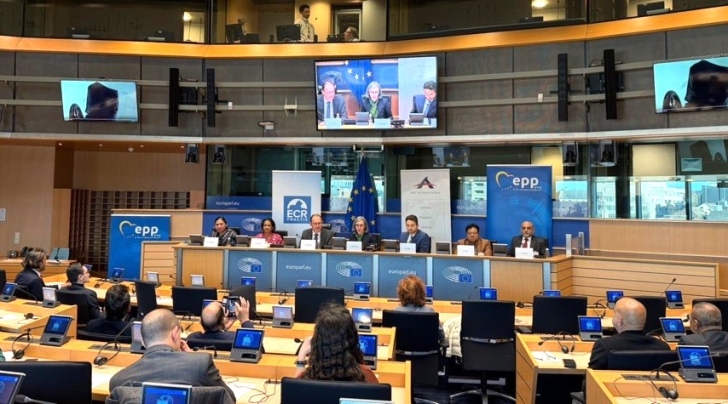
Citing a dramatic escalation of targeted attacks against Christians and other minorities in their countries, human rights advocates from South Asia called for stronger European Union (EU) engagement on freedom of religion or belief at a conference in Brussels on Dec. 4.
Representatives from India and Pakistan highlighted how religious minorities, whether Christian, Muslim, Hindu or Buddhist, were increasingly under pressure from those professing the majority religion despite constitutional protections in almost all of the region’s countries. They spoke at a conference entitled, “Targeted Violence against Christians in South Asia,” hosted by Members of the European Parliament (MEPs) Matej Tonin and Bert-Jan Ruissen and organized by legal advocacy group ADF International at the European Parliament.
In India, between January and October alone more than 600 incidents of violence were documented – averaging more than two attacks per day – including mob assaults, public humiliation, church disruption, and demolition of homes, said Tehmina Arora, director of Advocacy Asia for ADF International, citing India’s United Christians Forum.
“Twelve Indian states now enforce anti-conversion laws, often used to intimidate and criminalize peaceful religious activity. This year, 123 criminal complaints have been filed against Christians, and several believers remain in prison across the country,” Arora said. “Christians in India are punished not for wrongdoing but for simply gathering, praying, or helping their neighbors.”
She presented documented testimonies from across India’s most affected regions.
“Even the Supreme Court of India recently noted how the ‘anti-conversion laws’ are misused to wrongly prosecute Christians,” she added.
The panel also warned about Pakistan’s continued abuse of some of the world’s harshest blasphemy laws, including provisions carrying a mandatory death penalty. In 2024 alone, 344 new blasphemy cases were registered, many triggered by false or coerced allegations on social media and disproportionately targeting Christians, said Pakistani journalist Asher John, referencing 2023 attacks in the Jaranwala area, where more than two dozen churches and over 85 homes of Christians were burned, and the 2024 lynching of 74-year-old Christian Nazeer Masih Gill in Sargodha.
“False accusations of blasphemy continue to spark mob violence,” John said. “There’s an urgent need to introduce procedural changes in the blasphemy laws to curb false allegations that have often resulted in violent attacks on Christian settlements and individuals belonging to both the minority and majority communities.”
Moreover, a lack of effective prosecution gives perpetrators of violence a sense of impunity, he said, adding that law enforcement agencies and the judiciary should ensure that any person or group involved in such incidents are brought to justice.
Pakistani blasphemy law victim Shagufta Kausar thanked both God and the European Parliament for her release from prison after an emergency resolution in 2021. She told the seminar that she and her husband had been tortured while in custody, leaving their young children, who witnessed the beatings, traumatized.
Authorities had threatened to throw her naked into the street unless her husband confessed to sending blasphemous messages, Kausar said. They also pressured her to convert to Islam, but refused, she added.
Urging EU policymakers to remain vigilant, Kausar said, “Unless the international community acts, countless innocent people will continue to suffer under laws that are used to silence and destroy the most vulnerable.”
Ejaz Alam Augustine, a former Pakistani human rights and minorities affairs minister and current member of the Punjab Assembly, spoke on the issue of forced faith conversion and forced marriages of underage Christian and Hindu girls in Pakistan.
“Despite fierce opposition by religious groups, the federal government and the provincial government of Balochistan have taken a bold initiative by raising the legal age for marriage for both genders to 18 years,” Augustine said.
Similar legislation is pending approval in the Punjab Provincial Assembly since April 2024, he noted.
“I’m quite hopeful that after its passage, we will have a legal safeguard against the forced faith conversion of minor Christian girls as conversion and Islamic marriage is used by the perpetrators to give cover to their sexual crimes,” Augustine said.
Beyond India and Pakistan, Arora from ADF International highlighted the shrinking space for religious freedom in other South Asian countries. In Sri Lanka, rising religious nationalism has fueled at least 39 incidents of threats, intimidation or disruption of worship this year, including protests led by Buddhist monks preventing Christian services, she said.
“Nepal has intensified surveillance of Christian activity, with authorities arresting and expelling foreign missionaries and ordering district administrations to monitor religious gatherings,” Arora said. “Bangladesh also continues to see targeted attacks and harassment, particularly in rural areas where Christians lack protection.”
The European Union has both the mandate and the means to act, she added.
“The EU should not only continue but intensify efforts to protect freedom of religion or belief around the world. The reappointment of a Special Envoy for the promotion of freedom of religion or belief outside the EU is now more necessary than ever,” Arora said.
Matej Tonin, a Slovenian Member of the European Parliament (MEP) from the European People’s Party (EPP), said he was astonished that widespread reports of religious persecution across south Asia were ignored by mainstream media.
“I have to admit that it was some kind of a cultural shock when I came to the European Parliament,” he said. “I’m a Christian, I’m practicing religion back home, and I [had] never heard reports nor seen [on] the Slovenian news that Christians are persecuted,” he said.
Tonin stressed that the EU should be the promoter of freedom of religion or belief worldwide.
“We need to show it through facts, not words,” he said. “The EU has the tools to prevent the persecution of Christians around the world – and this was the key conclusion of the event. Political pressure from the European Parliament is important, but the EU also has powerful economic tools in its hands to pressure governments into ensuring religious freedom and stopping persecution. Christians are today the most persecuted religious group in the world, and it is vital that we speak about this publicly and loudly.”
Tonin’s co-host, Bert-Jan Ruissen, MEP from the European Conservatives and Reformists (ECR) group, called on the EU for freedom of religion to be a real condition for GSP+ trade benefits.
“Too many countries still violate this right while enjoying reduced import duties. This must be put to an end,” he said.








