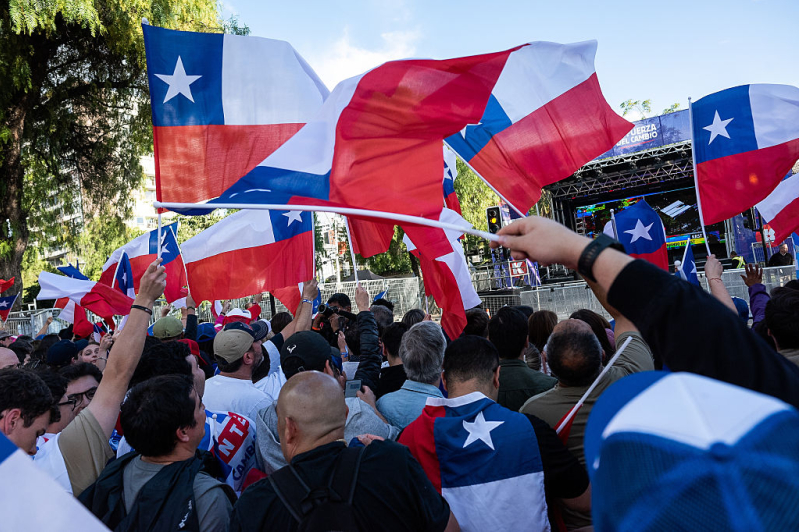
After José Antonio Kast’s victory was confirmed in Chile’s presidential election on Sunday (Dec. 14), evangelical leaders across the country expressed optimism and gratitude, describing the result as both a political shift and a response to sustained prayer.
According to Diario Cristiano Internacional, Christian Daily International's Spanish edition, the Republican Party candidate won by a historic margin. Several pastors and Christian political leaders said the outcome reflected not only voter dissatisfaction with the previous administration but also what they described as God’s will.
The evangelical community played an active role during the campaign and views the president-elect as an ally on moral and spiritual issues. Speaking from Santiago, Pastor Hernán Pérez Landeros told Diario Cristiano that the result was “a victory the evangelical people were hoping for.”
For many churches, the election carried spiritual significance beyond politics. Pérez Landeros said prayer mobilization was widespread among evangelicals. “Many evangelicals participated in the elections, and the vast majority of the evangelical community was praying for God to allow José Antonio Kast to become the president of Chile,” he said.
Kast, who has taken firm positions on public security and family-related issues, gained support amid concerns over crime and social instability.
Pérez Landeros said Kast’s relationship with evangelical leaders contributed to that support. He described the president-elect as a believer who maintains “very good relationships with all pastors” and noted that one of the vice presidents of Kast’s party is “an evangelical Christian sister.”
“We were praying for God’s will to be done, and His will was done in such a way that José Antonio Kast became our future president,” Pérez Landeros said.
Kast’s victory was also welcomed by conservative political groups that united to avoid splitting the vote. The Social Christian Party, which includes several evangelical lawmakers, played a key role in the campaign.
Rep. Francesca Muñoz withdrew her own presidential bid months earlier to back Kast, calling for unity “out of love for Chile.” Rep. Sara Concha, president of the Social Christian Party, also urged opposition groups to unite, citing concerns over public safety and what she described as the influence of the “radical left.”
Christian lawmakers said the election outcome validated their strategy and reinforced their commitment to defending life, family and civil liberties.
Benjamín Lorca, newly elected as a deputy for the Republican Party, described the result as an “exuberant and very decisive victory” in comments to Diario Cristiano.
Lorca said Kast won in every region of the country and secured majorities in all but 33 of Chile’s 346 municipalities, making him the most-voted presidential candidate in the nation’s history.
Despite the scale of the victory, Lorca said the next administration faces urgent challenges. He described it as an “emergency government” tasked with addressing irregular immigration, public safety and economic stagnation.
“We are at a critical moment as a country,” Lorca said, citing high levels of insecurity and declining foreign investment.
Religious leaders said the vote reflected public frustration with the outgoing administration. Pérez Landeros criticized the previous government as inexperienced and said it governed in ways “contrary to the Word of the Lord and to good moral values.”
Lorca said voters were seeking a “radical change,” adding that Kast represents “moderation, common sense and prudence.”
He pointed to the unrest following the 2019 protests as a turning point and said the president-elect symbolizes hope for restoring democratic institutions, family values and national stability.
Bishop Emiliano Soto Valenzuela, president emeritus of the Expanded Board of Evangelical and Protestant Entities, also welcomed the election results.
Speaking from Santiago, Soto said Kast’s victory for the 2026–2030 term was “very good news” for a large segment of the evangelical community. He said the president-elect aligns with principles the church has long supported.
Soto said he expects greater openness toward churches under the new administration and increased inclusion in national initiatives.
“There will be greater participation,” he said, adding prayers and blessings for the country.
Lorca said public sentiment during the campaign suggested a decisive outcome. “On the streets, we felt this was coming,” he said.
Pérez Landeros said evangelicals are optimistic about the transition ahead. “We are happy and grateful,” he said, crediting both prayer and political engagement.
Church leaders and Christian lawmakers said they plan to support the incoming administration as it addresses security, economic and social challenges, while advancing policies aligned with faith-based values and democratic principles.
Original reporting by Diario Cristiano, Christian Daily International's Spanish edition.