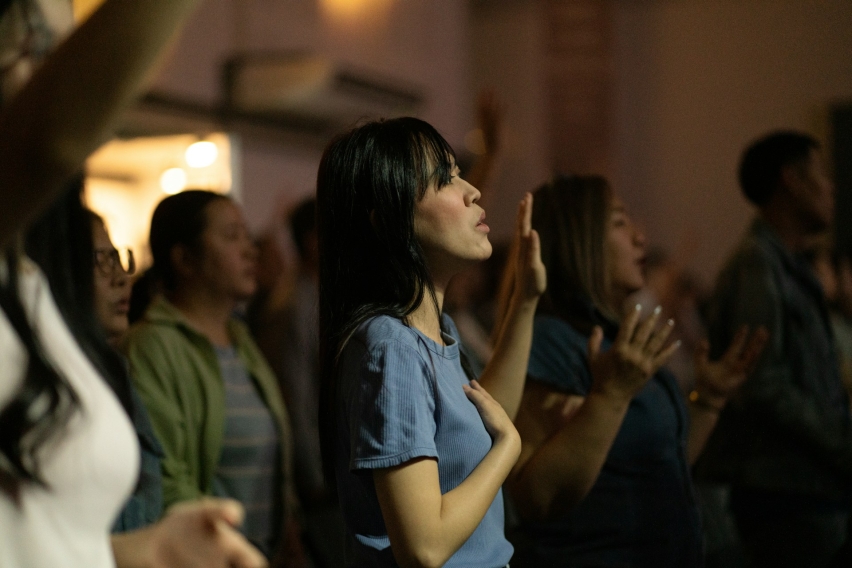
At the D6 Asia Online Family Conference 2026 on May 16, speakers Daniel Lim and Vania Christian encouraged churches and families to work together in guiding children and teenagers through seasons of faith questioning and spiritual formation.
The panel session, titled “Formed; Not Lost: Arresting Faith Drift in Children and Youth Through Family Discipleship,” focused on the growing challenges parents and ministry leaders face as younger generations wrestle with faith, identity and cultural pressures.
The D6 Family movement, based on Deuteronomy 6, seeks to equip churches and families for generational discipleship by connecting church and home. Supported by the Asia Evangelical Alliance Family & Children Commission, D6 Asia conferences encourage churches and families across Asia to work together in passing on faith to the next generation.
Lim, a father of three young children, spoke about the shifting nature of faith questions among younger generations. He said previous generations often focused on apologetic questions surrounding science, miracles or the existence of God, but many young people today are asking deeper moral and relational questions about the character of God.
“The question people ask today is actually, ‘Is God good?’” Lim said.
He said many young people are reevaluating long-held beliefs through what is commonly described as “deconstruction,” a process of questioning and rethinking previously accepted ideas.
Lim acknowledged concerns surrounding deconstruction within Christianity but argued the process itself is not always entirely negative. Instead, he said the outcome depends on what beliefs are being challenged and what replaces them afterward.
“No one actually stays at deconstruction alone,” he said. “We always have to believe in something else.”
According to Lim, some forms of deconstruction may lead people away from historic Christian beliefs, while other forms may help individuals reject unhealthy teachings and rebuild a more biblically grounded faith.
“If you’re deconstructing something that is incompatible with Christianity and your goal is to grow as a Christian, then you have a chance now to reconstruct with something better,” he said.
Lim said many younger Christians today struggle with parts of Christianity they perceive as difficult or uncomfortable, especially teachings involving accountability, sin and moral boundaries. He attributed this partly to broader cultural narratives emphasizing personal truth, justice and individual experience.
“The big questions have really shifted from ‘What is God?’ to ‘Who is God and why?’” he said.
Despite these tensions, Lim encouraged participants not to approach accountability in coercive or condemning ways but through grace, mercy and restoration.
“The point about judgment in Christianity is not to make someone feel bad, but toward recovery,” he said.
During the question-and-answer session, participants asked how churches should respond when teenagers raise difficult questions about violence and war in the Bible, particularly in books such as First and Second Kings.
Lim acknowledged that such questions are emotionally and spiritually difficult, especially for younger believers trying to reconcile God’s goodness with scenes of judgment and conflict in Scripture.
“I think it’s fair to acknowledge firstly the pain of war, because even God himself doesn’t delight in the suffering of people,” Lim said.
At the same time, he said Christians must wrestle honestly with the biblical theme of justice and God’s response to sin.
“God allows wars to happen and sometimes even as a tool of judgment for disobedience and sin,” he said. “If we understand sin from God’s perspective, it is utterly ugly.”
Lim said many people naturally long for justice when wrongdoing occurs, particularly when loved ones suffer harm, and argued that this desire reflects humanity’s deeper understanding that evil must ultimately be confronted.
“There is this sense of justice that does reflect what is the demand of holiness from God,” he said.
While emphasizing that Christians should never celebrate violence or human suffering, Lim encouraged churches to help young people approach such passages with humility and a broader understanding of God’s holiness, justice and mercy rather than reducing the issue to simplistic answers.
Vania Christian, executive director of Leadership and Discipleship Foundation and the Asia Evangelical Alliance Youth Commission, focused her remarks on the importance of mentorship and spiritual community in helping teenagers develop lasting faith.
“When children grow up in Christian families, it is often easy for them to believe what they are taught, but that does not always mean the faith has become their own faith yet,” she said.
Christian said adolescence is often a critical stage where teenagers begin questioning inherited beliefs as they seek personal ownership of their faith.
“This is not just a deconstruction of faith, but rather the beginning of ownership of faith,” she said.
Drawing from research involving approximately 1,400 Indonesian teenagers in 2024, Christian said young people with healthy spiritual mentors and strong youth communities were significantly more likely to pursue spiritual growth intentionally.
According to the research, teenagers connected to mentors and Christian communities were roughly twice as likely to engage in spiritual habits, church involvement and discipleship compared to those lacking such support systems.
“Mentors and community matter deeply for young people,” Christian said.
She emphasized that parents remain essential in discipleship but should not attempt to carry the responsibility alone.
“There is no perfect parent in this world and there is absolutely no parent who can disciple their youth or teenagers alone,” she said.
Instead, Christian encouraged churches to create intergenerational partnerships between parents, mentors and youth leaders to support teenagers through difficult questions and spiritual struggles.
“Parents move from being the sole disciplers to becoming shared disciplers,” she said.
Christian also encouraged churches to prioritize authentic relationships over programs alone, saying young people are searching for meaningful connection and safe spaces where they can wrestle honestly with questions about faith.
“They need community, not just great programs,” she said.
She encouraged parents to help teenagers connect with youth groups, mentors and healthy Christian friendships while maintaining communication with church leaders and ministry mentors.
“Very often young people discover their own answers while helping others wrestle with questions about faith,” Christian said.
The panel concluded with both speakers emphasizing the importance of churches and families working together to raise a generation whose faith is deeply rooted, personally owned and spiritually resilient.