
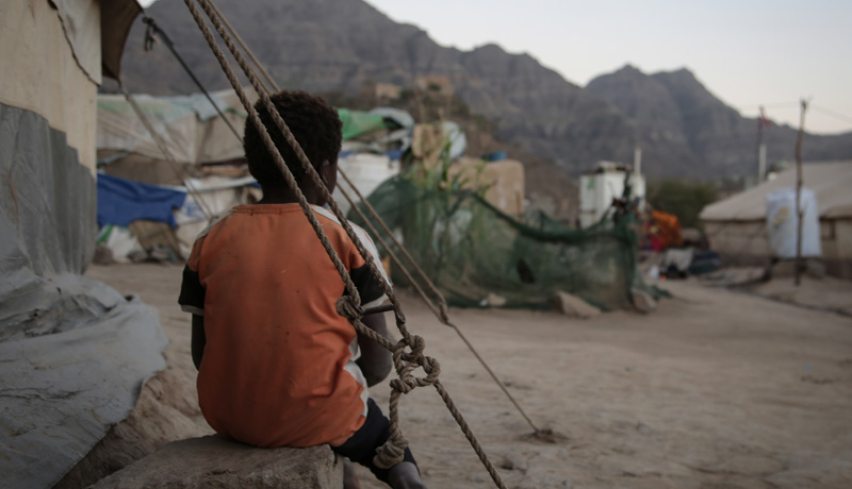
In Yemen, there are few churches left to burn, few congregations able to gather openly, and few Christian leaders who can speak publicly without endangering themselves or others. The persecution of Christians in Yemen is so complete that it has made them disappear from the world’s view.
Yemen is discussed as a humanitarian disaster, and an exporter of terror, and rightly so. More than a decade of war between the Houthi terror groups and a Saudi-backed Arab coalition, has devastated the country. Al Qaeda has stepped into the power vacuum that has been created in the more rural regions.
More than 22 million people require humanitarian assistance and protection.
In 2026, the United Nations estimates that more than 22 million people require humanitarian assistance and protection, including 5.2 million internally displaced people. Acute food insecurity affects 18.3 million people, and more than 2.2 million children under five are acutely malnourished. Essential services are collapsing, with barely six in ten health facilities functional.
At least 95 percent of Yemen’s Christians converted from Islam.
Within this catastrophe, Christians suffer like millions of other Yemenis. Yet they are also trapped between a collapsed state, armed Islamist movements, tribal enforcement of religious conformity, and a society in which conversion from Islam is treated by many families and communities as a betrayal punishable by death. At least 95 percent of Yemen’s Christians converted from Islam.
This is the defining feature of Christian persecution in Yemen: it is intimate as well as political. In some countries, the main danger comes from the state. In others, from militias. In Yemen, persecution operates through every level of social authority: the armed group, the mosque, the tribe, the checkpoint, and the family home.
Dozens of loosely organized Christian communities stopped gathering even in private because of heightened security threats.
They are seen as defectors, traitors, or even foreign agents. Between October 2023 and September 2024, dozens of loosely organized Christian communities stopped gathering even in private because of heightened security threats.
The Houthi radicals
The Houthis, who control Sana’a and much of north-western Yemen, have imposed an increasingly ideological system of rule with strict control over education and the media. Those who reject Houthi religious impositions have fled south or left Yemen altogether; those who remain often stay hidden for fear of intimidation and violence.
Christianity is the second oldest surviving religion in the country.
Houthi and Iranian propaganda presents the community as imperialist, and those converts from Islam as apostates who have betrayed their faith. Despite this, Christianity is the second oldest surviving religion in the country, after Judaism, having reached South Arabia by late antiquity.
By the sixth century AD, the region was home to a celebrated Christian community whose leader, Ḥārith ibn Kaʿb, later venerated as St Arethas, was killed in the persecutions of Dhu Nuwas. USCIRF (US Commission on International Religious Freedom), reports that Yemen’s Christian community once numbered around 41,000, including Yemenis and expatriates, but has fallen to only a few thousand as war and repression have driven many out.
UN... staff were reportedly pressured to confess falsely on camera that they worked for “Christian interests”.
During the Houthi crackdown on UN personnel, some staff were reportedly pressured to confess falsely on camera that they worked for “Christian interests” and were spies. In other words, “Christian” becomes not only a religious identity but a category of political treason. The believer is imagined as an agent of the West; the humanitarian worker is recast as a missionary conspirator; the convert is a traitor.
Since 2015, the Houthis have made nearly 500 modifications to Yemen’s school curriculum. All religious minorities, including Christians, are forced to study the Qur’an in Houthi education programs.
One Christian family fled a Houthi-controlled area so their children would not be forced into mosque prayers.
A teenage Christian brother and sister were reportedly expelled from school for refusing to take part in Houthi Qur’an lessons, while one Christian family fled a Houthi-controlled area so their children would not be forced into mosque prayers and indoctrination camps—camps which seek to eventually press them into armed militias.
Many are isolated believers, secret households, tiny networks, or displaced converts whose greatest danger may come from those closest to them. Female Christian converts can face isolation, confiscation of phones, abuse, forced marriage, or honor killing.
No safety in the south
In the south, where the internationally recognized government nominally holds authority, the state is weak and fragmented. Al-Qaeda in the Arabian Peninsula and other radical Islamist actors continue to exploit power vacuums to coerce the government and religious minorities.
Houthi hospitals refusing medical treatment to Christians because of their religious identity.
USCIRF reports discrimination against Christians and Baha’is in the distribution of essential humanitarian aid, as well as cases of Houthi hospitals refusing medical treatment to Christians because of their religious identity.
We have become accustomed to speaking of Yemen in the language of ceasefires, Iranian proxies, shipping lanes, famine, and regional escalation. Houthi rocket attacks in the Red Sea, Israeli strikes, Saudi-Iranian competition, and the stalled peace process shape the fate of the country. Its geostrategic value means a blind eye has been turned to its minorities.
The tragedy of Yemen’s Christians is that persecution has become almost perfectly deniable. There are few images, few public funerals, few ruined churches for cameras to film. The evidence is found instead in congregations that no longer meet, families that flee without explanation, and converts who choose either silence or disappearance. Their suffering raises uncomfortable questions for Western governments and regional powers that see Yemen primarily through the lens of Iran, the Houthis, shipping lanes and counter-terrorism.
Persecution succeeds first by forcing people out of public view, then by persuading the world that those people were never really there.
The geopolitical stakes make Yemen’s Christians seem a low priority. It is easy to argue that their rights can be addressed later, once the war is over. But that is precisely how persecution succeeds: first by forcing people out of public view, then by persuading the world that those people were never really there.
Azeem Ibrahim is the Chief Strategy Officer at the New Lines Institute for Strategy and Policy and a columnist at Foreign Policy magazine. He has written extensively on the persecution of religious minorities, including essays for Foreign Policy on the targeting of Christian communities in Myanmar and China. See Azeem's website for more information: https://www.azeemibrahim.com/.








