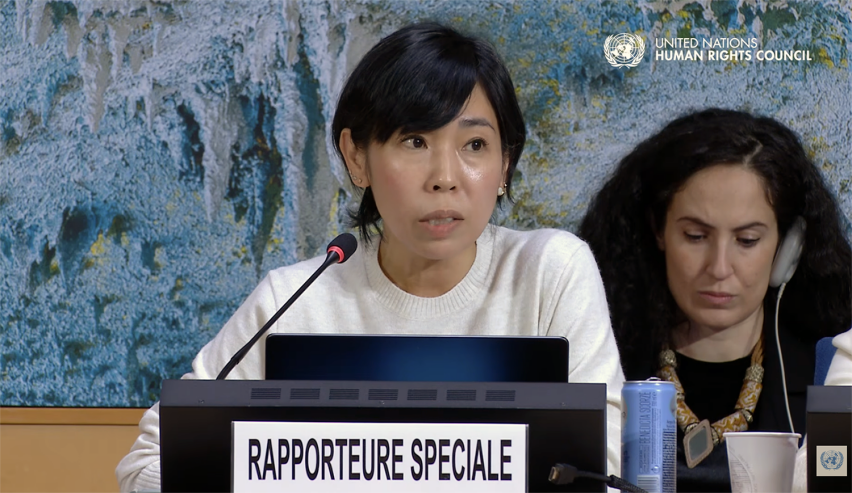
Iran has replied to only one of the eight communications U.N. human rights experts have sent it about Christians since 2011, and that single reply described Christian converts as a threat to national security, according to the U.N. Special Rapporteur on the situation of human rights in Iran.
Dr. Mai Sato, who has held the mandate since August 2024, made the remarks in an interview with Article18, a group that monitors religious freedom in Iran.
In the conversation, Sato set out the limits of her role, the U.N. record on Iran's Christians, the seizure of St. Peter's Evangelical Church in Tehran and the use of national security charges against house-church members. She also acknowledged that amid war and mass protests in Iran, the situation of Christians "hasn't always received the attention that it deserves."
A mandate without access to the country
Sato said the post is independent of the U.N. staff structure.
"This is an unpaid role, so I'm not an employee of the United Nations," she said.
Her full-time work is as an academic at Birkbeck, University of London.
The role is defined by a resolution of the Human Rights Council, the body of U.N. member states that created it. Under that resolution, Sato is tasked with monitoring civil, political, economic, social and cultural rights in Iran and measuring progress in the implementation of recommendations.
The mandate gives her four main tools. She submits two reports a year, to the Human Rights Council in March and to the General Assembly in late October. She can send communications, which are allegation letters to the Iranian authorities on specific cases, sent alone or jointly with other U.N. experts and published on a public U.N. database together with any government reply. She engages publicly through press statements and media.
She can conduct country visits, but they do not include Iran.
"The Iranian authorities don't recognize the legitimacy of my mandate, so I can't go to Iran, and that's been the case since the reestablishment of this mandate in 2011," Sato said.
Instead, she visits third countries with large Iranian diaspora communities. Other U.N. rapporteurs, including experts on unilateral coercive measures and on housing, have been admitted to Iran, she noted, but not the rapporteur on Iran.
Eight letters, only one reply
According to Sato, the U.N. communications database lists eight communications concerning Christians in Iran since 2011. All but one concerned the arrest and detention of Christians, most of them converts.
The exception is the most recent, a joint communication on the confiscation of the St. Peter's Evangelical Church compound in Tehran and on the Armenian and Assyrian Christians who lived there. Sato described it as "qualitatively different" from earlier cases because it concerned property and members of Iran's recognized Christian minorities rather than converts.
St. Peter's is the oldest Protestant church in Iran. In July, authorities moved to transfer it to the Execution of Imam Khomeini's Order, a state-controlled organization that confiscates religious and private property, enforcing a Revolutionary Court ruling from the late 1990s, International Christian Concern reported. Authorities seized the compound on July 12, a month ahead of the deadline they had set and days after the U.N. communication was sent, and posted guards outside. The remaining residents, 27 Armenian and Assyrian Christians, were evicted.
Sato and Nazila Ghanea, the U.N. Special Rapporteur on freedom of religion or belief, called for the seizure to be reversed in a joint statement, describing it as part of a long pattern of measures against Iran's Christian community, and in particular against Persian-speaking Christian worship. Iran once had around 50 Protestant churches, most of them offering services in Persian. Today there are effectively none, the experts said, as they have either been closed or have had to stop holding services in Persian.
Iran has not responded to the communication.
'National security' and the house church
The only Iranian reply on record answered the 2020 communication. Sato said it followed a familiar pattern: "the whole narrative around labeling Christians, Christian converts as sort of a threat to national security."
The reply used charges such as propaganda against the state and stated that those named had been convicted of national security offenses, not for converting to Christianity. Iran's reply, like the communication it answered, is published on the U.N. database.
She said the reply also drew a distinction that runs through Iran's treatment of Christians. Persian-speaking Christians, most of them converts from Islam, were presented as a threat to national security, while the authorities emphasized that they recognize the country's Armenian and Assyrian Christian communities.
That recognition did not prevent the evictions at St. Peter's. The 27 residents removed from the compound belonged to those recognized communities, the feature Sato said set that communication apart from all earlier U.N. letters on Iran's Christians.
The conduct behind such charges, she said, is often ordinary religious practice.
"You have all these national security offenses, but when you actually look at the acts, it's sometimes like gathering of house churches or dissemination of information," she said, adding that the information in question was probably the distribution of Bibles.
She recalled one case in which a man was labeled a spy after traveling abroad to take part in church activities.
'Authorities know that we're watching'
Asked how she responds to those who question the value of the mandate when Iran rarely answers, Sato said she understood the frustration, but that expectations should match the role.
"The main objective and the power that I have is to monitor and to report," she said. "I don't have any enforcement powers to make Iranian authorities do X, Y, and Z. I also don't have the power to make states do X, Y, and Z."
Demands that she do more, she said, are "almost like asking a journalist to stop an execution by writing a piece about it."
She said impact is difficult to measure, and prevention harder still.
"Authorities know that we're watching. Does that mean the next church confiscation may not happen, or would it be delayed? We'll never be able to measure that."
Sato views the mandate's value in the record it creates. Without it, she said, there would be no official U.N. record of cases and of what victims and their families endured that differs from the state narrative. She considered it as a truth-telling function and a means of preserving evidence that could serve future accountability mechanisms "if there is a fundamental change in governance."
The immediate and near-term impact, she acknowledged, is harder to see. For that, she said, governments carry greater responsibility, because the mandate exists at their initiative.
"It's the states that basically create the mandate to monitor and document," Sato said. "There's a lot of evidence, then what would the states like to do after creating the mandate?"
She suggested governments could do more, whether through longer-term accountability or through political and diplomatic channels.
'Your every day matters'
Sato said that since she took up the mandate, Iran has been through the 12-day war, a severe crackdown on nationwide protests and the current war, and much of her attention has gone to the right to life and to political prisoners facing execution. Because contacting her directly is risky under Iran's espionage law, she relies on civil society organizations to document cases and serve as a secure channel for victims and their families.
That focus, she acknowledged, has meant the situation of Christians and converts has not always received the attention it deserves, although her mandate covers all human rights. The right to life underpins every other right, she said, but "living isn't just about having oxygen to breathe and having enough food to eat." It also means being able to practice one's faith and find meaning in work and family without fear.
"Your every day matters to my mandate, not only when you're arrested or detained or imprisoned," Sato said in a message to Christian prisoners of conscience and their families.
She urged them to keep sharing their experiences with her mandate, directly or through trusted organizations, "whenever it's safe to do so."