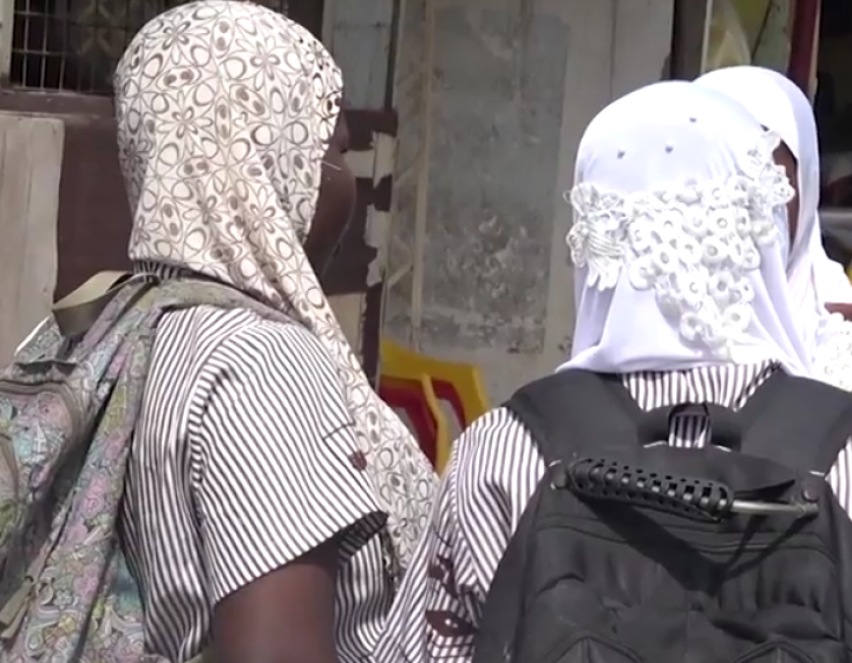
Two landmark court cases in Nigeria and Ghana are putting religious freedom in schools under judicial scrutiny, as judges weigh whether constitutional rights allow students to practice their faith even when it conflicts with the rules of private and mission schools.
An appeals court in Nigeria has ruled that private schools may enforce their own dress codes even when they conflict with students' religious preferences, drawing a legal distinction between public and private education that could shape future debates over religious freedom in the country's schools.
In a split 2-1 judgment delivered in Ibadan, the Court of Appeal overturned an earlier ruling by the Oyo State High Court that had allowed female Muslim students at the International School, University of Ibadan to wear the hijab as part of their school uniform.
The majority held that the school, commonly known as ISI, is a private institution whose dress code forms part of the agreement accepted by parents and students upon enrollment. As a result, the court said, a landmark Supreme Court decision permitting the hijab in public schools in Lagos State could not automatically be applied to the case.
In neighboring Ghana, the country's Supreme Court is considering a constitutional challenge over whether mission schools can restrict the religious practices of Muslim students.
The case, brought against Wesley Girls' High School, questions whether school policies limiting the wearing of the hijab and other religious observances violate constitutional guarantees of freedom of religion.
Earlier this month, the Supreme Court allowed the National Catholic Secretariat and the Presbyterian Church of Ghana to join the proceedings, underscoring the broader constitutional and public interest issues at stake. Ghana's Attorney General has opposed the challenge, arguing that Wesley Girls' High School, established by the Methodist Church Ghana, is entitled to preserve rules consistent with its religious traditions.
According to the Attorney General, the school's faith-based character permits it to enforce standards of conduct and religious observance, even where those rules may limit the expression of other religions within the school.
Public vs private schools
In Nigeria, the ruling means the school may prohibit the hijab as part of its uniform policy, distinguishing the case from earlier Supreme Court decisions that apply to public schools.
“The Supreme Court judgement, which granted the use of hijab, was in respect to a public school in Lagos State,” Justice Biobele Georgewill said while delivering the lead judgment.
He added that “the judgment of the lower court allowing female Muslim students to wear hijab on their school uniforms in ISI, a private school, is set aside.”
Justice K.I. Amadi agreed with the decision, forming the majority that allowed the appeal filed by the University of Ibadan, the school's management and other appellants. Justice Fadawu Umar dissented, saying the appeal should have been dismissed and that the earlier High Court ruling should have been upheld.
However, the court temporarily halted the enforcement of its own ruling that allowed the University of Ibadan International School to enforce its dress code, ordering all parties to maintain the status quo while it considers an application to stay the judgment pending a planned appeal to the Supreme Court.
The case marks the latest chapter in a legal dispute that has drawn national attention because it tests the balance between constitutional guarantees of religious freedom and the authority of private institutions to establish and enforce their own rules.
Section 38 of Nigeria's Constitution guarantees every citizen the right to freedom of thought, conscience and religion, including the freedom to manifest religious beliefs. Previous court decisions have affirmed that Muslim students attending public schools cannot be prevented from wearing the hijab where doing so would violate those constitutional protections.
The Court of Appeal, however, found that the legal circumstances surrounding a private school are fundamentally different.
Together, the two cases illustrate how courts across West Africa are increasingly being asked to define the balance between constitutional religious freedoms and the autonomy of faith-based educational institutions.
Justice Umar, in his dissenting opinion, concluded that the appeal lacked merit and would have affirmed the earlier High Court judgment recognizing the students' right to wear the hijab.
The case has been adjourned until Oct. 7, when the court is expected to hear arguments on whether enforcement of its judgment should remain suspended as the legal battle over religious freedom and the autonomy of private schools continues.
Although the two cases remain at different stages, they underscore a growing legal debate across West Africa and in other parts of the world where the autonomy of educational institutions has clashed with religious beliefs. In 2004, France banned the Hijab and other religious attires and symbols in public schools.