
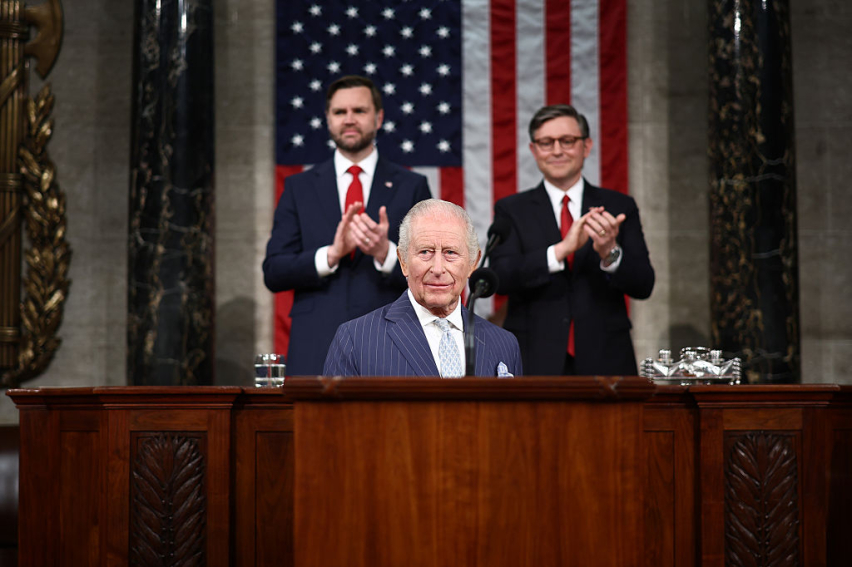
King Charles III told the U.S. Congress on Tuesday, April 28, that Christian faith, democratic tradition and a shared commitment to peace remain central to the alliance between the United Kingdom and the United States as both nations face growing global instability. 
Addressing a joint meeting of Congress during the United States’ semiquincentennial year marking 250 years since the Declaration of Independence, the British monarch spoke repeatedly about faith, reconciliation and international cooperation, while also referencing conflicts in Europe and the Middle East, the war in Ukraine and concerns about rising division and violence. 
The speech marked the first address by a British monarch to Congress since Queen Elizabeth II spoke there in 1991. Charles referred several times to his late mother, recalling that she had also addressed lawmakers “under the watchful eye of the Statue of Freedom above us.” 
“For many here and for myself, the Christian faith is a firm anchor and daily inspiration that guides us,” Charles said. “It is why I believe with all my heart that the essence of our two nations is a generosity of spirit and a duty to foster compassion, to promote peace, to deepen mutual understanding, and to value all people of all faiths and of none.” 
His remarks placed faith within a broader appeal for cooperation across political, national and religious differences. Charles said his decades of work in interfaith engagement had strengthened his belief that people of different faiths can grow in mutual respect through deeper understanding of one another. 
“It is my hope, my prayer, that in these turbulent times, working together and with our international partners, we can stem the beating of plow shares into swords,” he said, reversing the biblical image from the Book of Isaiah about turning weapons into farming tools. 
Charles also referred to the Easter season, describing it as “the season that most strengthens my hope.” 
The king framed many of his comments around what he described as shared democratic and legal traditions linking Britain and the United States. He cited Magna Carta, the English Bill of Rights of 1689 and the American Bill of Rights, arguing that both countries continue to draw strength from principles rooted in liberty, representative government and the rule of law. 
“In both of our countries, it is the very fact of our vibrant, diverse and free societies that gives us our collective strength,” he said. 
Charles opened the address by referring to the recent assassination attempt on President Trump during the White House Correspondents’ Dinner, condemning what he described as an effort “to harm the leadership of your nation and to ferment wider fear and discord.”
“Such acts of violence will never succeed,” he said. 
The king repeatedly linked moral conviction with public responsibility, particularly in relation to security and international conflict. Referring to NATO, the Sept. 11 attacks and the war in Ukraine, he said democratic nations must continue working together to defend freedom and secure “a truly just and lasting peace.” 
He described the current international environment as “more volatile and more dangerous” than the world in which Queen Elizabeth II addressed Congress in 1991. 
Charles also spoke about environmental concerns, warning against ignoring what he called the “collapse of critical natural systems.” He said the protection of nature should be seen as part of a shared responsibility between nations and generations. 
Throughout the address, the monarch mixed formal reflections with lighter remarks about history and the long sometimes difficult relationship between Britain and the United States. Referring to the American Revolution, he described the founding fathers as “bold and imaginative rebels with a cause.” 
Closing the speech, Charles urged both countries to resist isolationism and to renew their partnership in service to others.
“I pray with all my heart that our alliance will continue to defend our shared values with our partners in Europe and the Commonwealth and across the world,” he said. “Let our two countries rededicate ourselves to each other in the selfless service of our peoples and of all the peoples of the world.” 








