Evangelical leaders from Paraguay, Costa Rica, Spain, Colombia and Uruguay discussed missions, pastoral care, church credibility and child protection on Thursday (Oct. 15) at the general assembly of the Latin American Evangelical Alliance (AEL) in San José, Costa Rica.
The panel, titled "The Mission of the Alliances: Challenges and Good Practices," brought together leaders and representatives of Ibero-American federations. It focused on five themes facing representative organizations in the region: missionary outreach to unevangelized ethnic groups, holistic care for pastors, the public and internal credibility of the church, strategic connection in response to real needs, and the training and support of Christian workers.
The panelists also agreed that churches must end institutional silence on abuse and turn to the civil and criminal courts.
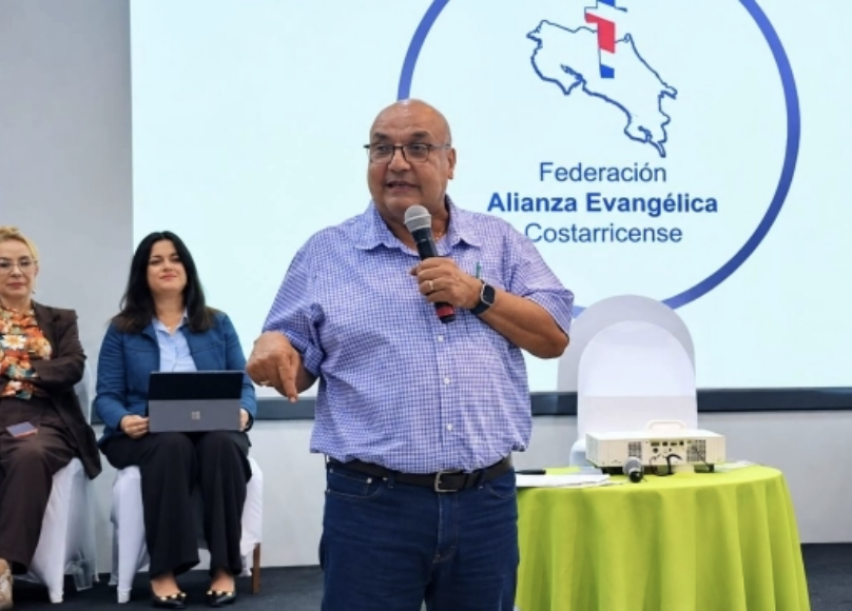
The panel featured Alcides Román, president of the Association of Evangelical Churches of Paraguay (ASIEP); Pastor Ronald Vargas Badilla, president of the Costa Rican Evangelical Alliance Federation (FAEC); Carolina Bueno, executive secretary of the Spanish Federation of Evangelical Religious Organizations (FEREDE); Pastor Lyda Arias, president of the Evangelical Confederation of Colombia (CEDECOL); and Pastor Louder Garabedian, president of the Evangelical Representative Council of Uruguay (CREU).
From mission field to mission force, and the challenge of generational succession
Román, a Paraguayan pastor, gave the first presentation. He focused on the growth of the Latin American missionary movement 39 years after the 1987 São Paulo declaration, when Luis Bush said Latin America was ceasing to be a mission field and becoming a mission force.
Citing records from the Alcance una Etnia (Reach an Ethnic Group) movement, Román said there are 15,128 unreached peoples in the world. Of those, 4,727 ethnic groups are considered completely unreached, and for 1,105 of them there is no information or they are entirely unknown.
He said Paraguay, despite historically being one of the least evangelized countries in the region, now has 129 missionaries serving in cross-cultural contexts around the world.
This work is coordinated through the National Missionary Cooperation (CONAMI), a missionary arm that works closely with ASIEP and the Pastors' Association (AP).
The three bodies have jointly committed to adopt 100 of the 4,727 completely unreached ethnic groups through daily prayer and mobilization. They also circulate profiles of missionary families daily to encourage intercession in local congregations.
New strategies amid the transition in missionary support
Román drew on 20 years of local pastoral ministry and 13 years of direct service among the Indigenous peoples of Paraguay, a period during which he directed a German mission focused on Indigenous communities.
He said he saw firsthand the decline in workers and resources sent from Europe. When he took on his role, there were 20 German missionary couples. Today only one German couple and one single German woman missionary remain, and most have been replaced by Latin American workers.
Román said the aging of European congregations reduced traditional offerings. That forced a rethinking of sustainability and mobilization under a new generation of leaders. His son now heads the mission.
Describing a recent tour in Germany, he cited the experience of the new leadership in presenting projects to businesses and youth groups.
"They accepted 100% the challenges we presented to them. The traditional way in which I had to work does not reach young people. Young people need to be reached with other challenges, other goals, so that they can respond. So I believe the church needs to learn new ways of reaching the new generation, so that all these peoples that still remain to be evangelized, we can reach them with the same gospel, with another generation, but with another strategy."
Dignifying the ministry and engaging with the state in Costa Rica
Vargas addressed pastoral care and the defense of ministerial rights.
He opened by recounting an interreligious meeting at the Presidential House, convened by the executive branch under then-President Rodrigo Chaves to address violence in the country, where he demanded equal treatment from government authorities.
"The minister of communication said this: 'Well, and here we have Bishop So-and-so, who is with us, and here we have little Pastor Ronald Vargas.' I said: 'Just a moment. I am not a little pastor; I am a spiritual authority, and I am to be respected.' And he was surprised and said: 'Well, the spiritual authority.' And every time I arrived, President Chaves would say to me: 'The spiritual authority has arrived.' Because we have learned that pastors have rights, and we work on the basis of those rights."
To put that support into practice, the Costa Rican Evangelical Alliance four years ago reactivated the College of Pastors (Colegio Pastoral), which had been inactive for 25 years. Its aim is to give the spiritual leaders of communities identity, professional representation and legal backing, much as professional associations do for physicians, engineers or lawyers.
Extension theological training and protocols in hospitals and prisons
Through the College of Pastors, the alliance launched an Extension Training Plan for pastors and leaders who did not have access to secondary or university education.
Offered at sites across Costa Rica, the program provides two years of training leading to a diploma in Bible and pastoral ministry. So far 1,200 pastors and leaders have graduated.
The organization also introduced an official ID card that costs $35 and is valid for two years. The card generates income for the alliance and also serves as an ethical check: to renew it, ministers must submit a letter of endorsement from their denomination or church authority certifying that their pastorate is current and that they are in good standing. The card also offers discounts through agreements with opticians, restaurants and hardware stores.
In the public sphere, the College of Pastors negotiated agreements with the prison system, the Ministry of Health and the Costa Rican Social Security Fund (CCSS). Vargas said that when ministers faced obstacles visiting the sick in hospitals, he filed a complaint with the CCSS executive presidency over the obstruction of religious freedom. He also committed to correcting the bad practices of some pastors who tried to hold services with lecterns and tambourines inside medical facilities.
"We are going to train pastors in how they should behave in hospitals; we are going to train them in how they should behave in prisons. And so we give them a workshop on how to minister in prisons and how to minister in hospitals so that what they are doing can have credibility. These institutions have the names of all the pastors; when a pastor arrives and presents that card, they know he is a pastor backed by the Costa Rican Evangelical Alliance."
As a result of this dialogue, spiritual care in hospitals now has an official regulation known to medical directors. The Ministry of Health also expedites operating permits for church buildings, which are renewed every five years, for accredited ministers.
Holistic health and generational transition among older pastors
Vargas also warned about the physical, emotional and financial condition of aging pastoral leaders in Latin America. He named four common ailments among pastors: diabetes, hypertension, depression and obesity. For that reason, the alliance runs seminars on ministers' emotional and physical health.
He said churches urgently need to plan for retirement and generational succession with financial foresight, and the alliance advises them on pensions and life insurance.
"Now we are working a great deal on the transition to new generations, because in Costa Rica 70% of us are 65 or older, and we already have to start thinking that within 15 years the church in Costa Rica will have to transition. We help them look at where they stand regarding their pension; we help them if they have any life insurance. We are attentive so that the church can know how to make that change and support the pastor, so that they don't tell him: 'Well, brother, God bless you, don't call us, we'll call you,' and he is left with nothing and becomes a burden on his children."
The three dimensions for recovering and sustaining the church's credibility
Bueno, of Spain's FEREDE, gave the third presentation. She spoke about the need to strengthen credibility both within congregations, to build trust in and commitment to the alliances, and externally, with civil society, governments and donors.
Drawing on Jesus' high priestly prayer in John 17 ("that they may be one so that the world may believe that you have sent me") and the call to self-examination in Psalm 139, she said Christian credibility is inseparable from the unity of the church and from ethical consistency.
"Credibility is not marketing; it is not having popularity or social prestige; it is not having wealth or enormous church buildings or many members. To have credibility we also don't have to be perfect — thankfully, because we are not. We need to be humble, to be able to acknowledge that we make mistakes, that we are sinners and are no better than others. Nor does Christian credibility consist in having everyone's approval or adapting the message of Jesus to social expectations; rather, it is offering reasons to trust through a faith lived out authentically, consistent ethical conduct and selfless service to one's neighbor."
Bueno distinguished between the rejection Christians suffer because of the gospel and the discredit that comes from their own sins, divisions and lack of integrity. She urged the alliances to evaluate themselves in three areas: spiritual, institutional-ethical and social-public.
Theological identity without political or economic instrumentalization
In the spiritual dimension, she said alliances must be recognizable by a clear theological identity grounded in the Scriptures, the centrality of Christ and salvation by grace through faith. That means firmness on essential doctrine, combined with generosity, respect and dialogue on secondary matters to make room for the diversity of evangelicals. She also warned about the risk of distorting the Christian message.
"An element that is very important for having spiritual credibility, from my point of view, is that we not instrumentalize the gospel for economic, partisan political or power purposes. The aforementioned linkage or instrumentalization distorts the message of Jesus and takes away, or will take away, our credibility in the future."
Good governance, financial transparency and verifiable social action
On institutional and ethical credibility, she cited Paul's principle in 2 Corinthians 8:20-21 of handling offerings honestly before the Lord and before people. She recommended effective bylaws, participatory rather than strongman-led governing bodies, compliance with tax obligations, clear budgets, accessible annual reports, reasonable pay and a strict separation between church and personal assets.
On the social and public dimension, she stressed concrete service to the common good without subordination to partisan interests.
"We need a voice that expresses visible unity, a voice that expresses cooperation by strengthening our common platforms, such as the AEL; we also need a public voice that is humble, truthful and open to dialogue, and a prophetic distance from political power."
During the question period, Pastor Christian Hooft, president of the Christian Alliance of Evangelical Churches of the Argentine Republic (ACIERA), asked about handling media crises in Spain and making community work visible. Bueno described the impact of documenting evangelical work rigorously. In 2022, she said, FEREDE commissioned a specialized polling firm to carry out a national study on evangelical social action. It found that Protestant churches rank fifth in Spain in the volume of social assistance, behind only the Red Cross, Cáritas and two other large organizations. The finding changed how politicians and authorities saw evangelicals when it was presented to them.
Spiritual intelligence and interdisciplinary work in managing the alliances
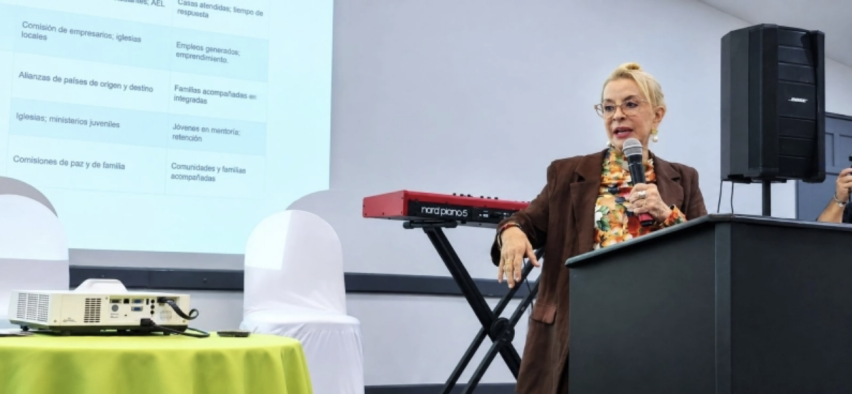
Arias, president of CEDECOL in Colombia, addressed the connection between strategy and need. She began by distinguishing vision from strategy: vision defines "the what" one wants to achieve, while strategy determines "the how" and the choice of the right tool for each circumstance.
Drawing on biblical accounts, including the organization of groups to feed the 5,000, the taking of Jericho, Jesus' visit to the house of Zacchaeus, and David trading Saul's armor for a sling to face Goliath, she questioned the church's tendency to spiritualize problems that require technical or professional action.
"I want to start from a truth that sometimes hurts us: we have a lot of anointing and little strategy. David did not defeat Goliath only because he had faith; he had faith, yes, but he won because he changed strategy. To every giant its sling; to every need its strategy. Sometimes we are praying about something that requires a lawyer. And with pastors, sometimes cases come to us and we spiritualize everything, and it turns out the person needs to go to the doctor, to be treated by a specialist."
Arias added that "not every battle is won by praying: some are won by praying, others are won by making a phone call; others are won by sitting down to negotiate." She gave as an example the steps taken during the week of the assembly to secure entry into the country for Pastor Gabriel and his wife, which required directly contacting a person with immediate access to the presidency.
Unity in the face of polarization, and delegation to specialists
Arias said an alliance cannot expect its president to master every discipline or attend every forum just to appear in a photograph. Instead, it must rely on qualified Christian professionals so as not to expose evangelicals to discredit in the media. When the Colombian Senate summoned her to discuss strictly legal matters, and when she was invited to international environmental summits in Cali, she delegated CEDECOL's representation to a specialized lawyer and to an internationally awarded Christian environmental researcher, securing high-level representation.
She also described how she became president of CEDECOL, the first woman and native of Cartagena to hold a post held for 75 years by men from Bogotá. After winning the election by four votes over Pastor Eduardo Gómez, she reached out to him directly to stop attempts at internal polarization.
"If there is an election that belongs to the people of God, you will never see me telling anyone: vote for me, because that is not of God. I was praying and I felt very uneasy about the polarization, and I called him and said to him: 'Pastor Eduardo, if you win, count on me; and if I win, I am counting on you.' We cried together and we prayed too. Today he is an extraordinary teammate; he has gifts that I don't have."
She used a similar approach with church leaders in the Colombian capital when CEDECOL needed a physical headquarters. She called together the pastors of the main congregations, beginning with Pastor Ricardo Rodríguez of Centro Mundial de Avivamiento. The Bogotá megachurches agreed to pay the rent for CEDECOL's office and the salary of one of its secretaries.
Pastoral calling, theological training and the priority of the family
Garabedian, president of CREU in Uruguay, gave the final main presentation, on the ministerial call, the training of workers and support for the family. A third-generation pastor, he said God's call comes together when there is "availability and intentionality," as in the case of the prophet Elisha.
Garabedian recalled the early years of his ministry with his wife, Mercedes, in extreme financial hardship. He walked eight kilometers in the dead of winter to serve a congregation of four elderly women, without pay and without asking for financial help.
"For 25 years in the exercise of the pastorate we began and ended the ministry by inaugurating a church. I could have asked for money because I needed it, but I didn't ask; nor did they offer it to me. I am not a beggar; I am a child of the King, and my King knows my needs, and I have no reason to tell people what I am suffering or what we are in need of. It is not pride; it is dignity."
He warned of what he described as an alarming lack of biblical preparation in today's Protestantism, and of the risks of emotionalism, syncretism with Judaizing symbols that displace the centrality of the cross, and ecumenism without doctrinal foundations.
"There is a great danger in the calling: many times we are exposed to a lack of theological preparation. Seminary is not just for finding a husband or a wife, but for preparing ourselves so that we are not like a wind of doctrine blowing here and there. And the lack of theological training is alarming at this moment in the evangelical church. The opposing clergy are prepared from head to toe, from A to Z. We are not; we are guided many times by emotion and very few times by reason. That brings with it dangers of immorality, of spiritual heresy, of deviation."
Bivocational pastoring and the role of the home in the face of paternal absence
Garabedian's comments on pastors' children and bivocational work drew some of the most audience participation, including contributions from Gómez and from pastors from Chile and Brazil. He said his own father, though a Bible teacher and seminary professor, was "a perfect stranger" to him because he was so often away for ministry. When Garabedian noticed he was repeating the pattern of the traveling preacher as his two children reached adolescence, he made a radical decision.
"When my daughter and my son were teenagers, I realized I was doing the same thing as my dad. So I chose to be a perfect stranger to others and known by my children. The essential point is that God's call is solitary, it involves suffering, it is incomprehensible."
He credited Mercedes with the decisive role in their children's spiritual formation at home while he worked 10 to 15 hours a day at a lumber company they founded to make ends meet. He urged pastors to break with church structures that prevent secular work when the congregation cannot cover a family's basic needs.
"Children turn out rebellious because of paternal absence; they turn out rebellious because of need in a materialistic, calculating, cold society; they turn out rebellious because we cannot meet their needs. And I want to be very blunt about this: be like the apostle Paul — go and put in your eight hours and then serve the Lord. Go and put in your eight hours, brothers and sisters, feet on the ground. Because if the church cannot support you, that is called mediocrity, complacency. Go and put in your eight hours and be an example to your children."
Zero tolerance for child abuse
In the final question-and-answer segment, a representative of a mission organization asked the panelists what concrete steps the alliances are taking to protect children and vulnerable people from all forms of abuse in churches.
The leaders agreed unanimously on ending institutional silence and on the obligation to turn to the civil and criminal courts.
Paraguay: Román said that for years, out of fear of staining the testimony of the gospel, some congregations kept silent about internal cases. But he said "the gospel cannot be stained — evangelicals can," and urged participation in public protection policies and speaking up about specific incidents.
Costa Rica: Vargas said that through the Children's Commission, pastors are trained under strict protocols. These include installing cameras in churches, never leaving minors alone with Sunday school teachers, and having women minister to other women. He said that in any crime, "they have to report it; they cannot stay silent. We can offer them restoration, but they cannot shake off the consequences."
Spain: Bueno said FEREDE runs national awareness and prevention courses under a zero-tolerance policy. Because the federation officially accredits ministers of religion before the Spanish state, it also requires an official criminal record certificate and a specific certificate covering sexual offenses.
Colombia: Arias said CEDECOL created its children's commission a year ago. It has drafted prevention protocols and is promoting training to raise awareness across all denominations.
Uruguay: Garabedian said CREU brings together 1,400 churches and has no administrative authority over denominations, but it holds a non-negotiable position against cover-ups. He recalled the case of a 73-year-old pastor reported for inappropriately touching a girl. CREU demanded that he appear before the ordinary courts. After the courts found him guilty, his denomination complained that the alliance had not defended him and chose to leave it. "We simply put him in front of it: 'Take responsibility, and that's that.' They resigned and left the Alliance. Between a greater evil and a lesser evil, I will always stay with the lesser," he said.
Original reporting by Diario Cristiano, Christian Daily International's Spanish edition.