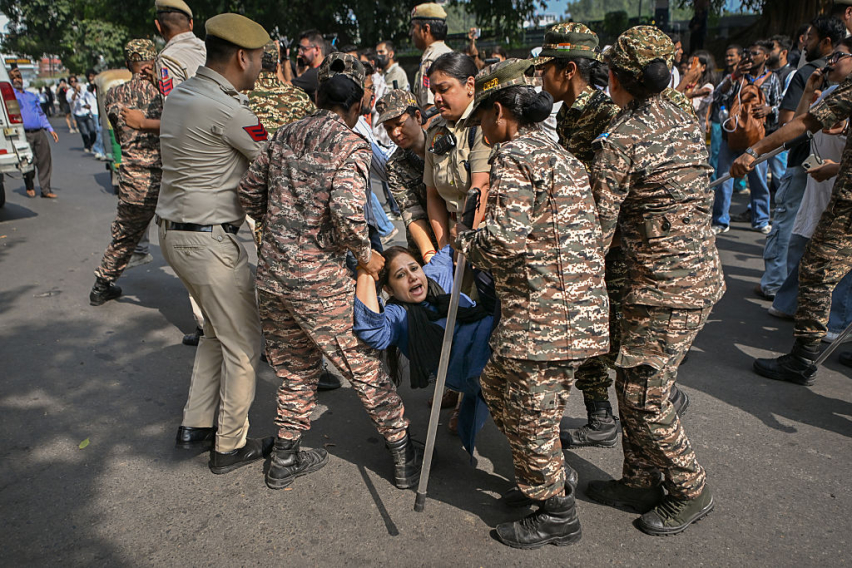
Delhi Police detained the founder and two senior leaders of a Gen Z protest movement aboard their plane Saturday, Oct. 10, as authorities shut dozens of metro stations, canceled more than 250 trains and deployed tens of thousands of officers to keep protesters away from the capital’s designated protest ground.
The Cockroach Janta Party (CJP) is demanding the resignation of Chief Election Commissioner Gyanesh Kumar over a nationwide revision of India’s voter rolls. Reports put the number of names removed or flagged at about 130 million. In India, the world’s largest democracy, a name missing from the roll means no ballot.
Opposition parties allege that eligible voters are dropping off the rolls, particularly religious minorities and women. The commission and the governing Bharatiya Janata Party (BJP) have denied any wrongdoing or political bias.
Police broke up flash protests across Delhi and held hundreds of the movement’s supporters in a stadium. Reported counts of those detained rose from about 1,000 to more than 7,000 during the day. Opposition leaders, including four former chief ministers, were among those held.
The Supreme Court had warned Friday that the transport restrictions appeared to be “overreaching.” The CJP says it will try again Sunday at 10 a.m.
Church leaders are watching. The Rev. Vijayesh Lal, general secretary of the Evangelical Fellowship of India, wrote on his personal blog that the day was “unprecedented and shameful.”
Reporting is current as of 2:30 a.m. Sunday, Oct. 11, India time. Figures come from different sources and are attributed accordingly.
What the fight is about
The Election Commission is the constitutional body that runs India’s elections and keeps the voter rolls. Its Special Intensive Revision began in the state of Bihar in June 2025 and now covers much of the country.
The 130 million figure, or 13 crore (one crore equals 10 million), covers names removed or flagged. The commission says most are draft-stage markings of dead, duplicate or relocated voters, not final deletions.
The Indian Express, a national newspaper, reported on Sept. 23 that the two other election commissioners had formally objected at least 14 times in 10 months to decisions made during the revision. On Oct. 5, the Supreme Court declined to suspend Kumar but ordered the commission to respond within a week.
The movement began as online satire, as CDI reported in June. “Janta” means “people” in Hindi, and the name mocks the BJP. It also echoes a May remark by Chief Justice Surya Kant about youth “like cockroaches,” which he later said targeted people with fake degrees.
The movement first took on leaks of NEET, India’s national medical school entrance exam. After hunger strikes and a police crackdown in July, Education Minister Dharmendra Pradhan resigned on July 25. On Sept. 25, the movement turned to the Election Commission.
A capital under lock
Delhi Police, which reports to the national government’s Home Ministry and not to Delhi’s elected government, refused permission for the rally at Jantar Mantar, an 18th-century observatory near Parliament that serves as the capital’s designated protest site.
Joint Commissioner of Police Nupur Prasad said the CJP applied on Oct. 7, though guidelines require 10 days’ notice. “This time the permission is rejected; it is not approved,” she said.
The CJP disputes that it needed permission. Spokesperson Saurav Das said the party notified Parliament Street police station instead: “Who is Delhi Police to give us permission?”
Section 163 of the Bharatiya Nagarik Suraksha Sanhita, India’s new criminal procedure code, was in force. The section lets authorities ban assemblies. Special Commissioner of Police Devesh Srivastava told the media that “no permission for such protest is granted” and that police had appealed to citizens to stay away.
Reports said 35,000 police and paramilitary personnel were on duty, and authorities suspended mobile internet near the central government district.
The Delhi Metro Rail Corporation announced the closure of 57 stations from 9 p.m. Friday. After the Supreme Court intervened, it said Saturday evening that 45 stations would stay shut until 10 p.m., a closure of 25 hours. Indian Railways canceled more than 250 long-distance trains.
Protesters detained on the way to Delhi
Authorities also tried to stop protesters before they reached Delhi. In one widely reported case, railway police removed 14 students from the Goa Express at Itarsi station in Madhya Pradesh state on the night of Oct. 8. Student leader Shravani Bua said the police “manhandled, dragged and forced the students out of the train.”
Delhi Police also detained CJP founder Abhijeet Dipke and party leaders Ashutosh Ranka and Saurav Das aboard their Mumbai-to-Delhi flight after it landed.
Dipke had expected it. In a video recorded Friday night but posted later, he said: “If you are watching this video, it means Ashutosh Ranka, Saurav Das, and I have been taken into custody. The movement does not end here.”
Ajinkya Shinde, named to lead the protest in their absence, spoke at a joint news conference of the CJP and allied student groups. “We will march to Jantar Mantar again tomorrow and stay there until all our demands are met,” he said.
A CJP member, Gaurav Bharti, has asked the Supreme Court to order authorities to produce Dipke, Das and Ranka and to disclose where they are held. His habeas corpus petition — a request that a court make the state justify a person’s detention — argues that refusing permission for a protest cannot justify indiscriminate detention. It also asks the court to preserve airport CCTV footage.
Flash protests across the city
As police kept nearly every protester out of Jantar Mantar all day, small groups demonstrated wherever they could. By evening, officers had taken in about 200 people at Dilli Haat, a crafts market.
At Sansad Marg, near Parliament, members of the Students’ Federation of India broke through a barricade. Police charged with batons and held about 30. Hundreds more were held at Chhatrasal Stadium, one of 15 designated detention sites.
Some protesters had spent the night at Bangla Sahib Gurdwara, a Sikh house of worship, and returned there after barricades blocked Jantar Mantar. Media reported that at about 1 p.m., police came “from behind the gurudwara walls” and detained people at the entrance. The CJP alleged that officers entered the premises. Videos shared on social media show police inside the compound; CDI could not independently verify them.
Opposition leaders were also among those held. Officers detained former Delhi Chief Minister Arvind Kejriwal outside his home. A chief minister is the elected head of a state government, similar to a U.S. governor. Former Chief Ministers Mamata Banerjee, Manik Sarkar and Pinarayi Vijayan were also detained.
In Mumbai, police held about 600 people at August Kranti Maidan (Ground), among them Tushar Gandhi, a great-grandson of Mahatma Gandhi.
Who was taken, and how many
No reliable national count exists. Figures in media reports rose through the day. Police sources put the number at about 1,000 by afternoon. Officials then said more than 3,000 by evening and more than 7,000 by 8 p.m. The CJP claims that more than 15,000 people nationwide faced detention or police action. None of these figures has been independently verified.
Shortly after midnight, most detainees had been released, except the CJP’s top leaders and YouTuber Dhruv Rathee.
On Saturday, the United Nations human rights office said it was “concerned by reports of mass detentions in India of demonstrators, protest leaders, members of civil society organisations, lawyers and journalists.” It added: “All those arbitrarily detained must be immediately and unconditionally released.”
Economist Jean Dreze, who was also detained, told The Indian Express that officers held 30 to 35 working-class and minority people who had no connection to the protest and took their phones.
Mayur Malkhede, a CJP activist from Ballarpur in Maharashtra state who had received a preventive police notice before the protest, was in Connaught Place, the central shopping district. “Almost all our CJP members were detained,” he told CDI. He said some were released at about 9 or 10 p.m. after being taken to a stadium.
Near RML Hospital, he said, police chased protesters, including women and children, and some ran inside the hospital to escape. He also said officers forcibly took away journalists and content creators.
In a message to CDI after midnight, Malkhede said police were following CJP members who had been released. Officers were also singling out CJP volunteers and other young people who had come to Delhi from other parts of the country, questioning them in their hotels, he said. Lawyers made a similar claim in the Supreme Court on Friday.
The court’s warning
On Friday, a Supreme Court bench led by Chief Justice Surya Kant heard petitions from M.A. Baby, general secretary of the Communist Party of India (Marxist), and others. The order said: “It appears that the notifications are overreaching, as they impose a complete ban upon essential public transportation.” The court clarified that “there shall be no outright prohibition on the movement of Metro trains.”
The chief justice said “a large group of ordinary people” were commuting and “have an equal right to movement as there is right to protest.” Precautions are fine, he said, but “that does not mean you should use a hammer to kill a fly.” Justice Joymalya Bagchi cautioned that a protest held without permission is open to prosecution.
Senior advocate Kapil Sibal asked: “What is happening in my country? Can we not protest peacefully anymore?” Solicitor General Tushar Mehta, the government’s second-highest law officer, answered: “It is our country.” He rejected the claim that the city was paralyzed.
The bench said it would not rule on the police refusal because no organizer was in court. It did not examine lawyers’ claims that police were going “mosque to mosque” to intimidate people and that hotels had been told not to register new guests. The court also asked the government to find a better-equipped protest site. Mehta agreed to consider it.
Sunday and beyond
The CJP has called supporters to Jantar Mantar at 10 a.m. Sunday. “Wherever the Delhi Police stops you, make that place your Jantar Mantar,” Shinde said. Delhi Police said the deployment would stay the same and that more metro and train measures could follow.
The Supreme Court will hold special hearings at 10:30 a.m. on a contempt petition against Home Secretary Govind Mohan, the Delhi Police commissioner and the Delhi Metro chairperson. It will also hear a plea by Trinamool Congress member of Parliament and senior advocate Menaka Guruswamy against the preventive custody of opposition politicians, including four former chief ministers. Petitioners have also asked that a habeas corpus petition seeking the CJP leaders’ release be heard at the same time.
Churches weigh in
Lal, speaking as general secretary of the Evangelical Fellowship of India, linked the protests to a wider question of trust. “The issues are different, but the underlying question is the same: whether citizens can trust the institutions that shape their lives and their democracy,” he told CDI. “For minorities especially, the integrity of the electoral roll and confidence in the Election Commission matter because equal citizenship begins with an equal and protected right to vote.”
“When Christians face violence or discrimination, their security depends greatly on whether they believe constitutional institutions, the police, administration and courts will act impartially and according to law,” he said. He urged Christians to “check their names on the electoral rolls, correct errors where necessary and participate responsibly in the democratic process.”
On the ground, Christians describe a city closed in. A young Christian man who asked not to be named told CDI he tried to reach Jantar Mantar on Saturday but turned back because no route was open. He sounded angry as he described it.
A Christian leader who lives in central Delhi and asked not to be named described a tense day and an unusual quiet. Police blocked the streets around her home, so no one could come or go, she said. Officers were also watching her church and home, which kept her family from joining the protest, she said.
The Catholic Bishops’ Conference of India said on Oct. 7: “Disenfranchisement must never become the ‘new normal.’” It urged a free, fair and transparent revision and expressed solidarity with those “peacefully protesting,” while asking them to refrain strictly from violence.
Another Christian leader sees the community as too quiet. A.C. Michael, national coordinator of the United Christian Forum, a Christian activist group, told CDI that Christians are staying away from the public demand that the government answer allegations of “voter roll manipulation.”
Lal’s “unprecedented and shameful” remark comes from a Substack post, “Perhaps We Will Remember This Time,” which he published in his personal capacity, not for the fellowship. “I do not remember Delhi being so fortified, movement so compromised, just so citizens could be denied their right to peacefully protest,” he wrote.
Lal wrote that “non-state actors” as well as police committed excesses against peaceful protesters. If reports prove true that police entered Bangla Sahib Gurdwara, he wrote, it showed no regard “for the sanctity of the place.” Violence by any protesters, he added, “too would be shameful.”
Indians have set aside Kandhamal, the 2008 anti-Christian violence in the state of Odisha, and Manipur, where ethnic conflict has displaced tens of thousands since 2023, he wrote. They may forget this day too. “We specialise in forgetting,” he wrote, yet added: “Perhaps the hope is that some of us will refuse to forget.”