
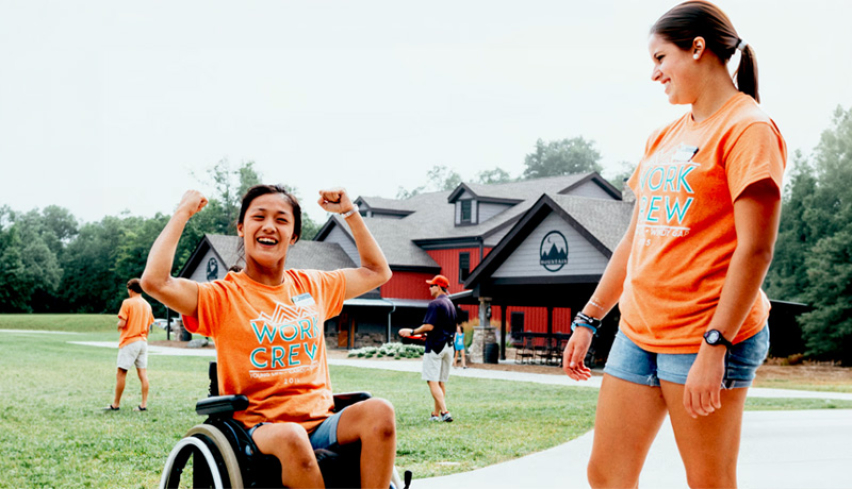
Take a moment to look around your organization, wherever you are. Imagine what it would take in your organization for you to work alongside someone with a disability. Imagine what they might have to overcome in order to thrive. Imagine what they might offer.
If you haven’t thought about this before, that’s okay! This is just a starting point. There was a time in our organization when we didn't even know what the answers were ourselves.
But we invite our young men and women with disabilities to ask this same question when they interview community leaders as part of our leadership program. It's an often educational—and illuminating—exercise.
Many people take for granted that their workplace is a more or less accessible place to be.
Many people take for granted that their workplace is a more or less accessible place to be. They don’t encounter barriers themselves, so they may not realize they are there. And in the busyness of our own day-to-day lives, we don’t often step out of our own shoes to wonder what others might need to flourish.
The physical and social difficulties that men and women with disabilities face are amply documented. They’re generally perceived as less competent, less capable and more dependent. This tends to mean fewer promotions—and, as a result, lower lifetime income. They’re often bullied and excluded as children, and suffer from low-esteem or loneliness as adults.
"Disability isn’t what someone lacks, it’s whether the world makes room for them.”
Spaces we take for granted like coffee shops, workplaces, churches, parks, playgrounds and grocery stores can pose unique challenges for men and women with disabilities. Much like one of our friends at Young Life said, “To me disability isn’t what someone lacks, it’s whether the world makes room for them.”
This is the result of a culture that is wrong side up.
Friendship with these men and women can, in turn, transform our perspective.
It’s often easy to turn away, or even to refuse—either consciously or unconsciously — to do the work of imagining and building a world where men and women with disabilities can thrive by our side. But, to know, understand and become a friend to someone with disabilities is to walk steadfastly alongside a man or woman with unique insights, talents and gifts. Friendship with these men and women can, in turn, transform our perspective.
Men and women with disabilities invite us to more than new relationships. They invite us to look at the world in a new way, to work in new ways, to love and hope in new ways.
When they are given the opportunity to lead and serve, those of us without disability have a chance to learn greater humility, adaptability, hope, and fortitude.
We learn greater humility when we de-center our own perspective. We confront how limited and partial our own experience is, or can be. We also have a chance to learn from their leadership—which draws from a very different experience than our own. Their gifts and insights actively instruct our work.
Proactive and reactive problem-solving is an essential skill.
We learn greater adaptability, as well. Proactive and reactive problem-solving is an essential skill if we are going to make our workplaces, homes and communities welcoming and uplifting to men and women with disabilities.
We learn hope when we refuse to accept that nothing can be done or that nothing can be improved. We choose to trust in others and in God; and this trust, tested in hardship, is one of the most powerful antidotes we have to cynicism and despair.
Finally, we learn fortitude. Turning the culture “right side up” is difficult. It can feel daunting. The more we lean into the messy, hard parts of God’s work in the world, the stronger and braver we become in the middle of it.
Reflection is... a powerful and important tool.
But we can’t learn or grow unless we do the work necessary to do so. That’s why I have found that reflection is such a powerful and important tool. It can help us know how to grow—and where we need to grow—which then prompts intentional investment.
Taking stock of our workplaces, volunteer spaces, churches, and communities is the first step. We must first become aware of the need if we want to meet it. That begins with honest questions: does this space truly make room for all people? If someone with a disability came here today, would they be able to enter, participate, and feel that they belong?
The next step is proactive investment. Partner with your coworkers and help change your workplace. Advocate in your churches, neighborhoods, and clubs for the inclusion and authentic empowerment of men and women with disabilities. Become a friend to people who need friendship and guidance.
A program created for all leaders but crafted for leaders with disabilities.
Our Capernaum program’s Leadership Experience—a professional and personal development program designed with young men and women with disabilities in mind—is a great template for what practical steps you could take. It’s a program created for all leaders but crafted for leaders with disabilities.
We set up one-on-one mentorship relationships at the core of the program. Every participant has someone who is invested in them and in their success. Our graduates also develop a network of supportive friendships as they work through the program. They get professional coaching, encouragement and guidance at every stage of their growth.
These relationships and the culture they help form have the power to change lives.
These relationships and the culture they help form have the power to change lives. They already have.
But those relationships and the joy and resilience they’ve helped bring into the world wouldn’t exist unless we’d taken the time to first think about and reflect upon the needs and gifts of young men and women with disabilities.
Turning the culture right side up starts with reflection. It means taking stock of our own assumptions and, occasionally, trying to see and experience the world as someone else does. That shift alone can change more than we expect.
Suzanne Williams is a seasoned professional with extensive experience in leadership roles within the nonprofit sector. She is currently serving as Vice President for Capernaum at Young Life, and has been serving with YL Capernaum since June 2000.








