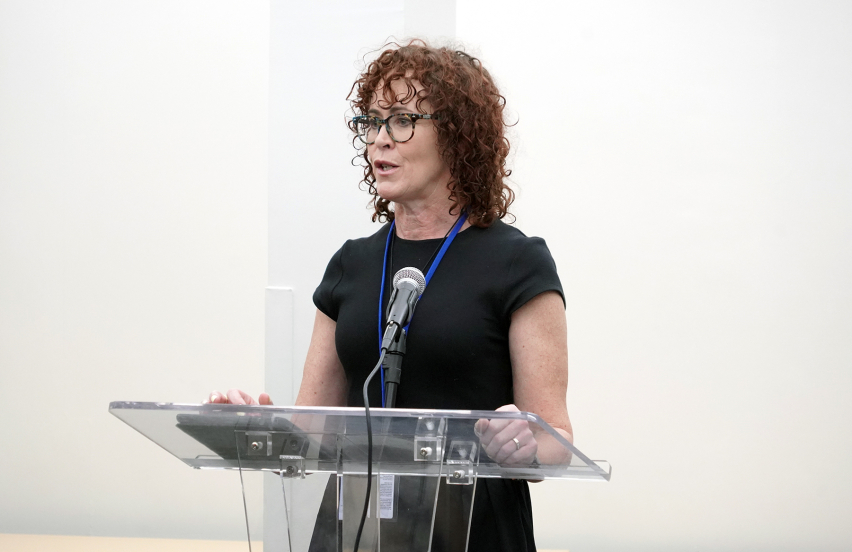
Fewer than one in a hundred victims of human trafficking is ever formally identified, a global anti-trafficking advocate told a United Nations side event Monday, calling the gap a fundamental failure of protection systems worldwide — and a challenge the church is uniquely placed to help address.
Sarah Scott Webb, founder and director of the Oceania Freedom Network and a leader within the World Freedom Network, addressed the High-Level Political Forum side event "From Commitment to Action: Urban Solutions to Human Trafficking in Liberia and Sierra Leone," held July 13 at the Salvation Army's International Social Justice Commission in New York.
"Less than one percent of trafficking victims are ever officially identified," Webb told the gathering. "That means for every one victim who reaches protection and assistance, more than ninety-nine remain invisible — invisible to governments, invisible to services, invisible to justice, invisible to us."
Webb argued that victim identification is the single most critical bottleneck in the global anti-trafficking response. "Victim identification is the gateway to every other part of the anti-trafficking response," she said. "Without identification, victims aren't protected, traffickers aren't held accountable, communities remain vulnerable, and the true nature of trafficking stays hidden."
The side event was planned by the World Evangelical Alliance's UN New York team as part of its ongoing advocacy on human trafficking policy, and co-organized by the World Freedom Network, Rain Collective, and World Hope International. It brought together UN member states, UN agencies, researchers, civil society, and faith-based organizations to examine evidence-based approaches to combating trafficking, with a particular focus on Liberia and Sierra Leone.
Speakers discussed research findings from both West African countries, where grassroots programming by trusted local networks is working to strengthen community resilience against emerging forms of exploitation. The session was framed around Sustainable Development Goal (SDG) 11: Sustainable Cities and Communities, and SDG 17: Partnerships for the Goals.
At the heart of Webb's address was a challenge to how victim identification is understood. She said the standard definition — the moment an official authority formally certifies someone as a trafficking victim — is correct but incomplete, because it captures only the end of a much longer process.
She drew on her home country as an illustration. In New Zealand, she said, victim identification is considered to have occurred at the moment Immigration New Zealand formally certifies that the legal threshold for trafficking or exploitation has been met. That determination unlocks legal protections for the person involved. "That's how victim identification is commonly understood — and it's not wrong," Webb said. "But it's incomplete. Because it's only the very end of the identification process, not the whole thing."
"Victim identification begins long before that moment of formal determination," she said. "It is more accurately defined as a process — a series of interactions where different people, at different points of contact, notice indicators of trafficking, build trust, ask the right questions, share information, and make decisions that shape what happens next in a victim's journey to safety."
Webb illustrated the point with an account of a young migrant woman who passed through a health clinic, a factory labor audit, a place of worship, and an immigration encounter — each interaction a missed opportunity. "At every point she was visible. She interacted with multiple systems designed to protect people. And yet identification never happened. Not because no one cared, but because each point of contact saw only one piece of her story."
She contrasted this with a different version of the same encounters, in which a health worker asks whether the woman is free to leave her job, a labor auditor notices her passport is not in her possession, a faith leader recognizes fear rather than stress and knows who to call, and an immigration officer pauses to ask questions before issuing a penalty. "Nothing about the victim changed," Webb said. "Everything changed about the ecosystem."
Webb emphasized that victim identification requires awareness, trust, screening, referral, and partnership across multiple sectors. Governments, law enforcement, health professionals, businesses, researchers, churches, and civil society all have a place within it, she said, but none can do the work alone.
The role of churches and faith communities drew particular emphasis. Webb noted that faith communities often hold the trust and local access that formal systems lack, giving them the ability to reach people who would never approach a government office or law enforcement agency.
"Civil society and faith communities bring trust, local knowledge and access to vulnerable communities," Webb said. "Together, we create the conditions in which victims can be recognized, protected and supported."
That argument has a long international pedigree, she noted. The Palermo Protocol — the United Nations agreement that has formed the legal backbone of the global anti-trafficking response for more than two decades — has recognized partnership as one of the foundations of an effective response since its adoption. SDG 17 reinforces the same principle, she said, affirming that complex global challenges can only be solved through strong, multi-stakeholder collaboration.
She noted that the importance of partnership was affirmed at the same day's ministerial session of the UN General Assembly. "Partnership is essential," she said, "emphasized by the president of the General Assembly at this morning's ministerial session at the UN."
Webb also highlighted the need for evidence over assumption. Research into why victims remain hidden — what barriers exist, where systems break down, which partnerships make the greatest difference — is what makes better policy and practice possible, she said.
"If we can't understand why victims remain hidden, we cannot build the ecosystems that help them be found," she said.
The stakes are high: an estimated 50 million people live in modern slavery globally, with 27.6 million trafficked into situations of forced labor. The response to those numbers, she said, depends on persuading every sector of society — including the church — to see victim identification as a shared responsibility rather than a task delegated to authorities.
"We need to stop seeing victim identification as an event," she said, "and start seeing it as a shared responsibility. Our responsibility."