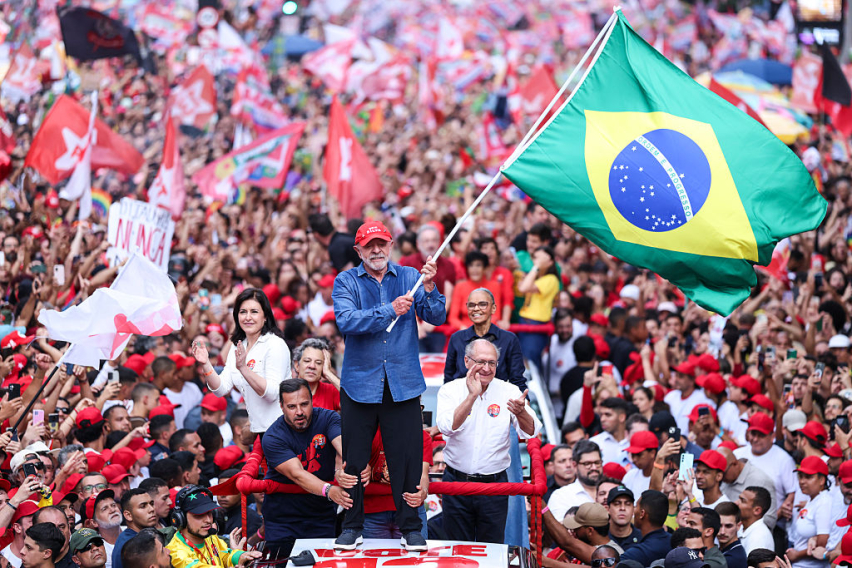
Brazilian President Luiz Inácio Lula da Silva, 80, won a fourth term Sunday, defeating Sen. Flávio Bolsonaro, 45, in a runoff his opponent refused to accept. Lula won 51.79% of the valid votes to 48.21%, according to the final count from Brazil's Superior Electoral Court (TSE).
Flávio Bolsonaro said late Sunday in Brasília that he would not recognize the result and would seek to annul the runoff. "It is impossible to recognize the result," he said, criticizing the extension of voting hours at polling stations. His supporters say the extension benefited Lula, ABC+ reported.
Supreme Federal Court (STF) Justice Cristiano Zanin extended voting by two hours, to 7 p.m. Brasília time. Lula's coalition had asked for the extension, citing reduced bus service and failures in free public transportation in several states. Zanin later clarified that the extension applied only to polling stations still open when he issued the order, Mix Vale reported. Stations that had already closed did not reopen.
Flávio Bolsonaro's campaign had also asked the electoral court for a two-hour extension, citing heavy rain, flooding and power outages at polling places in Minas Gerais and Rio Grande do Sul.
No Brazilian presidential election has been annulled since the country's return to democracy, The New York Times reported. In 2014, the losing party requested an audit, which found no evidence of fraud. In 2022, Flávio Bolsonaro's Liberal Party (PL) challenged his father's loss. The party was fined more than $4 million for failing to provide evidence for its allegations.
Lula received 64,256,232 votes to Flávio Bolsonaro's 59,826,041, a margin of about 4.4 million. Flávio Bolsonaro led the Oct. 4 first round with 47.03% to Lula's 45.16%. It is the first time in Brazil's history that a candidate who lost the first round has won the runoff, Infobae and The Times reported.
Turnout rose between rounds. More than 128 million Brazilians voted Sunday, compared with 125 million in the first round.
Evangelicals shaping both campaigns
Evangelical voters, who represent nearly a third of Brazil's population, were at the center of the contest. Both candidates reshaped their campaigns after the first round to reach faith communities.
The campaign was charged with moral and political tension, and both sides fervently rallied their bases.
Lula, leader of the Workers' Party, centered his message on protecting vulnerable groups. He insisted the contest represented "a defense of democracy" against a possible return of the family of former President Jair Bolsonaro, Flávio Bolsonaro's father.
Jair Bolsonaro, whom Lula defeated in 2022, was sentenced last year to 27 years in prison for attempting a coup after that election.
Economic measures in the final stretch
In the weeks before the vote, the government expanded family assistance programs and cut taxes on fuel. Responding to opposition criticism over the cost of living and government spending, Lula said that "change is not depriving people of their rights."
Flávio Bolsonaro and his conservative allies warned that recent measures, such as the reduction of the working week, would drive inflation and hurt employment.
The result confirmed a narrowly divided electorate. Millions of families voiced concern about jobs as well as the ethical and material stability of society.
Security and international relations
Lula's new term promises closer state coordination on public security through a Ministry of Public Security, along with greater investment in intelligence.
For churches and faith communities in the region, pacifying low-income neighborhoods and protecting young people are priorities as crime advances.
Relations with Washington also present challenges following recent trade tensions. Last year, U.S. President Donald Trump imposed tariffs and sanctions on Brazil in connection with Jair Bolsonaro's prosecution.
The contest for the faith vote
After the first round, both candidates retooled their message to faith communities. In the weeks before the runoff, they stepped up efforts to connect with the values, fears and aspirations of believers across the country.
Flávio Bolsonaro sought to shore up conservative support through his security plan, "Brasil sem medo" ("Brazil Without Fear"). It combined a tough-on-crime approach to organized crime with an explicit defense of religious freedom and traditional family values.
The pitch drew on churches' deep concern over violence in the urban outskirts. It presented itself as a moral bulwark against secularism and leaned on the long-standing bond between Bolsonarism and prominent pastors.
The PT, for its part, tried to overcome long-standing mistrust with letters and statements addressed directly to Christian congregations. Lula stressed commitments to freedom of worship, human dignity and the fight against extreme poverty. He said social justice and care for the most vulnerable are ethical mandates shared with the Gospel.
Significant sectors remained skeptical of the left on doctrinal grounds. But the approach reached grassroots voters who prioritize jobs and food assistance.
The result leaves Christian leaders with the task of healing rifts caused by partisan polarization. Pastors and theologians in Brazil say the church's mission goes beyond election cycles. They describe it as keeping a prophetic voice independent of whoever holds power, prioritizing reconciliation in communities and remaining a place of spiritual refuge and social service.
Includes reporting by Diario Cristiano, Christian Daily International's Spanish edition.