
In central India’s Chhattisgarh state, followers of tribal religion in Bastar District recently dug up the grave of a tribal Christian buried 20 years before. They unearthed his skeleton, burned it and scattered the ashes.
The message to the living Christian community was unmistakable.
Degree Prasad Chouhan, a human rights attorney for marginalized communities in Chhattisgarh, brought this testimony to an unofficial public hearing known as a “people’s tribunal” on June 1.
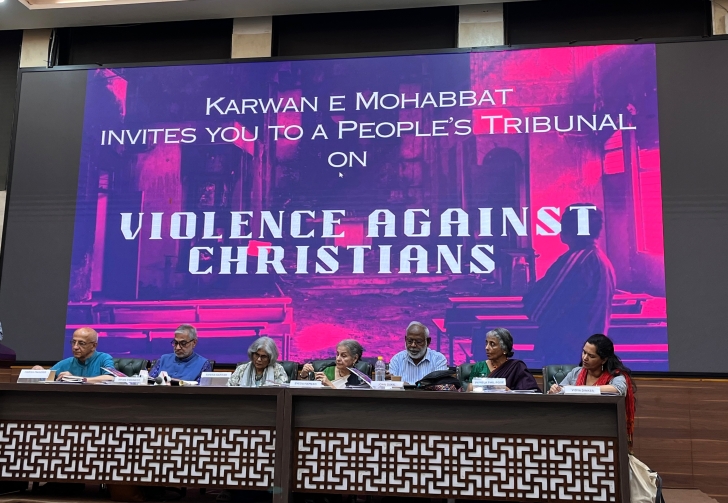
The People’s Tribunal on Violence Against Christians in India in New Delhi was convened at the Constitution Club by Karwan-e-Mohabbat, an Urdu phrase meaning “Caravan of Love,” a civil society organization founded by human rights activist and author Harsh Mander that accompanies victims of communal and religious violence across India, along with a collective of concerned citizens.
More than 200 people attended the hearing. Survivors, lawyers, researchers, community representatives and human rights defenders from Uttar Pradesh, Rajasthan, Madhya Pradesh, Chhattisgarh, Gujarat and Odisha states testified before a panel of eminent scholars, journalists and activists.
It was only the second such hearing since the Kandhamal massacres of 2008, when Hindu nationalist mobs burned hundreds of church buildings, killed dozens of Christians and drove tens of thousands from their homes in Odisha state.
John Dayal, a veteran journalist, human rights activist and one of the organizers of the hearing, opened the proceedings by reaching back through decades of violence to show that what was being documented was not new. He recalled the 1999 murder of Australian missionary Graham Staines and his two young sons, Philip and Timothy, burned alive in their vehicle while asleep in Manoharpur village, in Odisha’s Keonjhar District, by a mob led by Bajrang Dal member Dara Singh.
Dayal reminded the gathering that the subsequent judicial inquiry initially contained language suggesting Staines had brought the crime upon himself by converting people, a line that civil society was forced to take to the Chief Justice of India to have struck from the record.
“What we have heard today is this design, this conspiracy of the government, to which the state is blind, to divide the community within and without, to isolate it from civil society, from the larger India that grew up governed by a constitution,” Dayal told Christian Daily International.
Vidya Dinker, a social activist who served on the tribunal panel and participated in field visits to Chhattisgarh and Odisha before the Delhi hearings, returned to Staines when she addressed the gathered survivors.
“When they went to the jeep and opened the jeep door, all that was left of Graham Staines was his spine that could not be destroyed by that fire of hate,” she said at the hearing. Turning to Christian leaders in the room, she added, “I think Christian leadership now needs to show some spine.”
She singled out bishops, cardinals and archbishops, saying the tribunal had repeatedly heard survivors describe how when violence came, established church leaders did not come with them.
“We do not hear them speaking enough for ordinary Christians,” Dinker said.
She warned that the communities being targeted today in remote rural areas and small evangelical congregations were simply the first.
“It is only a question of time,” she said. “Since you have decided that you follow the ultimate revolutionary, please lead the resistance.”
When the Dead Cannot Rest
Syeda Hameed, a recipient of the Padma Shri, one of India’s highest civilian honors, and a former member of the Planning Commission of India, the country’s apex economic policy body, began her remarks at the hearing by describing the India of her childhood: a Muslim girl who attended a convent school and recited the Lord’s Prayer at home every day, with her parents’ blessing.
“We are leaving behind a conflict-ridden world for the next generation,” she said, “but we hope you find a way.”
Then she addressed what she had heard at the hearing all day.
“I am very moved by the whole question of burials,” she said. Of the Bastar exhumation that Chouhan had described, she was unequivocal. It was, she said, “the greatest atrocity” against a community.
Father Ajay Singh, former director of the Odisha Forum for Social Action of the Catholic Church, told the tribunal that the denial of burial rights represented “one of the gravest forms of humiliation inflicted upon Christian communities.”
He described cases in which funeral processions were obstructed, burial in village graveyards was denied, and the bodies of deceased Christians were allegedly removed and subjected to reconversion ceremonies against the wishes of their families.
Irfan Engineer, director of the Centre for Study of Society and Secularism in Mumbai, served on the tribunal panel. The son of the late Dr. Asghar Ali Engineer, the renowned Islamic scholar and communal harmony activist, he said at the hearing that narratives around ghar wapsi, a Hindi term meaning “homecoming” used by Hindu nationalist groups to describe the reconversion of Christians and Muslims to Hinduism, were frequently deployed to legitimize coercion and discrimination.
Genuine freedom of conscience, he said, must remain central to India’s constitutional framework.
Prayer Meetings as ‘Crimes’
A.C. Michael, coordinator of the United Christian Forum (UCF), which monitors and documents attacks on Christians across India, described the growing normalization of hostility toward Christian worship.
Peaceful prayer meetings, he said at the hearing, are increasingly portrayed by authorities and Hindu nationalist groups as threats to public order and national interest. Christians gathering in homes or small halls to pray face accusations of conducting illegal conversion activities, charges that carry criminal penalties under anti-conversion laws enacted by more than a dozen states governed by the ruling Bharatiya Janata Party (BJP).
The BJP is a Hindu nationalist party that has governed India at the national level since 2014.
Chouhan pointed to a pattern civil society organizations have documented for years: hundreds of incidents are reported annually in Chhattisgarh alone, but First Information Reports (FIRs), the official complaints that trigger police investigations in India, are filed in only a fraction of cases. Where complaints are registered at all, he said, they are frequently filed against victims rather than perpetrators.
The Supreme Court of India in October dismissed multiple cases brought under Uttar Pradesh’s anti-conversion law, finding they suffered from what it called “incurable legal defects” and appeared aimed at harassment rather than legitimate law enforcement. Despite the ruling, arrests and police interventions at prayer meetings and church services have continued.
Historian Tanika Sarkar of the tribunal panel noted at the proceedings that established churches with long institutional histories appeared relatively protected, while newer congregations, house churches and small evangelical groups bore the brunt of the hostility.
“It is the new churches which show the growth of Christianity, they are being attacked,” she said.
Minorities Enjoy ‘Full Freedom’
Three days after the tribunal concluded, Minister for Minority Affairs Kiren Rijiju stood at Bharat Mandapam, a government convention center in New Delhi, and told a celebratory gathering marking 12 years of Prime Minister Narendra Modi’s BJP government that minorities in India enjoy “full freedom.”
He called reports of persecution “propaganda” spread by opposition parties and foreign powers jealous of India’s growth. He challenged anyone to name a single person who had left India because of their religious identity.
The U.S.-based Pew Research Center published findings in 2024 that quietly addressed that challenge. Christians, who make up approximately 2.3 percent of India’s population of 1.4 billion people, account for 16 percent of Indian emigrants. Muslims, who make up roughly 14 percent of the population, account for 33 percent. Hindus, who make up 80 percent of the population, represent only 41 percent of those who leave.
The Rev. Vijayesh Lal, general secretary of the Evangelical Fellowship of India (EFI), also addressed the hearing before giving CDI his response to the minister’s claims.
“The real question is not whether Christians have freedom on paper, but whether the poorest Christian in the most remote village can exercise that freedom without fear,” Lal said. “When families struggle to bury their dead, when prayer gatherings attract suspicion, and when victims struggle to access justice, the gap between constitutional promise and lived reality becomes difficult to ignore. A democracy is ultimately measured by how confidently its most vulnerable citizens can exercise the rights it guarantees.”
The EFI is the national umbrella body of evangelical Christians and a charter member of the World Evangelical Alliance, which represents more than 600 million evangelicals worldwide.
India’s overall persecution score on Open Doors’ 2026 World Watch List stood at 84 out of 100. The country now leads the world in Christian detentions, with 1,622 believers arrested, imprisoned or detained without trial in the most recent reporting period, and its violence score reached 16.1 out of a maximum 16.7, the highest recorded since Open Doors began tracking India in 1993.
The EFI’s Religious Liberty Commission documented 747 verified incidents of violence, intimidation and discrimination against Christians in 2025, more than five times the 147 cases documented in 2014, the year the BJP first came to power nationally.
Harsh Mander, who founded Karwan-e-Mohabbat and steered the tribunal, told CDI he was not done.
“We will continue to speak out in different ways,” he said. “People listen to our voice.”
He recalled 2017, when his organization spent nearly a month traveling from Assam state to Andhra Pradesh, visiting families who had suffered lynchings and offering what he described as atonement and solidarity.
“It was a very useful attention probe,” he said. “We went on this journey, and we will try to do the same. The country needs to know, and we will keep speaking out about it, intervening in court, and various other ways.”
Concluding the tribunal’s proceedings, Mander said the incidents placed before the panel pointed to something more troubling than a series of unconnected attacks. The testimonies, he said, pointed to a coordinated effort to push India’s most vulnerable citizens to the margins of the republic that the Constitution promises.
He called on citizens, institutions and governments to act urgently to defend it.








