
Romania has a higher number of prisoners than the European Union average - a rate of 126 to 136 per 100,000 people, compared to the continent’s average of 110 to 115 per 100,000 inmates. The European Court of Human Rights has also sanctioned the country repeatedly about substandard prison conditions, including a lack of space, poor hygiene and outdated infrastructure.
Prisoners in such situations desperately need hope, and Mircea Cristian and his wife Ronela realised an opportunity to bring the wonderful news about Jesus Christ to them. They began a successful prison ministry called Rock of Ages in 1991, working with volunteers to provide family reunions between inmates and their loved ones, Bible correspondence courses, practical needs such as warm clothes and the provision of life skills.
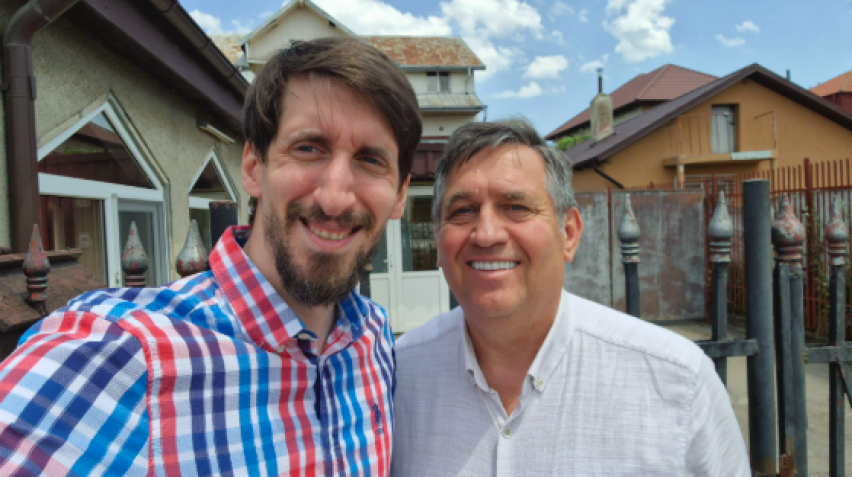
Christian Daily International interviewed Mircea and his son Timotei, who is leaving a corporate role at Amazon to be mentored in taking over the leadership from his father, about the challenges of presenting the love of God to so many criminals needing to know the wonderful realities of salvation.
Mircea explained how the late Richard Wurmbrandt, renowned advocate for persecuted Christians and himself a survivor of Romania’s former oppression under Communist dictator Nicolae Ceaușescu, stirred evangelicals in the United States after he informed them about the situation in his country. Romania became the focus of prayer for the gospel at this time and Cristians, supported by Americans, got involved in outreach to prisons in their country after “seeing the needs of the prisoners and their need to be safe, and to know someone loved them.”
Mircea worked as a civil engineer but the pull of the ministry led the couple to live by faith, taking over the ministry fully by 1995. The reality of not having a “regular pay check was very hard” but they left paid employment with the belief that God called them for the task and “just believing the Lord would provide for the next month’s money.”
The ministry became a non-profit organisation in 1996 and the Cristians visited prisoners four times per week, starting with a jail close to the city of Constanta. Then other prisons realized the value of their Christian ministry and requested visits too: “Slowly by slowly we developed in more places.”
Another family joined the ministry to carry the weight of the needs.
“The ministry was growing and we realised there was no chance we could reach all Romanian prisons, so we started going to churches to ask them to help us,” said Mircea. “And the work started to develop and we were praying for more people and more workers."
Before the Covid-19 pandemic hit, the ministry had about 196 volunteers working in 22 teams across the country. At present, they have about 96 volunteers.
In recent years, the Cristians realised they were not getting any younger and so sought the Lord’s guidance as to who could take over the leadership. The needs had become too great for the couple to cover them all. Mircea used the comparison of Moses handing over leadership to Joshua: “The Lord said to me, ‘Oh, you’re going to have a Joshua beside you. Don’t worry.’”
“So we start to pray, and we start to ask our boys to pray because they actually knew everything happening in the ministry because they had to live by faith with us in our home [growing up].”
Mircea described his gladness when Timotei joined the work as a volunteer. In fact, all of their sons were involved on a voluntary basis but with Timotei “somehow the Lord touched his heart much more about that, so we were very glad.”
Mircea explained that the handover of leadership to Timotei is a slow process because it’s not a business but a spiritual work. People in the prisons and ministry partners know the older Cristians and it will take time for Timotei to become a familiar face too.
“People have to know you. The coordinators have to know you. The staff of the prison have to know you. They have to trust you. So it's a process, but we prayed for this process for many years, and we had to start it because I'm not young now.”
The ministry is currently utilizing two methods for outreach - face-to-face, physical contact in groups in about 19 prisons, and secondly via correspondence like running Bible courses, which has a wider reach to 32 prisons.
Mircea said returning to ministry after the Covid-19 pandemic continues to be a challenge. While "it's slowly coming back", he said "it's not the same", citing a lingering sense of disconnection and the loss of the close personal interactions that characterised life before 2019.
A cohesive approach between spiritual care and practical rehabilitation continues to be important and Timotei is looking at ways to develop the work, at the same time as learning about it.
“The younger generation, Timi’s generation - they think differently to us,” said Mircea, admitting that Timotei would have better ideas on how to reach younger people.
Mircea pointed out that the spiritual aspect underpins the social outreach of the ministry “because if someone is released from the prison or I meet a family for the prisoners and they are in need, I have to try to do something for them and it is social before spiritual.”
Every one of the ministry’s voluntary teams have these aspects - social before spiritual - embedded in their working culture, with support from the churches that are involved.
Mircea gave the example of a forthcoming outreach in the city of Braila where prisoners will meet their loved ones in family reunions. The prison allows the ministry to host this meeting in a safe place, where Mircea and others can share the gospel and talk with them for about three to four hours, and review their practical needs.
“In those places, we see the need,” said Mircea, who wants to see the prison ministry expand among churches across the country.
“We are working to try to change the mentality of the churches. I mean, change and show them it's our responsibility to take care of them. It's not someone else’s. We have to try to support them.”
Mircea said that former prisoners have no place to go, and they need a “church to accept them, a church to love them, a church to go after them.”
Timotei formerly worked at international retailer Amazon and his colleagues there have been supportive of his move to ministry. He felt inspired by his parents’ hard work as a child but their constant travel schedule, often leaving him in the care of grandparents, was painful for the family. He received encouragement to go into ministry himself when younger but felt reluctant. The personal sacrifices seemed too great.
“I saw what ministry is like on the battlefield,” he said. “My parents, I admired them and they sacrificed a lot doing ministry and the best thing is, God blessed us children through them.”
Timotei pulled towards business and “tried to shut down the thoughts in my mind” about ministry. He started studying marketing but found it hard because “there was that constant feeling that you are not doing the thing you are meant to do.”
“And then I said, ‘Okay, Lord, if you want me to go into a ministry, you need to prepare me because I've seen stuff, but I'm not prepared to do that.’"
Timotei worked at a Starbucks cafe at the time and began studying theology as well as marketing, at two colleges. He sought the Lord’s guidance about the next steps and sensed a call again towards ministry, although not clearly Rock of Ages.
“Then my parents came to me and said, ‘Do you want to take over?’ And I was like Jonah, the one who got swallowed by the fish.”
Timotei’s reluctance came from his childhood memories of his parents being absent to serve the ministry and he recalled feelings as a youngster that he’d never see his parents again when they left the house to the airport to network with funding partners in the United States.
As a newly engaged young man, he did not want his children to one day experience the same pain as he did when he was younger.
“I liked the ministry but I didn’t like that my parents weren’t there when I needed them,” he said. “But I admired them.”
Timotei initially refused but "the fish came to swallow me” and he reconsidered after he heard God telling him to "rethink."
Timotei eventually committed to the Rock of Ages ministry but gave God a “condition.”
He asked, “Never, ever leave me alone in this ministry. I don’t want to feel alone because it’s a big stress. It’s a big ministry, it’s not a small ministry and I cannot handle the stress.”
He turned to a Bible app on his phone and read a verse from Exodus 33:14: “ The Lord replied, ‘My Presence will go with you, and I will give you rest.’”
Timotei is not a believer in mysticism but the profound relevance of this Bible verse in his situation was undeniable. He told his wife the next morning but he found it hard to find people in church believing him.
By his own admission “I’m an anxious guy” and he sought further encouragement, which God gave twice more through a message at church about the Lord of the harvest taking hold and also an encouragement from 1 John 5:14-15 - “this is the confidence that we have in Him, that if we ask anything according to His will, He hears us. And if we know that He hears us, whatever we ask, we know that we have the petitions that we have asked of Him."
Timotei asked for courage and now feels zeal to employ his marketing skills for Rock of Ages. He loves technology and wants to optimize the online presence of the ministry in a way that honors God especially in regards to donations. He also wants to create videos witnessing to the powerful work of the ministry.
“I want Romanian people to know there is a ministry in the country that’s been doing this for 31 years. I want Europe to know there is a ministry in Romania that does this. Why? Because maybe somebody in the UK [for example] will say, ‘There are prisoners in the UK that need God’ or somebody in Germany. There are prisoners in Germany that need God. So those guys will say: look, those guys [from Rock of Ages] are doing it, so why can’t we?”
He felt led in prayer to reach out to Transform Europe Network for the Christian mission’s support.
Timotei is also training for his leadership role by volunteering in a prison and as a ministry coordinator. He felt excited about completing two recent courses, as well as two family reunions with prisoners where he prayed for them at the end: “I hope that God will see their hearts and He will change them.”
The family reunions witnessed by Timotei saw a remarkable change in the way the prisoners spoke about their wives and children. He is subsequently planning to start more programs in the Fall with four teams serving 50 prisoners.
“I’m doing this because in my mind, if God so loved me as I am. What stops me from spreading the gospel? This is my responsibility to spread the gospel. I am not changing people. I’m just a little pawn that God is using. I just want to do His will. I just want to do His work.”
Mircea and Timotei ask for prayer for the prison work and taking the gospel to Romanian prisoners, for financial resources and more helpers in the aftermath of the Covid-19 pandemic, which saw numbers of volunteers fall. Prayers are sought for more prisoners to enrol in the bible study program, and in presenting the ministry to churches - as well as for the churches to understand the gospel imperative to reach prisoners.
Mircea emphasized that the heart of prison ministry is not just providing physical aid, but sharing Christ's love to bring genuine hope and life transformation to inmates.
As he hands over the leadership to Timi, Mircea’s advice is that taking over is not about stepping into a job or title, but continuing the mission only if he has received a clear, personal calling from God to sustain him through hard times.
Ultimately, Mircea framed this transition as a testimony that God is faithful, trusting Him to provide for Timi's personal and ministry needs as he steps forward by faith.
“God is able. The only thing is He’s waiting for us to trust Him.”
Mircea says 80% of the prisoners have never owned a Bible, let alone studied or read one.
“They need the Lord. This is what we understand from God, this is our desire: to give them a chance to meet our Lord personally; to give them a Bible to help them to study the Bible.
“This is our heart: to help them to know our Lord, to understand what is the salvation they can have through our Lord Jesus Christ.”








