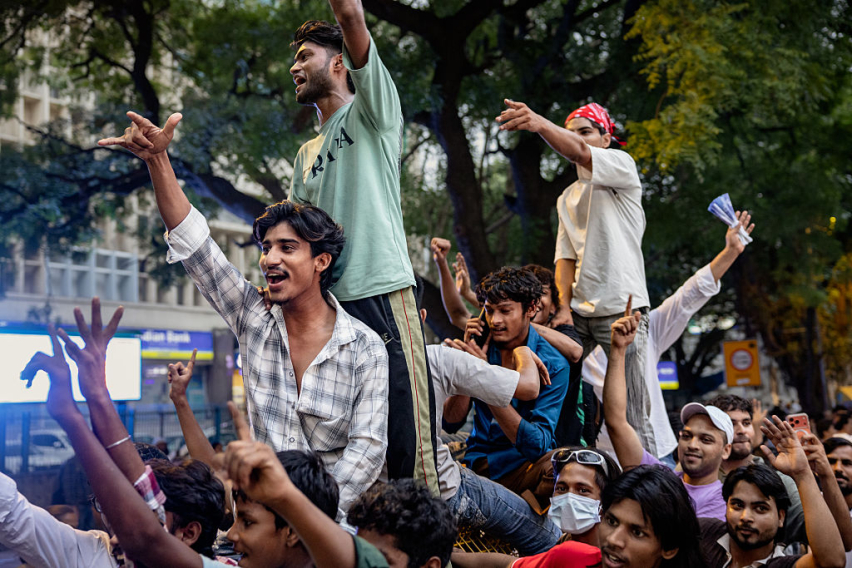
India’s government has given itself until Saturday afternoon (July 25) to answer the one demand it has not yet met: whether Education Minister Dharmendra Pradhan will lose his job.
For weeks, a youth-led protest movement has demanded his resignation over a leaked medical school entrance exam. This past week alone brought tear gas at the gates of Parliament, a 26-day hunger strike that ended only after midnight negotiations, and the Leader of the Opposition dragged bleeding from a sit-in outside the Prime Minister’s residence.
On Friday, July 24, the government agreed to two of the movement’s three demands. Pradhan’s job was not one of them.
When Christian Daily International last reported on this movement, called the “Cockroach Janta Party,” the mood was closer to a street festival than a standoff. It was June 6, and thousands had just held the movement’s first march, peacefully, with a police permit. Seven weeks later, that peaceful mood is gone.
A fast begins
The Cockroach Janta Party, or CJP, a satirical, Gen Z-led movement mocking Prime Minister Narendra Modi’s Bharatiya Janata Party (BJP), had by early June amassed a social media following larger than the BJP’s own, close to 26 million followers on Instagram at last count. That number reflects online supporters, not registered members.
Its grievance never changed: accountability for the leaked National Eligibility cum Entrance Test, known as NEET, and a botched school-grading system, both under Education Minister Dharmendra Pradhan’s watch.
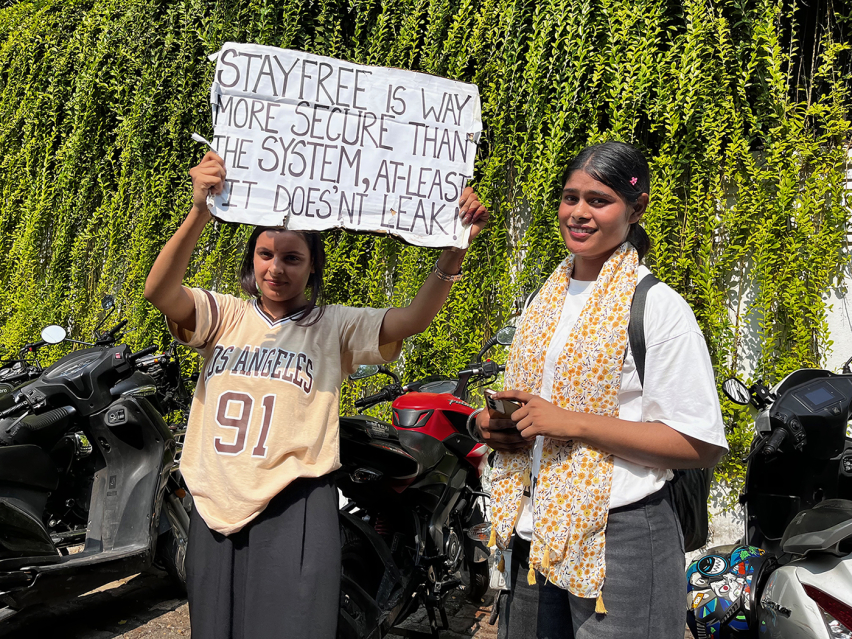
What changed was who joined the fight. On June 28, Sonam Wangchuk, a Ladakhi engineer, education reformer, and Ramon Magsaysay Award winner already treated by CJP supporters as an “honorary cockroach,” began an indefinite hunger strike at Jantar Mantar, New Delhi’s designated protest ground. Six students from the All India Students Association fasted alongside him.
His health declined steadily even as opposition leaders, actors, and public intellectuals urged him to stop. By mid-July he had lost close to 20 pounds.
On July 14, a delegation of Christian leaders came to express solidarity with the movement and to sit with Wangchuk at Jantar Mantar. Among them were veteran human rights activist John Dayal, Father Susai Sebastian, a Catholic priest, Michael Williams, and Minakshi Singh, who helped coordinate the visit. Several came in a personal capacity rather than representing any single church or organization.
They prayed with Wangchuk. Singh later said the visit stayed with her. “Seeing the whole situation there was very painful,” she said, describing a generation that felt scattered and unheard.
By mid-July, thousands of messages arrived daily asking Wangchuk to break his fast. He refused, arguing that ending it without a government response would send the wrong signal.
Instead, he urged supporters to turn out for the CJP’s planned July 20 march to Parliament, dubbed “Chalo Sansad,” and asked schools and colleges to treat the day as a lesson in civic participation. He noted that Indian governments had fallen before under public pressure, once even over onion prices. “Do the people of India love their children’s lives and education more, or onions?” he asked.
Removed by force
Before dawn on July 19, Delhi Police moved into Jantar Mantar and carried Wangchuk out amid what officials called “a slight commotion.” He was taken to Safdarjung Hospital, a government facility, weighing about 125 pounds, some 20 pounds lighter than when he began fasting. Police cited Delhi High Court directions and his deteriorating health. CJP said he had been manhandled and forcefully removed.
Within hours, CJP founder Abhijeet Dipke, a postgraduate in public relations from Boston University, began his own hunger strike at the same spot. The party sharpened its demand to also call for Modi’s resignation.
Tens of thousands at the gates of Parliament
The confrontation reached its sharpest point on July 20, the opening day of Parliament’s Monsoon Session, when tens of thousands of CJP supporters, by some estimates considerably more, tried to march to Parliament itself, far exceeding what organizers had expected and fueled by anger over Wangchuk’s removal.
Police used batons that morning, then fired tear gas by afternoon to stop protesters nearing Parliament. Several metro stations along the route were shut.
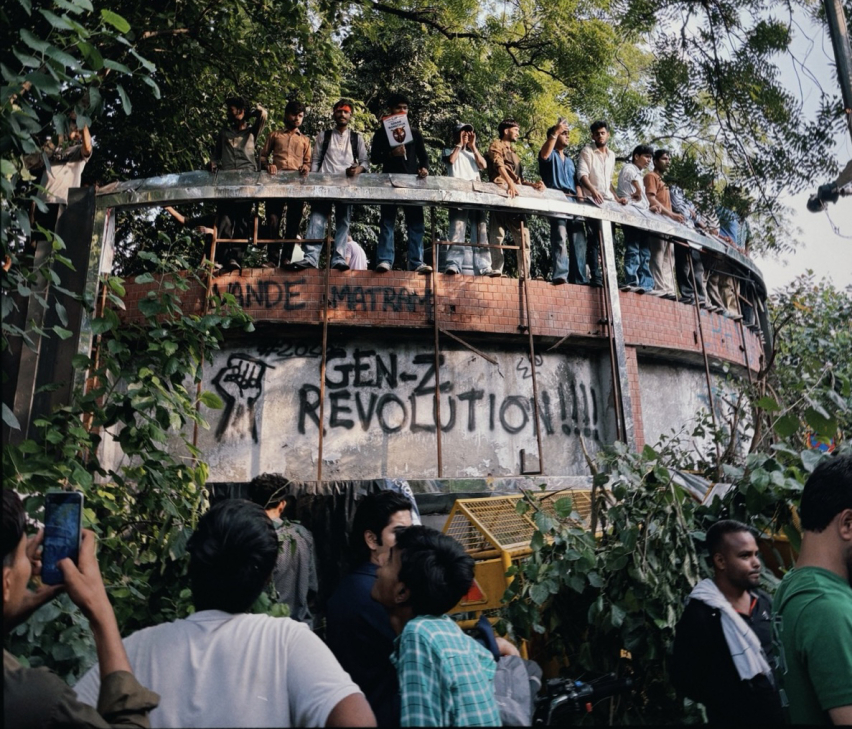
Police said close to 180 people were hurt, 118 of them officers, and detained roughly 70 protesters, some of whom, they said, had thrown stones. Independent reporting by media outlets put the number of injured students alone at more than 100, nearly double the police’s total for all protesters combined. Dipke alleged authorities had planned to let “goons” disrupt the march and blame protesters, a claim police did not directly address. Amnesty International India called it a possible breach of legality and proportionality.
That night, Dipke told the roughly 2,000 protesters who stayed that this was only the movement’s “first call to march.” Earlier that day, two CJP spokespeople had waited four hours to see Union Health Minister J.P. Nadda, then gotten just ten minutes with him, “a waste of our time,” spokesperson Ashutosh Ranka said. Nadda called the meeting cordial.
Churches respond
Christian bodies were among the first religious institutions in the country to speak out. On July 20, the Church of North India’s Delhi diocese, led by Bishop Paul Swarup, called for a transparent investigation into the exam leaks, citing scripture to affirm that every student deserves a system “founded upon honesty, fairness, transparency, and equal opportunity.”
The next morning, the Evangelical Fellowship of India said the state “carries a greater responsibility because it possesses greater power” than protesters and pressed for an independent inquiry into the crackdown. The Catholic Bishops’ Conference of India went further, calling the police action “a heartbreaking assault on the very soul of our democracy” and voicing solidarity with Wangchuk during his hospitalization.
Many in Delhi’s Christian community have also been present in person. The historic Free Church on Parliament Street, next to Jantar Mantar, has been serving for the past several days as the site for distributing water, food, ORS, and light snacks to protesters and others gathered there, an effort coordinated by Christians in Delhi together with the Diocese of Delhi, CNI. An appeal circulated within the city’s Christian community, and individuals and organizations have responded with supplies and volunteers.
Sikh institutions moved in a similar way. Gurdwara Bangla Sahib and other gurdwaras across the city opened their doors after the July 20 crackdown, offering food, first aid, and a place to sleep to protesters fleeing tear gas and baton charges, while separate groups of Sikh volunteers set up a langar (free community kitchen) directly at Jantar Mantar, distributing meals, blankets, and mats to those camping at the protest site.
Not all of it has gone smoothly. Recently a team of Christian volunteers headed toward Jantar Mantar was stopped by police in the Nizamuddin area and told to turn back or face arrest. One local pastor involved in the effort, who asked not to be named, called it an instance of random profiling.
A bloodied nose outside the Prime Minister’s house
The day after the march, Congress leaders Rahul Gandhi, Mallikarjun Kharge, and Priyanka Gandhi Vadra marched to Modi’s residence, demanding his resignation over the police action. A minister from the Prime Minister’s Office came out to negotiate, but talks collapsed when Congress refused to drop its demands.
Gandhi sat on the road outside the residence through the afternoon. Around 6:40 p.m., police physically removed him along with his sister and other lawmakers. Videos showed him bleeding from the nose as he was dragged away. Before being removed, he said, “An attack on students is an attack on every Indian family.”
Cameras, courts, and claims of intimidation
A Public Interest Litigation before the Delhi High Court, filed by former student union president Aishe Ghosh, alleged Delhi Police had installed a permanent surveillance tower at Jantar Mantar capable of facial recognition, filming protesters continuously, even while eating or resting. The court admitted the matter for hearing.
Plainclothes police were separately reported operating during the crackdowns. Disability rights groups alleged that one protester, identified as Sheikh Irshad Mansuri, 25, suffered pellet wounds to his chest, neck, and face and was being treated at Delhi’s Lady Hardinge Medical College Hospital, and warned that shock batons were also being used. Police denied using pellet guns at all, calling the claim “completely false and misleading.” On Friday, July 24, Rahul Gandhi brought Mansuri to a press conference and lifted his shirt to show reporters the wounds, calling Pradhan a “criminal education minister” and demanding his removal.
Parliament was repeatedly adjourned through 20 – 24 July. Kharge told reporters his microphone was switched off moments after he rose to raise the issue, calling it a mockery of democracy.
The fast ends, in writing
After he was forcibly taken to hospital on July 19, Wangchuk’s condition remained precarious, with doctors reporting low blood sugar, dangerously low potassium, and dehydration. His wife, Gitanjali Angmo, asked the Delhi High Court to let him transfer to a private hospital, arguing his stay at the government facility amounted to confinement without consent. A single judge declined, but a two-judge bench reversed that on appeal on July 21 and ordered his immediate transfer to Medanta Hospital, ruling it necessary to protect his health and rights.
Wangchuk broke his 26-day fast late on July 23, before two federal ministers at Medanta Hospital. His team said the government had given written assurance that accountability in the exam system would be discussed on the floor of Parliament, that families of students who died by suicide would receive compensation, and that no cases would be filed against peaceful protesters. “End of hunger,” his team wrote. “Beginning of accountability.”
Modi responded personally: “I pray to the Almighty that Sonam ji remains healthy.”
The message came from a government that, just over three months earlier, had released Wangchuk after nearly six months in detention under India’s National Security Act, a law that permits imprisonment without trial for up to a year. He had been held since September 2025, after protests demanding statehood for Ladakh turned deadly. Dozens of others arrested in that crackdown remained in custody for months afterward, cases the Bar Association president in Leh, Mohd Shafi Lassu, called a “pressure tactic by the administration.”
A late-night video and a fast-track court
Close to midnight on July 23, Modi released his own video message, his first direct comment on the crisis after two months of silence. He said those responsible for the leak had been caught and jailed, that 2.2 million students had been given a retest, and that a bill to punish future leaks would go before Parliament. He said nothing about Pradhan. Congress leader Jairam Ramesh noted the government had until recently told a parliamentary committee no leak had occurred at all.
The timing carried its own irony. Hours earlier, the Central Bureau of Investigation had given a “clean chit” to Sanjeev Mukhiya, the alleged kingpin behind a separate, earlier NEET paper leak scandal from 2024, distinct from the 2026 leak driving the current protests.
The same day, the Delhi High Court appointed a judge to head a fast-track court dedicated to exam-fraud cases, a first concrete step on one of Modi’s promised reforms.
Universities, a chief justice, and a battle over the narrative
Delhi University and Jawaharlal Nehru University both issued advisories telling students to stay away from Jantar Mantar, citing Supreme Court directions and warning of disciplinary action. Kharge accused the government of turning universities into “propaganda outlets.” Gandhi was blunter: “How dare you threaten students for exercising their democratic rights?”
Chief Justice Surya Kant, whose “cockroaches” remark started the movement, rejected reports that he had refused to hear a challenge to the crackdown, saying no formal petition existed, only a lawyer’s letter, and called the reporting “irresponsible and reckless.”
Solidarity protests took place this week in Mumbai, Bengaluru, Patna, and Guwahati among other places. Huge crowds were reported in Mumbai and Patna.
Talks at the Constitution Club
On Friday, July 24, CJP spokespeople Saurav Das and Ashutosh Ranka met ministers Nadda and Jitendra Singh for nearly two hours at the Constitution Club of India, a historic meeting place for lawmakers. It was the second round after an earlier meeting on July 20 ended without agreement.
As per statements by the CJP leaders after the meeting, the government agreed in principle to two of CJP’s three demands: withdrawing cases against protesters and paying roughly ₹1 crore (roughly $104,000) in compensation to each family that lost a child to suicide linked to the leak.
On the central demand, Pradhan’s resignation, the government asked for more time. “The government has sought time till tomorrow afternoon to respond,” Ranka said, adding CJP would not soften its position. “Nothing short of Pradhan’s resignation or his removal would be acceptable,” he said.
Das raised a separate complaint: that Delhi Police had been detaining young people at random since the previous night, including some simply heading home or delivering food, and had manhandled lawyers trying to help them. He said the government first denied it, then assured CJP the incidents would stop.
What longtime activists see in this
Shabnam Hashmi has spent more than four decades working to bridge India’s religious and communal divides, since her brother, the street theater artist Safdar Hashmi, was murdered while performing in 1989. She founded ANHAD, a group working on secularism and communal harmony, in the aftermath of the 2002 Gujarat riots.
What stands out to her about Jantar Mantar is who has shown up. “Students, workers, job seekers, activists, intellectuals, filmmakers and ordinary citizens from different regions, communities, and faiths are standing together,” she told CDI. In her assessment, it may be the first protest in years to openly challenge India’s Hindu-Muslim political narrative.
She also sees a generational shift in how the movement organizes itself. Young Indians, she said, are building “decentralized networks that are fast, creative, and driven by collective action” rather than waiting on traditional political leadership.
John Dayal, the human rights activist who visited Wangchuk at Jantar Mantar earlier in July, offered his own assessment of the week’s events.
“Six weeks ago, I wrote that the cockroaches had made this government look small and a little naked,” he said. “It has taken tear gas, a 26-day fast, and the Leader of the Opposition dragged away bleeding to make it look, for a moment, almost reasonable, paying the families it should have paid weeks ago, promising not to prosecute the young people it beat in the street. What it still will not do is answer for the one man responsible. A government that will compensate the dead but will not name the living men responsible for those deaths, is not being reasonable, it is doing arithmetic on how much accountability it can afford.”
Where things stand
That is where matters stood as the week closed. The government has moved on compensation and legal protection, concessions previously unthinkable from an administration that stayed silent for two months. What it has not done is answer the question that started all of this: whether Pradhan would keep his job, a decision it has promised within a day.
The sit-in at Jantar Mantar continues, six weeks after it began as a peaceful, permitted march — the kind of origin story that has preceded Gen Z uprisings across South Asia. Whether this one joins that list may depend on what the government ultimately decides.