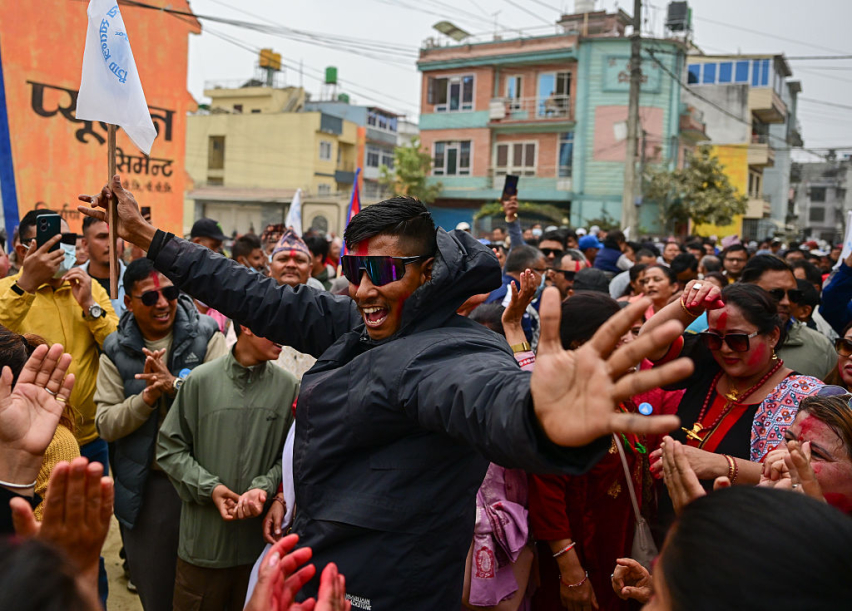
Nepal held its first general election since a deadly youth-led uprising toppled the government last year, with nearly 19 million voters casting ballots on March 5 in an election that has reshaped the country’s established political map.
Vote counting is now largely complete for the 165 directly elected seats in Nepal’s House of Representatives, revealing a landslide victory for the Rastriya Swatantra Party (RSP), a political force formed just four years ago. The party has won 125 of those seats, according to figures released by Nepal’s Election Commission. The final, formal declaration of complete results, including the allocation of 110 additional seats through proportional representation, is still pending.
The election drew strong participation, with turnout reaching approximately 60 percent. Celebrations broke out in cities and towns throughout Nepal as results poured in, though RSP officials asked candidates and supporters to refrain from public rallies out of respect for the dozens of protesters who lost their lives during last year’s uprising.
A Nation Weary of Instability
Nepal has experienced persistent instability since becoming a federal democratic republic in 2008, following the abolition of the Hindu monarchy that had ruled the country for 240 years. Since then, the nation has cycled through 14 governments, with shifting coalitions among competing parties preventing any single force from securing a stable majority.
The latest crisis began in September 2025, when widespread protests erupted after the government of Prime Minister K.P. Sharma Oli imposed a ban on social media platforms. The demonstrations, driven largely by young Nepalis, rapidly expanded into a nationwide movement demanding an end to corruption, better governance and greater economic opportunity.
The unrest turned violent. Police fired on protesters, killing at least 19 people in a single day. By the time order was restored, at least 76 people had died, parliament had been torched and Oli had resigned.
Nepal’s president dissolved parliament and appointed former Chief Justice Sushila Karki to lead an interim administration tasked with organizing fresh elections within six months. In a historic first for the country, Karki became Nepal’s first woman to serve as head of government.
How Nepal Votes
Nepal elects its 275-member House of Representatives through a two-ballot system. Voters choose a candidate directly in one of 165 single-member constituencies under a first-past-the-post method. They also cast a separate vote for a political party, which determines the allocation of the remaining 110 seats through proportional representation. A party must receive at least three percent of the nationwide party vote to qualify for proportional seats. A party or coalition needs at least 138 seats to form a government.
For the March 5 election, 3,406 candidates from 68 parties competed for the directly elected seats. More than 18.9 million citizens were registered to vote across 10,967 polling stations spread over Nepal’s challenging terrain, which ranges from the low-lying Madhesh plains to the high Himalayas.
The major traditional forces, the Nepali Congress and the Communist Party of Nepal (UML), contested all 165 constituencies. Several newer parties formed directly in the wake of the 2025 protests also entered the race, among them the Nepali Communist Party, a merger of several left-wing factions including the former Maoists, and the Shram Sanskriti Party, a grassroots labor movement.
The campaign was fought along generational lines as much as political ones. More than 40 percent of Nepal’s nearly 30 million people are under 35, yet the leadership of its established parties has remained in its 70s. Younger candidates across multiple parties explicitly framed their campaigns against the veteran politicians who have dominated Nepali politics since the 1990s. The RSP in particular ran a highly organised operation, deploying a social media team of more than 660 people and drawing significant funding from the Nepali diaspora, particularly in the United States, according to Al Jazeera.
A New Wave
At the center of this electoral shift stands Balendra Shah, a 35-year-old structural engineer and former rapper known simply as “Balen.” Shah gained national prominence in 2022 when he won the mayoral race in Kathmandu as an independent, defeating candidates from both the Nepali Congress and the Communist Party of Nepal (UML). Born to a Madheshi family from the Mithila region, he emerged as a prominent supporter of the 2025 protest movement, siding publicly with demonstrators as the crisis unfolded.
In January 2026, Shah resigned as mayor and joined the Rastriya Swatantra Party, which declared him its candidate for prime minister. The party’s official leader is Rabi Lamichhane, a former television journalist who founded the RSP in June 2022.
The RSP ran on a platform centered on anti-corruption measures, economic reform and improving governance. Its manifesto pledged the creation of 1.2 million jobs to stem the exodus of young Nepalis seeking work abroad and committed to doubling economic output and introducing universal health insurance.
Shah campaigned extensively in both urban centers and rural provinces, including Madhesh, where he framed his candidacy as that of a “son of Madhesh.” He chose to contest the parliamentary seat of Jhapa-5 in eastern Nepal, the home constituency and political stronghold of former Prime Minister Oli.
Voting Day
On March 5, polls opened at 7 a.m. and closed at 5 p.m. local time. Voters lined up early at polling stations nationwide, from densely populated urban centers in the Kathmandu Valley to remote mountain villages accessible only by foot or helicopter. The Election Commission deployed over 320,000 security personnel drawn from the Nepal Police, Armed Police Force and Nepal Army to maintain order, a reflection of the tensions that had gripped the country since the September uprising.
The heavy security presence proved largely unnecessary. International observers and Nepali media reported a peaceful polling day nationwide, with only isolated incidents recorded. The Election Commission recorded a voter turnout of approximately 60 percent of the 18.9 million registered voters, boosted in part by strong participation from young first-time voters.
Ballot counting began the same evening as polling stations closed, and the first results emerged within 24 hours, faster than the 2022 election, which took nearly two weeks to be called.
Sweeping the Country
The results confirmed the scale of the RSP’s victory. Shah defeated Oli in Jhapa-5 by a margin of nearly 50,000 votes, securing 68,348 votes against Oli’s 18,734. The RSP won every one of the ten directly elected constituencies in the Kathmandu Valley. It also made major inroads in Madhesh and other provinces.
Among the prominent defeats was that of Gagan Thapa, the newly elected president of the Nepali Congress and one of the party’s most prominent younger figures, who lost his parliamentary seat to an RSP candidate.
The Nepali Congress, which had been the largest party in the previous coalition government, won 18 directly elected seats. The Communist Party of Nepal (UML) won nine seats. The Nepali Communist Party won eight seats.
The Hindu nationalist Rastriya Prajatantra Party (RPP), which had long campaigned to restore Nepal as a Hindu monarchy and had held 14 seats in the previous parliament, was reduced to just one directly elected seat.
Under the proportional representation count still underway, the RSP has secured approximately 48 percent of valid party votes counted so far, according to the Election Commission. The party has already surpassed the 138-seat threshold required to form a government from its directly elected seats alone.
Shah is set to become Nepal’s youngest-ever prime minister and the first from the Madhesh region.
What the Collapse of Hindu Nationalism Means
For Nepal’s religious minorities, the RPP’s dramatic decline carries particular significance. The party had explicitly sought to overturn Nepal’s secular status and restore the country as a Hindu state. Under Nepal’s former Hindu monarchy, Christianity was not legally recognized, evangelism was prohibited, and conversion was punishable by imprisonment or deportation.
Nepal became a secular republic in 2008, and the 2015 constitution formally enshrined freedom of religion. However, the same constitution and a 2017 penal code retained prohibitions on proselytism, imposing penalties of up to five years in prison for attempting to convert others. Christians, who number over one million and are primarily Evangelical and Protestant, have navigated these legal constraints while building a significant presence across the country.
The RPP’s near-elimination from directly elected seats, and its sharply reduced share of the proportional vote, indicates that voters were unwilling to support its agenda to reverse Nepal’s secular framework.
International Reactions
India’s Prime Minister Narendra Modi offered congratulations shortly after results emerged, describing the elections as a “proud moment” in Nepal’s democratic journey and pledging continued cooperation with the incoming government. China’s Foreign Ministry also welcomed the outcome, with spokesperson Mao Ning saying Beijing was “glad to see Nepal advance its political agenda smoothly.”
Nepal sits between the two regional powers, and shifts in Kathmandu’s leadership are watched closely by both capitals. The RSP has not articulated a detailed foreign policy platform, though party leaders adopted a restrained tone on geopolitical matters as the election approached.
Counting Continues
The Election Commission is still tallying the proportional representation ballots, a process complicated by the need to transport votes from remote mountain constituencies to counting centers. Officials have not announced a specific date for the formal declaration of complete results.
Once the full results are certified, Nepal will enter the process of government formation. The RSP has already surpassed the majority threshold from its directly elected seats alone, and the party will be invited to form a government and present a prime minister to parliament.