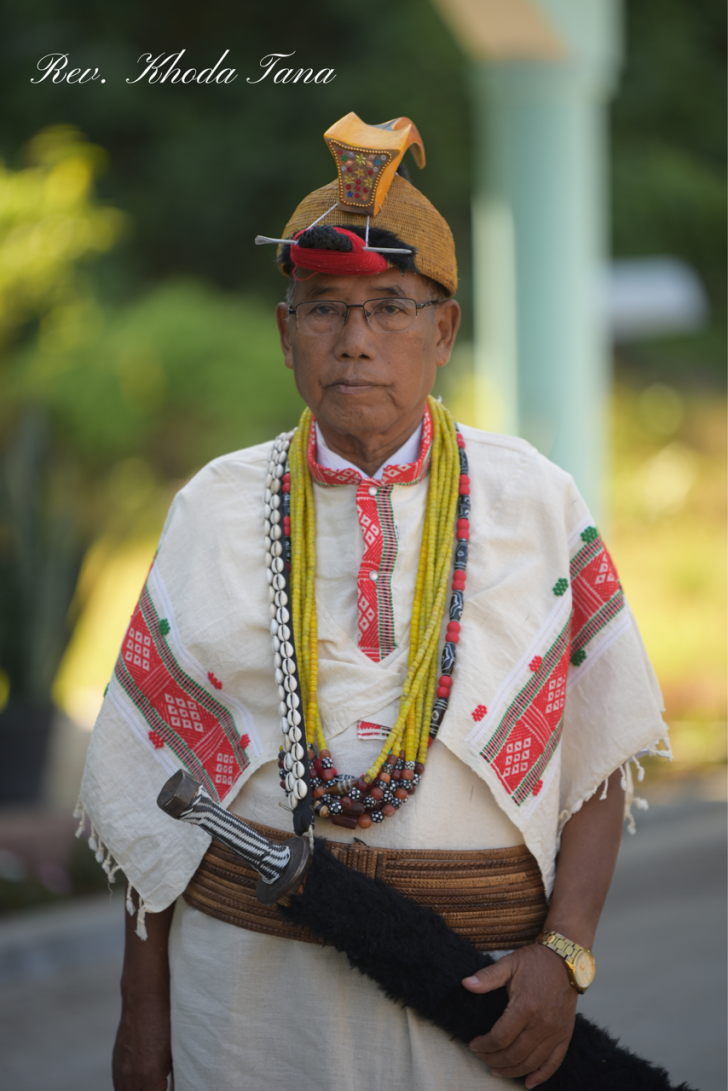
Under a canopy at Nirjuli Village-I, district Papum Pare, at the residence of Mrs. Jumshi Tana, mourners gathered on the morning of July 13 for the funeral of the Reverend Khoda Tana – a founding figure of the Christian faith among the Nyishi, the largest indigenous tribal community in India’s northeastern border state of Arunachal Pradesh.
The Rev. Halli Likha, principal of the Arunachal Theological College in Moinhappa and a former chairman and regional secretary of the Evangelical Fellowship of India, officiated as minister. The Rev. Dr. Tagang Gelo, pastor of the NBCC’s Nirjuli Pastoral Range, led the service.
“It was Rev. Khoda’s last wish that I conduct his funeral service, so it was an honor for me,” Rev. Likha told Christian Daily International (CDI). He had first associated with Rev. Tana in 1988 as a schoolboy, a relationship that gradually deepened into what he described as a “father-son” bond.
The order of service, held under the Nyishi Baptist Church Council (NBCC), included a congregational hymn led by the Nirjuli Town Baptist Church youth, tributes from family, church and the NBCC, and a floral tribute. The coffin was carried to the grave by NBCC ministers.
“We have a tradition of celebrating a person’s life for three days,” said Dalin Tana, Rev. Tana’s son, speaking to CDI. “Beginning with the funeral service on July 13, we had a fellowship at home where church youth had gathered on the second day. On the third day, the NBCC organized a ‘Protection and Comfort Service’ at our home. A few close friends were invited, and many church leaders came and prayed over us. So, we celebrated dad’s life from July 13 to 15.”
When CDI asked Dalin Tana about the proudest moment he had experienced regarding his father’s life, he answered honestly: “I felt the proudest of my father on his funeral day. After hearing several people pay respects to him, and receiving hundreds of condolence messages, I realized the enormous impact my father had on people’s lives across the country and beyond. I am very fortunate to have been born as his son.”
Rev. Tana died two days before the funeral, on July 11, 2026, of natural causes, at 10:30 am. He was 82.
A former President and Executive Secretary of the NBCC, Rev. Tana belonged to the first generation of Nyishi converts to Christianity.
He was born on December 1, 1944, in Reyi village – now known as Pech – in the Sagalee sub-division of Papum Pare district to Tana Tach [father] and Nangbia Yata Tana [mother]. He later made his home in Nirjuli Village-I in the same district.
Orphaned young, he lost his father at the age of four or five, and his mother in 1953, according to a personal testimony he had written of his own life.
His mother had taken him to Rangajan Christian Mission School in North Lakhimpur, Assam, around 1948. After her death, he was transferred to John Firth Christian Mission School. He was baptized that same year, on May 17, 1953, by Peter Pando, at the age of nine.
In the summer of 1955, travelling home through Doimukh, a small hill settlement near his own village, he was detained by a local administrative officer for studying at a Christian school. His Bible and hymn books were confiscated, and he was warned not to return. He was taken by personnel of the Central Reserve Police Force (CRPF) to Kimin and then to Ziro, a nearby administrative outpost, where another government official also rebuked him. He was later admitted to a school in Ziro.
He went on to Tezu High School in eastern Arunachal Pradesh, and then to Harisinga Christian High School in Darrang, Assam, with the help of American missionary Rev. K.W. Hagstrom, passing his matriculation in 1963. He later enrolled at J.N. College in Pasighat, also in eastern Arunachal Pradesh, and graduated with a Bachelor of Arts in 1971. He is understood locally to have been among the first graduates from the Sagalee-Doimukh area.
After graduating, Rev. Tana joined the civil secretariat of the North-East Frontier Agency (NEFA), now Arunachal Pradesh. He moved with it from Shillong to Itanagar in April 1974.
That same year, persecution against Christians in the region intensified. In his own account, 47 churches among his tribe were burned, believers were beaten and scattered, homes were destroyed and livestock looted.
Opposition was an everyday affair for Rev. Tana, and several such incidents have taken on the quality of folktales, narrated to children and elders alike in the villages where Tana moved. One story in particular was consistently recalled when CDI spoke to his wife, son, second daughter and a close friend.
He was placed under house arrest and detained for a week at Rono village, Doimukh, by local villagers. He was tortured for several days before his hands and feet were tied to a bamboo, “like a pig ready to be roasted under fire.” His persecutors then took him to Sagalee, intending to throw him from a hanging bridge.
“It was a very clear afternoon. There were many people there – some of the witnesses are still living,” narrated Dalin Tana.
“They mockingly said to my father, ‘Hey Khoda, if your God is so real, there will be thunder and lightning this afternoon,’ and they laughed at him. Then, as soon as they grabbed my father’s hand to throw him off the bridge, a massive thunderstorm broke out. Rain began to pour on that bright afternoon. The people carrying my father were frightened and scattered. They began to say – ‘Koda’s God is really true, and we should not touch him’,” said Dalin Tana.
He added that the man who first grabbed Rev. Tana’s hand to throw him off later accepted Christ and went on to testify about the incident in his church and wherever he shared his testimony.
On April 30, 1974, Rev. Tana’s own house and all his belongings were burned to the ground.
Tana married later that year, soon after the persecution subsided.
“I was not a Christian when I married Khoda,” recollected Jumshi Tana, Rev. Tana’s wife, who was 15 when she married 30-year-old Tana. “He was an educated man and thus very well respected within our community. My parents, without hesitation, gave me in marriage to him, asking me to ‘stand by him.’ My own relatives opposed my marriage to a Christian and persecuted Khoda.”
Jumshi Tana also recalled developing severe leg pain, and how her animist mother took her to worship places where they sacrificed a goat, a cock, a Drung ox and offered several other sacrifices in hopes of healing. It was then that Rev. Tana counselled his wife to “believe in the Lord Jesus and get baptized.”
Jumshi Tana quoted the biblical account of Naaman obeying Elisha and washing in the Jordan River: “In the same way, I obeyed my husband and took baptism in March 1984. When I came out of the water, my whole body became so light and my leg pain was completely healed – even to this day,” she said.
Dalin Tana admires his father for remaining faithful to his mother. “In a culture where men kept three wives, my father remained faithful to my mum and spoke out against the practice of polygamy.”
Rev. Tana held his church post when the NBCC was still known as the Subansiri Baptist Christian Association (SBCA). He helped structure the body in its early years while strengthening churches across Arunachal Pradesh and Assam. He also bridged the NBCC with the state’s apex Baptist body, the Arunachal Baptist Church Council (ABCC).
In 2014, he contributed the foreword to the sixth edition of the Nyishi Kristian Bemin, the community’s Christian hymnal.
In 1978, under pressure from his community, he resigned from government service to contest the state’s first Legislative Assembly election from the Doimukh-Sagalee constituency as an independent candidate. He polled 1,520 votes and finished second, behind Janata Party’s Tara Sinda.
In 1980, he contested again – this time on a People’s Party of Arunachal (PPA) ticket and lost by a razor-thin margin of 321 votes to Congress(I)’s Techi Takar.
Rev. Tana himself described both defeats as providential and wrote that “God did not permit me to win.”
He entered full-time ministry afterward under the SBCA, serving the council as Executive Secretary, President and Treasurer at different times. He also served as Secretary and Treasurer of Calvary English School in Moinhappa, and as President of the North Bank Baptist Christian Association (NBBCA).
“Wherever my husband did ministry, he did it at his own cost, and I supported him by managing the children and financially through my salary,” said his wife.
Beyond church administration, Rev. Tana was a gospel singer, composer and lyricist. He translated 248 hymns into the Nyishi language for the Nyishi Kristian Bemin, contributed to the translation of the New Testament, and developed Christian literature for the community, according to a tribute by Kon Jirjo Jotham, his successor.
The Nyishi language had no written script until relatively recently, making such translation work foundational to how the community reads and worships today.
A separate tribute, from Mrs. Likha Yaram of Hollongi village, placed Rev. Tana among a wider generation of pioneering Nyishi Christian leaders. She named Tana Duli, Rev. Ter Tana, Taying Bate, Neelam Taram, Piel Tekhi and Taying Kuma – all now deceased, as those credited together with laying the spiritual foundation of the Nyishi Church.
Rev. Tana is survived by his wife, Jumshi Tana – who retired as Under Secretary from the Civil Secretariat in Itanagar, three daughters, a son, Dalin Tana, and nine grandchildren. A second son died in infancy at eleven months.
Rev. Tana remained engaged with the long-running dispute over the Arunachal Pradesh Freedom of Religion Act, 1978 – an anti-conversion law that sat unenforced for nearly five decades until a 2022 petition led the Gauhati High Court to order the state to frame implementing rules. In March 2025, he wrote to the Chief Minister urging the state to reconsider enforcing the law and proposing a state-level interfaith summit instead, warning of a “Manipur-like situation” if the matter went unresolved.
Word of Rev. Tana’s death drew tributes from public figures across the state’s political and religious spectrum.
Former Chief Minister and Indian National Congress leader Nabam Tuki, himself from Sagalee, wrote on Facebook: “I am deeply saddened by the passing of Rev. Khoda Tana, a revered spiritual leader and a pioneer of the Christian faith among the Nyishi community.” He added that Rev. Tana’s “lifelong service, unwavering dedication, visionary leadership, and invaluable contributions” to the NBCC and church growth across Arunachal Pradesh and Assam “will be remembered with deep gratitude and respect,” and extended condolences to the bereaved family and the “NBCC fraternity.”
Techi Kaso, a state legislator from the Itanagar constituency, called Rev. Tana “a veteran and a pioneer” who was “instrumental in unifying the state Baptist community.”
James Techi Tara, president of the Arunachal Christian Forum, called Rev. Tana “not merely a pastor” but “a pioneer, a teacher, a mentor and a visionary.” He highlighted Rev. Tana’s contribution to Nyishi Christian literature and wrote that his life reflected the Apostle Paul’s words in 2 Timothy 4:7: “I have fought the good fight, I have finished the race, I have kept the faith.”
Likha Saaya, a former Arunachal Pradesh legislator, said Rev. Tana’s “legacy of faith, unity, humility, and selfless service” leaves an irreparable loss.
The All Nyishi Youth Association (ANYA) said, in a statement from its president Jamru Ruja, that Rev. Tana was “a mentor to countless youths” whose “life of faith, humility, and selfless service will continue to inspire generations to come.”
“He trusted me, just as I trusted him,” said Rev. Likha, recounting how it was Rev. Tana who assigned him his first church as a presbyter and, the following year, sent him for further theological study. “In 1993, he sent me to Union Biblical Seminary to do a Bachelor of Divinity, and thus I became the first Bachelor of Divinity in my tribe,” said Likha proudly, calling Rev. Tana his “closest friend and mentor.” Rev. Tana also appointed him as a Bible translator.
Kon Jirjo Jotham, who succeeded Rev. Tana as Executive Secretary of the SBCA, now the NBCC, wrote of meeting Rev. Tana’s widow at the family residence, describing her as bearing “the immense pain of bidding farewell to her beloved husband.” He described Rev. Tana as “a living history, a spiritual father, a humble shepherd, a great mentor, great educator and a towering pillar of faith.”
Among those who also travelled to Nirjuli was Mrs. Likha Yaram of Hollongi village, wife of the late Tana Duli. She paid her last respects to the family on July 12 as a close relative, offering words of comfort and spiritual encouragement.
Tadup Tana Tara, a senior advocate and distant relative, who attended the service, wrote that he was bidding farewell to “Abb Rev. Khoda Tana” – using a Nyishi term of address. “Death is but a relocation of place, a farewell that lingers in the chest like a soft echo of a once-warm voice,” he wrote.
Among the Nyishi, Rev. Tana was fondly addressed as “Makte”, “Achi” and “Abb” – terms of respect for elders and father figures.
Dalin Tana recalled that his father held a firm moral code he expected his children to uphold: “He expected us to dress modestly, stay away from bad influences and bad habits, to uphold our parents’ dignity in society, and to attend church regularly.”
Myrline Tana, 48, Rev. Tana’s second daughter, described her father as “a disciplinarian who would often crack jokes with his children.” She recalled that the first verse he taught them as children was John 3:16, and that in their teenage years he would emphasize 1 Corinthians 6:19–20: “Do you not know that your bodies are temples of the Holy Spirit, who is in you, whom you have received from God? You are not your own; you were bought at a price. Therefore, honor God with your bodies.”
“He made my sister repeat this verse day in and day out when she was in her teens, then when I was, and when my brother was. There was a reason behind this, and he understood it really well,” said Myrline Tana.
“I doubt if we would ever have anybody like him in the generations to come – such is the loss to the Christian community,” said Rev. Likha.