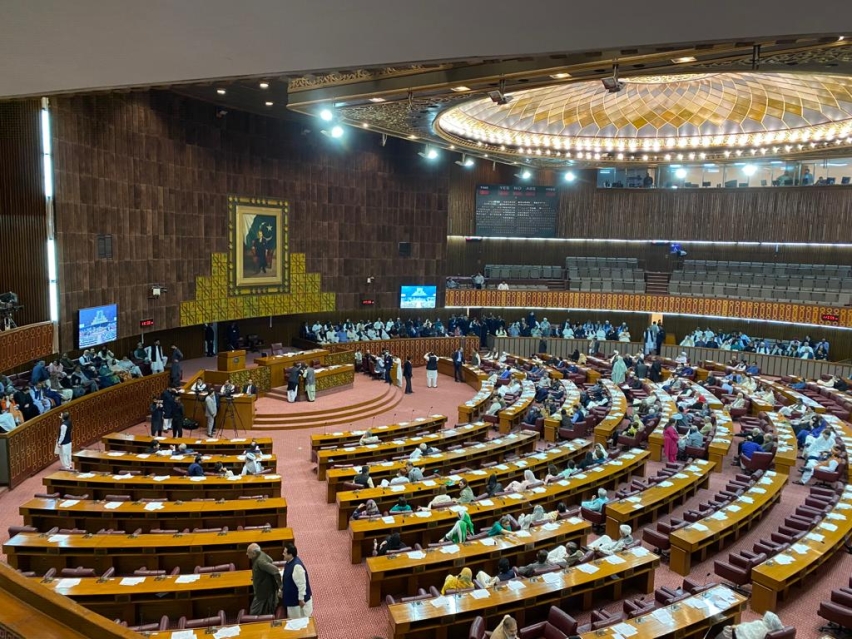
Pakistan’s parliament has approved long-delayed legislation to establish a National Commission for Minorities Rights, a move welcomed as a step toward protecting non-Muslim communities, including Christians, but criticized by rights advocates for stripping the body of key investigative and enforcement powers.
The National Commission for Minorities Rights Bill 2025 was passed Dec. 2 with a majority vote during a joint session of the National Assembly and Senate, clearing the way for the creation of a government-appointed commission to monitor minority rights and advise authorities. However, the revised law removes provisions that would have allowed the commission to initiate inquiries or summon officials—changes that have prompted concerns about its independence and effectiveness.
Under the new law, an 18-member commission comprising three Hindus — two from lower caste backgrounds — three Christians, one Sikh, one Baha’i, one Parsee, and two Muslim human rights experts, will investigate minority rights violations, monitor policy implementation, and advise government departments on minority welfare.
Each of the four provinces will nominate a representative from its human rights or minorities department, along with one minority member from Islamabad. Appointments will be made by Pakistan’s prime minister for three-year terms.
The revised legislation, however, strips the commission of the authority to summon witnesses, inspect detention centers, or initiate inquiries on its own — powers included in the earlier May 12 bill which was sent back to the parliament by President Asif Ali Zardari for a wider discussion and review after some parliamentarians and the government objected to granting of “suo motu” powers to the body.
Opposition parties, particularly the Pakistan Tehreek-e-Insaf (PTI) and Jamiat Ulema-e-Islam-Fazl (JUI-F), created a ruckus in the House when Federal Minister for Law and Human Rights Azam Nazeer Tarar tabled the bill for vote.
Addressing the session, Tarar said that “neither the law and the Constitution, nor our conscience allows us to make a proposal that contradicts the Quran and Sunnah.”
He said that four amendments were suggested to the original draft of the bill, and they had been incorporated into the proposed legislation. The revised bill was ultimately supported by 160 members, with 79 voting against it.
Saying that minorities were defined as “non-Muslims” in the Constitution, Tarar said, “This is a commission for non-Muslims. Our Hindu, Christian and Parsi brothers are as good Pakistanis as we are.”
The minister recalled that a 2014 Supreme Court judgement by former chief justice of Pakistan Tassaduq Hussain Jilani called for the constitution of a commission for minorities.
According to Article 75(2) of the Constitution, the legislation will now be referred back to the president. The provision states that “the president shall give his assent within 10 days, failing which such assent shall be deemed to have been given.”
Minority rights activists expressed cautious support to the new legislation.
Peter Jacob, the Executive Director of research and advocacy organization Center for Social Justice (CSJ), said there was confusion about the legislation that was passed by parliament as the draft uploaded on the website of the National Assembly on Dec. 2 stated that the commission would comprise 18 members, but that document was later removed from the website.
“Until the government shares the final draft of the passed legislation, I cannot comment on the composition of the members. However, if the approved bill in its current form states that the commission will have 18 members with proportionate representation from the federating units as well as the federation, then there is hope for the establishment of a good institution,” Jacob told Christian Daily International.
However, the prominent minority rights advocate regretted the removal of the suo motu powers of the commission from the revised legislation, saying the authority could have enabled the commission to intervene in issues on its own, as there were chances of complainants succumbing to pressure from government departments or other entities.
Calling for merit-based appointments in the commission, Jacob said this was necessary to end structural imbalance in the government machinery and make it more inclusive.
Minorities Alliance Pakistan Chairman Advocate Akmal Bhatti echoed similar concerns, saying the legislation had fallen short of expectations.
"The Supreme Court's 2014 directive to establish a minorities commission was ignored, and the bill languished with the president for over a year due to unwarranted objections,” Bhatti told Christian Daily International.
Arguing that the legislation appears designed to satisfy international observers rather than meaningfully protect minorities at home, he said, “It's regrettable that the government has yielded to pressure from the European Union's monitoring mission, prioritizing international scrutiny over its constitutional obligations.”
Bhatti specifically criticized the bill's limitations saying that the government-nominated members would be unable to effectively address discriminatory policies. “The commission can only make recommendations, lacking the authority to enforce change or hold institutions accountable,” he said.
He welcomed the 33% representation of women but expressed concerns about reduced representation of minorities in the proposed commission.
“The NCMR will also lack the authority to take action against government institutions involved in violating minority rights. The commission's reports will be subject to review by the Senate's Standing Committee on Human Rights and the National Assembly's Parliamentary Committee on Human Rights, rendering the commission powerless in its current form,” he said.
Meanwhile, the Human Rights Commission of Pakistan (HRCP) welcomed the passage of the bill in a post on X.
“Noting that the legislative debate and amendments reflected some political friction, we intend to review the bill closely but emphasize that the proposed commission must protect all religious minorities equally, without exception or hierarchy,” the HRCP wrote.
“Moreover, its mandate and powers must align strictly with constitutional guarantees of freedom of religion or belief and nondiscrimination for all minority citizens,” it stated.
Christians, Hindus and Sikhs make up roughly 4 percent of Pakistan’s 241.5 million people. Entrenched discrimination, poverty, and limited access to education and employment, make these minority communities vulnerable to rights abuses, rights activists say.