
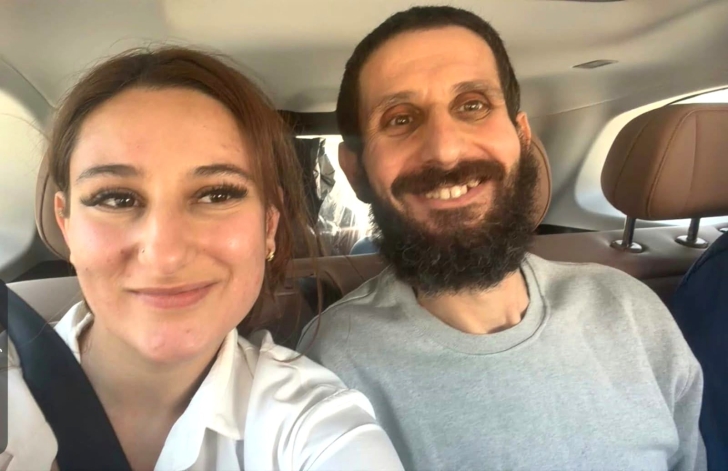
Looking frail after 32 months in an Israeli jail, a Palestinian Christian prisoner from the Ramallah area was released on Aug. 20.
Rami Fadayel served a 32-month detention without charge or trial. While in detention, he was denied an Arabic-language Bible until the day before his release.
Following legal intervention, an Israeli judge ruled earlier this year that he should be able to get a copy of the Holy Bible and asked the Israeli attorney general to explain why a Bible a visit by his religious leader was barred.
Rami Saleh, director of Jerusalem Legal Aid and Human Rights Center (JLAC), said that last April, after months of intervention, JLAC finally received court approval to make a Bible available to Fadayel.
Speaking from Ramallah, Fadayel told Christian Daily International that conditions in jail were extremely difficult.
“The situation is beyond explanation. Food was rationed, beating was a daily occurrence, and the ability to have a shaving blade was denied,” he said.
On June 8, nearly two months after the court decision to receive a Bible, a Torah (Old Testament) in Hebrew was given to him, even though he has only beginner-level knowledge of Hebrew, he said. On July 21, even this Hebrew Bible was confiscated when he was transferred to a different section of the Beersheva Prison.
Fadayel again submitted a legal complaint, and on Aug. 19, a day before his release as the extended administrative detention expired, he was given an Arabic Bible.
He said his favorite Bible verse Matt. 4:4, “Man shall not live by bread alone, but by every word that comes out of the mouth of God.”
His lawyer, Rami Saleh, had noted earlier in a report that he began legal intervention in December, making two requests: access to the Holy Bible and access to a priest.
“According to his faith, a Christian is to be administered the sacrament by an ordained priest and is to be allowed a confession to a priest at least once a year,” Saleh said.
Bishop William Shomali of the Jerusalem Latin Patriarchate had affirmed to Christian Daily International that getting a Bible to a prisoner and visiting him is part of Christian belief.
“The Lord Jesus specifically talked about the need to visit prisoners,” Bishop Shomali said. “In Matthew 25:31-46, Jesus emphasizes that visiting prisoners is a direct act of service to Him. He identifies with the ‘least of these,’ stating that helping – or neglecting – those in prison is equivalent to doing so to Him.”
Saleh said that Nafha Prison, a high-security Israeli prison in the Negev about 200 kilometers from Jerusalem, had refused both requests. The Israeli prison authorities have agreed to allow the Bible but not the priest’s visit.
Despite being released, the Israeli attorney general is still expected to reply to the Israeli court as to why a Bible and a visit by a priest were denied. Saleh said he doesn’t expect much from the attorney general’s office’s reply, due Aug. 29, but that it could be helpful in further litigation.
Another detained Palestinian Christian, Nael Halabi, has let it be known that he wants access to the Bible in Arabic. Saleh’s office is handling that case.
“Palestinian prisoners have had access to their religious books, but since Oct. 7, 2023, all were confiscated,” Saleh said. “The Islamic Quran was returned to prisoners after some time, but not the Bible.”








