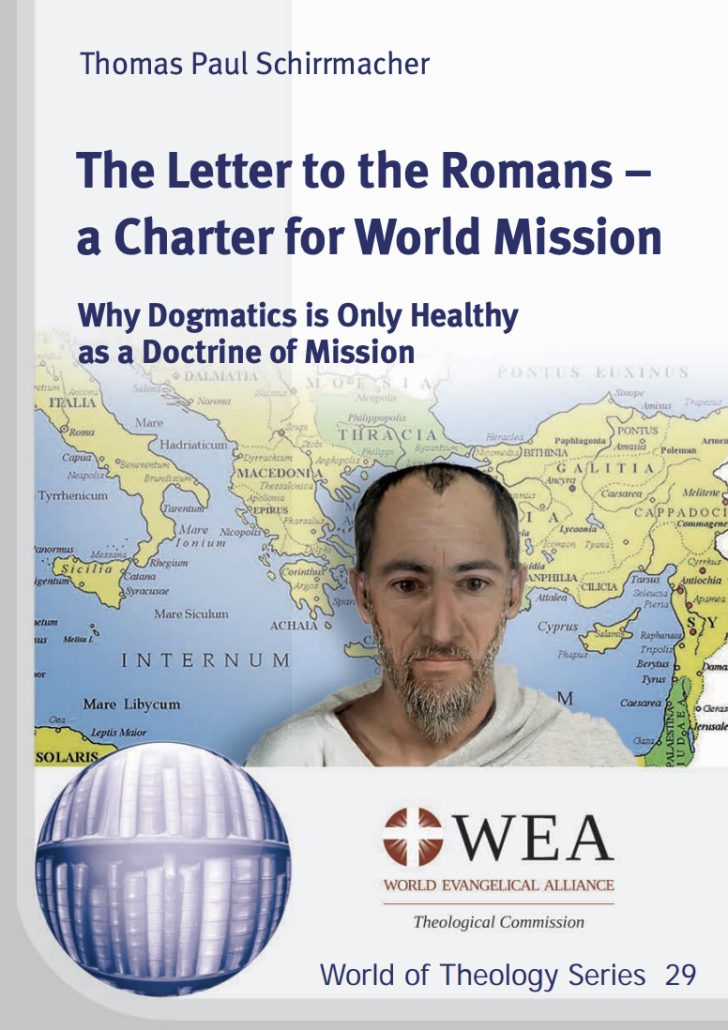
German theologian and missiologist Dr. Thomas Schirrmacher, former secretary general of the World Evangelical Alliance, is calling for a renewed understanding of the Apostle Paul’s Letter to the Romans as a foundational text for global mission rather than a purely doctrinal treatise. In a recent interview with Christian Daily International, Schirrmacher reflects on insights from his latest book, The Letter to the Romans – a Charter for World Mission, arguing that Western theology has long overlooked the epistle’s missionary purpose and that recovering this perspective is essential for shaping theological education, strengthening the global church and aligning doctrine more closely with the church’s calling to participate in God’s mission.
CDI: In your latest book, you argue that the Epistle to the Romans has been historically misread as a purely doctrinal text. Why do you believe its missionary character has been mostly overlooked, and why is recovering that emphasis important today?
Schirrmacher: Even though the first and last chapters of Romans make it clear that Paul wrote this letter from the midst of his missionary endeavors to gain the support of the church in Rome for his plans for world missions, Romans has largely been read as though Paul were primarily an important thinker with a professorship in Antioch. I believe the reason for this is that Romans was at the heart of dogmatic battles in church history several times when world missions were out of sight and reach of the Western church, especially during the Reformation in the 16th century. For the Western world, Romans is the Bible book that most closely aligns with its largely systematic and philosophical mindset, presenting arguments with a clear structure. Romans seems to have fallen prey to the idea that the church lost sight of God as a missionary who created the Church to fulfill His mission.
You have been exploring the themes of Romans since the late 1980s, what is it that personally fascinates you so much with this book?
Paul's primary profession was that of a missionary and apostle. He traveled the world, establishing churches wherever he went. Once a church became somewhat self-sufficient, Paul moved on to the next place. This raises the question of how the fascinating, dogmatic explanation in Romans relates to Paul’s profession. Why did Paul write such a lengthy letter amidst his stress and personal struggles? The answer can be found in the letter itself.
Paul’s strategy was to plant churches in strategic locations, appoint elders as their leaders, and have these churches perform further tasks in their regions. Once a church was established, Paul said, "I have nothing more to do in these countries" (Rom. 15:19–23). Passing through on his way to Spain, Paul now desires to be strengthened by the congregation in Rome. Paul and his team made the mission plans. However, he seeks the church's support, beginning with evangelism in Rome and extending to further missions in new areas. He knows he has something to offer the church as a missionary. To this day, churches have never been harmed by missionaries bringing "spiritual gifts."
I find this fascinating!
You write that “dogmatics and mission are two sides of the same coin.” Can you elaborate on what it means for systematic theology to be “healthy only as a doctrine of mission”? How should this shape theological education and church practice today?
God sent his Son, who sent the Holy Spirit, who sent the Church. Therefore, missions are part of God's essence. Any systematic view of our faith that bypasses this and does not see it as the unifying theme throughout history is flawed. I tried to prove this especially in my book “Missio Dei”.
For me, the book of Romans is evidence that the most brilliant intellectual defense of the Gospel only made and makes sense if the Gospel is spread beyond a small circle of theological experts into all the world.
Many believers have a gut feeling that something is going wrong with theological education and that it is in danger of becoming self-entertaining. The most detailed and well-thought-out defense of the Gospel emerged from the Pauline call to world mission. At the same time, world mission deserves the most brilliant minds and thoughts for its defense.
Who is this book written for primarily? Are you speaking mainly to theologians and pastors, or is your hope that everyday Christians will reframe how they understand Romans—and their role in the Great Commission?
I am 65 years old, and I first of all wanted to document my four-decade study of Romans before I am too old to take part in this global discussion any longer. I also wanted to encourage leaders in the Global South that their intuition that Romans is more than just dogmatic treaties is supported by the work of many renowned New Testament scholars and missiologists over time.
You provide a historical overview of the so-called “mission thesis” on Romans going back to 1863. How does your own approach build on or differ from earlier interpretations? What makes your contribution unique at this moment in church history?
Romans has been extensively used in systematic theology, primarily by individuals with no expertise or interest in world missions. Those teaching, researching, and strategizing missions have quoted Romans selectively, but did not publish commentaries. Having worked and taught in both areas, I want to merge the viewpoint of exegesis and systematic theology with mission researchers and practitioners, as I did in my German commentary on Romans.
Additionally, I want to return Romans to its original form as a letter about God's mission to the local church. In essence, I want the local church to reclaim the letter.
Finally, in a time when global mission is shifting dramatically—especially with the growth of the Church in the Global South—how do you hope this book will serve the global evangelical movement?
Western theology is characterized by the division of academic theology into specialized subjects. Western evangelicalism has often inherited this approach from Western liberal theology. For too long, this originally has also shaped theological education in the rapidly growing Church in the Global South. However, the Global South has since overcome the divide between personal piety versus public Christianity, between teaching in academia versus vibrant preaching in local churches, and between an easy to understand summary of the gospel versus offering detailed, even academic reflections on it inspired by thousands of pages of Scripture.
The Church in the Global South increasingly takes Scripture at face value and recognizes Romans as a letter to a local church, encouraging them to fulfill the one Great Commission God has given us: to spread the good news of Jesus Christ, the King of Kings, to every corner of the world.