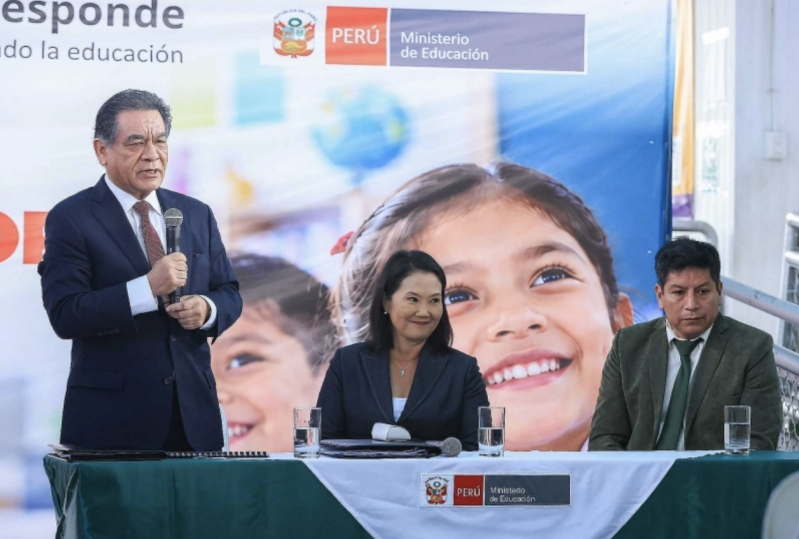
Peruvian President Keiko Fujimori unveiled an education reform Sept. 14 that would update the national school curriculum and remove content her government considers ideological.
The review is not limited to so-called "gender ideology." Education Minister José Antonio Chang said it will also cover how schools teach the period of violence Peru experienced from 1980 to 2000. The reform follows a 2025 law that already ordered changes to sex education in schools.
Fujimori and Chang announced the plan during the presentation of the National Education Plan 2026-2031 at the José María Arguedas school in Santa Anita, a district of Lima.
Fujimori said teaching should prioritize data and verifiable information, the official gazette El Peruano reported.
Chang said: "We are going to remove every kind of ideology from the national curriculum."
The plan also aims to strengthen reading, writing, mathematics, science, civic education, English and financial education. The executive branch announced a daily reading hour and a guide to help families support their children's learning.
What content is under review
Official statements point to a broad review of the curriculum. Some outlets have reported the announcement as a specific order to eliminate "gender ideology," but the government's wording also covers the teaching of the country's recent history.
In an interview with Caretas, Chang said his ministry will review content and materials on the 1980-2000 period of violence.
He said the changes must be based on teaching criteria and scientific evidence. He also said he rejects what he considers manipulation or indoctrination in how terrorism is taught.
The government has not yet announced a timeline for the changes.
The 2025 law on gender and sex education
Law 32535, published Dec. 24, 2025, set a new framework for equal opportunities between women and men.
The law provided for replacing the National Gender Equality Policy. It also established that references to the gender approach are to be understood as references to the approach of equal opportunities between women and men.
In education, the law directed the Ministry of Education to issue sex education guidelines on a scientific, biological and ethical basis and to include them in the curriculum update. It removed references to comprehensive sexuality education. It also recognized the role of parents or guardians in their children's education.
The law is separate from this week's reform announcement. Further steps are still needed to bring the changes into classrooms.
Questions over the reform's scope
The proposal has raised questions about how the government will decide what counts as ideological content.
In an editorial, the Institute for Democracy and Human Rights of the Pontifical Catholic University of Peru expressed concern about the reform's possible effects on the teaching of the internal armed conflict, the gender approach and comprehensive sexuality education.
The executive branch has not yet defined which content will be removed or the criteria it will use to apply the changes.