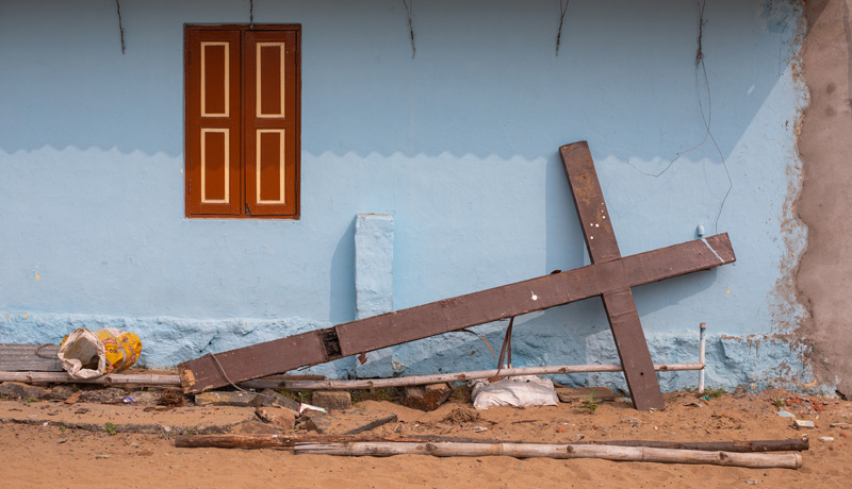
India will always be for me a warning as to how quickly a culture can change from one largely hospitable to the exercise of the faith to one that is more inhospitable. One Christian leader summed it up this way, “Just 20 years ago, when you were introduced as a Christian few were bothered; now, if you are, you can see the person thinking, ‘I wonder how much money they took to convert!” He added, “We have moved from being a people who belonged, to a people who were bribed.”
I remember my first visit to Delhi in 1996 asking a group of high-ranking Indian church leaders; Are you worried about the rise of Hindu extremists in your society? There were hoots of laughter. One of them explained to me, a touch condescendingly, "we are a secular country; the only one in Asia, so our entire history is against it.”
In 1999... waves of anti-Muslim and anti-Christian violence roiled parts of the country.
Two years later that the political party that represented the ideology of Hindutva (that India was, and should always be, a Hindu state) took power in 1998, and although it was short lived, they returned in 1999 and waves of anti-Muslim and anti-Christian violence roiled parts of the country.
Increased globalization always brings increased tribalism in its wake.
In 2004 people breathed a sigh of relief as the Congress party returned to power, and the leadership of the economist Mahomet Singh turbocharged the economy. But increased globalization always brings increased tribalism in its wake, and in 2014 the new voice and face of Hindutva, Narendra Modi, exploited this fear and swept into power, where he is still today.
Such is Modi’s alchemy that Shashi Tharoor called the new ideology, “Moditva”, since his personality and nationalist “I’m for India” brand softens the hard Hindutva which formerly tended only to appeal to the higher caste voter.
India has overhauled China as the world’s largest state by population.
Now Modi could appeal to the vast underbelly of Indian society who were normally left behind, the so-called Other Backward Castes, or OBC’s. Since then, India has overhauled China as the world’s largest state by population (1.42 billion) and the UK to become the world’s fourth largest economy by GDP (US$4.5trillion).
Fast forward then to 2024 and a similar gathering of the leaders of India’s church in Delhi. My first surprise was to discover that if my attendance as a foreigner was made public the conference would be cancelled. That was new.
No one expected this to change in the short to medium term.
My second one was to see that every leader began from the same assumption—that they were all living in a “new India”. The third surprise was that no one expected this to change in the short to medium term.
Many papers were read under strict rules banning attribution, but the similarities were striking coming from the most respected leaders of the mostly Protestant church. I remember this comprehensive comment most of all, significantly because of who uttered it:
"It is no longer easy to affirm I am Christian and I am Indian. In this new context of Hindutva, we must accept that we were wrong to think that India was secular to the core. This was smuggled in by Nehru and his western socialism. But India always was a Hindu nation. Now our task is to affirm what kind of identity we need to have and what kind of India we must affirm. We are unable currently to do this because we have a church full of Dalits and teachers who are Brahmins."
The need to rethink the identity of the Christian church was also an acceptance that the Hindu extremist capture of the state was semi-permanent.
This was interesting. There was a clear acceptance that the secular nature of India was paper thin; that it had been foolish to assume it was deep and impossible to resist. Indeed, one character even said, “The BJP are only the right wing of the Congress party”. But the need to rethink the identity of the Christian church was also an acceptance that the Hindu extremist capture of the state was semi-permanent.
Gone were any predictions of a Christian India. Life in the “new India” would involve a Church recognizing that elderly bromides of “more evangelization” were missing the point about the extent of structural changes that had taken place in the country.
Modi’s government moved quickly to control education, justice and media, and repurposed the Foreign Contributions Act to dry up western funds for their charitable arms in India, prompting the end of organizations like World Vision and putting others like Compassion International on life support. This was callous, since hundreds of thousands of poor children remain unassisted as a result.
No one does political self-righteousness as well as Modi, but the poor suffer more. The Pew forum released its latest annual report on religious restrictions around the world this June. India is classed as “very high” on their social hostilities index, and “high” on the government restrictions index.
“Freedom of religion laws”... ask for huge fines or even life imprisonment for those found guilty of converting anyone.
Even the Economist was moved to tut-tut about the two new anti-conversion laws pushed through in March in the states of Chhattisgarh and Maharashtra, making that fourteen out of twenty eight states that have them. Cleverly called “freedom of religion laws”, they ask for huge fines or even life imprisonment for those found guilty of converting anyone, and to justify this nonsense police chiefs are rolled out to claim that conversions to Christianity the biggest threat to security of the state.
Violence against Christians and Muslims is a definite tactic of the followers of Hindutva fueled by lies. The individual state that saw the worst violence in recent years has been tiny Manipur in the north east, which is 48% Christian, professed among the Kuki and Naga tribes.
Well planned violence in May 2023 from the Metei community left over 300 hundred dead and 60,000 displaced in grisly violence that only rang the world’s alarm bells when video footage of the rape and murder of the wife of a pastor was smuggled out to the world’s press. This number are still displaced, and fearful of their dependence on fickle western donors to keep them fed and housed.
On 13th May 2026 that three Manipur church leaders returning from a Baptist convention were ambushed on the road and killed.
This hit me hard again when I heard on 13th May 2026 that three Manipur church leaders returning from a Baptist convention were ambushed on the road and killed. Immediately pictures were posted of their bloody and slumped bodies, red from the slashes of machetes, still in the vehicle. It was not banditry, but assassination, though this will be impossible to prove.
One of these pastors in 2024 had driven seventeen hours to see me in neighboring Assam province. I remember him saying, “We have no words left. All we can preach is, ‘Love God and try not the hate the Metei too much.” He also added, “Yet when I preach this, people come up to me and say, ‘I can’t manage this yet…my home was burned.'”
Persecution... was not regarded as the prime challenge for the Indian church facing the future. That was discipleship.
Despite the violence, which is real though significantly concentrated in six of India’s 28 states, it was fascinating that persecution in this conference was not regarded as the prime challenge for the Indian church facing the future. That was discipleship. And this is to do with the greatest news story in the world of missions in the 21st century. A leader at the same conference made this astonishing statement: “It took 200 years for the church in India to be at 3%. It has taken a mere 20 years for it to be at 7%.”
If he’s right, that’s a jump in the Christian population from 32 million to over 70 million today. What he is referring to is the so-called “Christ-follower” movement, which since 2001 has seen Hindus follow Christ in a movement that may number 30 million or more.
Between 3,000 to 5,000 come to Christ every day in India.
This was confirmed by an interview given by the gifted leader of the Evangelical Fellowship of India, Vijayesh Lal, with the Christian Daily on June 18, 2026, who said, “Conservatively speaking, between 3,000 to 5,000 come to Christ every day in India” yet this group do not seek interactions with the organized churches.
(Former) Hindus seem to have discovered in Christ a power God, but there is concern that they are not discipled in their new faith. They continue to be called Christ-followers because they do not change their registration from Hindu to Christian. That’s just too much bother and loses them benefits as well.
The more the Hindu extremist government outlawed foreign assistance, the more the church of India grew indigenously and in ways that have astonished everyone.
It is one of the great ironies of the current age that the more the Hindu extremist government outlawed foreign assistance, the more the church of India grew indigenously and in ways that have astonished everyone. The dismay of Hindu leaders in government will surely be expressed in increased persecution—it is the only way they know how to respond!
Still, there is one place a person can go to remain ignorant of this… to church! As another church leader put it at that amazing conference: “There is one place you can go to be blissfully and stupidly unaware of what is happening in India, and that is in church on a Sunday morning!”.
As researchers of Christian mission are not slow to point out, perhaps the Holy Spirit knew this long before the church leaders did, and thus India remains the site of the largest revival of the 21st century.
Originally published by on the Five4Faith Substack. Republished with permission.
Dr Ronald MacMillan has forty years as a journalist, scholar and activist in helping the persecuted. He co-founded the world’s first news agency to focus on religious conflict, News Network International, and authored the definitive book on persecution in 2006, entitled Faith That Endures: The Essential Guide to the Persecuted Church. He is currently President of a Speech Tuition Company enabling leaders to change the world for the better through their words, and Chairman & Global Analyst of the world’s first Think Tank focusing on religious freedom, The International Institute for Religious Freedom. He is based in the UK.
The International Institute for Religious Freedom (IIRF) was founded in 2005 with the mission to promote religious freedom for all faiths from an academic perspective. The IIRF aspires to be an authoritative voice on religious freedom. They provide reliable and unbiased data on religious freedom—beyond anecdotal evidence—to strengthen academic research on the topic and to inform public policy at all levels. The IIRF's research results are disseminated through the International Journal for Religious Freedom and other publications. A particular emphasis of the IIRF is to encourage the study of religious freedom in tertiary institutions through its inclusion in educational curricula and by supporting postgraduate students with research projects.