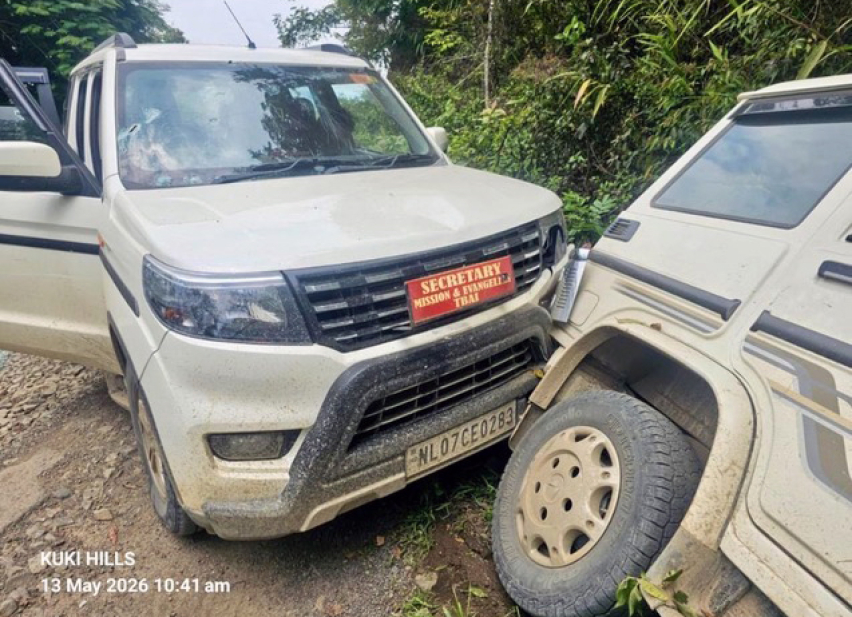
Three Baptist pastors were shot dead in an ambush in India’s northeastern state of Manipur on Wednesday, May 13, while traveling home from an interchurch peace conference focused on easing tensions between tribal Christian communities in the conflict-hit state. At least five others were wounded.
By nightfall, condemnations had arrived from India’s major Christian bodies, regional governments, and community organizations across the Northeast, while the question of who carried out the attack remained bitterly contested.
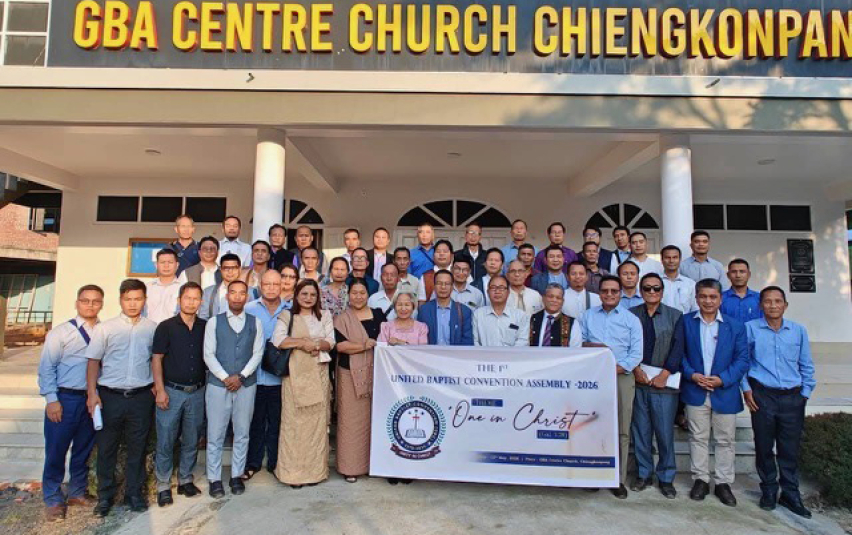
The victims were senior leaders of the Thadou Baptist Association India (TBAI), a Baptist denomination rooted in the Thadou-Kuki community of Manipur. They had attended the United Baptist Convention Assembly in Churachandpur, a town in Manipur’s southern hill district also known as Lamka, and were traveling back to Kangpokpi, roughly 60 miles north, when gunmen ambushed their convoy between the villages of Kotzim and Kotlen along the Imphal-Tamenglong highway at around 10:25 a.m.
The killings struck at ongoing efforts by Christian leaders to reduce tensions between the Kuki-Zo and Naga communities, both largely Christian tribal populations whose relations have deteriorated in recent months amid Manipur’s wider ethnic conflict. One of those killed, Rev. Dr. Vumthang Sitlhou, had emerged as a prominent advocate for reconciliation between the communities.
Who Was Killed
The Evangelical Fellowship of India (EFI), the national evangelical umbrella body of India and a charter member of the World Evangelical Alliance, was among the first national organizations to confirm the deaths and issue a formal response. EFI General Secretary Rev. Vijayesh Lal identified the three killed as Rev. Dr. Vumthang Sitlhou, TBAI’s president and former general secretary of the Manipur Baptist Convention; Pastor Kaigoulun Lhouvum, TBAI’s secretary for finance, youth and music; and Pastor Paogoulen Sitlhou, TBAI’s superintendent pastor.
The injured include Rev. SM Haopu Sitlhou, TBAI’s executive secretary; Rev. Kaithang Singsit; Mr. Thangtinlen Sitlhou; and Mr. Lungoumang Lhouvum, three of whom were transported to Shija Hospitals and Research Institute in Imphal, the state capital, for advanced medical care.
Rev. Lal called the killing of “unarmed church leaders returning from Christian fellowship and ministry deeply disturbing and tragic,” urging authorities to ensure urgent medical care for the injured, protection for affected communities, and a thorough investigation so that those responsible are brought to justice.
EFI also called on churches across India to remember Manipur in their upcoming worship services and prayer gatherings, “asking God for comfort, healing, peace, and wisdom.”
A Peacemaker Among the Dead
The killing of Rev. Dr. Sitlhou has drawn grief across community lines in a region where such lines are rarely crossed. His mother belonged to the Rongmei Naga community, one of the groups whose relationship with the Kuki-Zo people has been under severe strain. His late father, Pastor Pakho Sitlhou, had dedicated much of his ministry among the Rongmei Naga community and translated Kuki gospel songs into the Rongmei language.
In the weeks before his death, Rev. Dr. Sitlhou had been one of the most active bridge-builders between Kuki and Naga Christians in Manipur. He had convened a peace consultation in Kohima, the capital of the neighboring state of Nagaland, under the auspices of the Nagaland Joint Christian Forum, bringing together leaders from communities currently in conflict. On the day before he was killed, he participated in discussions in Churachandpur where Christian leaders from both communities met to discuss peaceful coexistence and dialogue.
He was traveling home from that meeting when armed men stopped his vehicle and opened fire.
“It is heartbreaking that a man dedicated to reconciliation was killed so mercilessly,” the Kuki-Zo Council said. The Kuki Inpi Manipur, the apex body of the Kuki tribes in Manipur, added: “It is … profoundly heartbreaking and enraging that a man who dedicated himself to peace and reconciliation should fall victim to such a merciless and calculated act of violence.”
Similarly, Allen Brooks, spokesperson for the United Christian Forum of North East India (UCFNEI), said: “The Church in North East stands poor today, as it has lost a tall leader, and most importantly a man of peace. Rev. Sitlhou was at the forefront working tirelessly for peace to return to the land he so dearly loved.”
Background: Manipur’s Overlapping Conflicts
Manipur, a state of approximately 3.2 million people bordering Myanmar, has been convulsed by ethnic violence since May 2023, when clashes erupted between the Meitei community, the majority population of the state’s lowland valley and predominantly Hindu, and the Kuki-Zo people, a cluster of predominantly Christian tribal communities living in the surrounding hills. The conflict has displaced tens of thousands and claimed hundreds of lives.
More recently, relations between the Kuki-Zo and Naga peoples, another group of predominantly Christian tribal communities in Manipur’s hills, have also deteriorated sharply, with clashes breaking out in Ukhrul district in February 2026. It was this Kuki-Naga divide that Rev. Dr. Sitlhou had been working to address.
Several armed groups operate in this volatile environment, including the NSCN-IM (National Socialist Council of Nagalim, Isak-Muivah faction), a longstanding Naga insurgent organization in a ceasefire with the Indian government since 1997, and the Zeliangrong United Front (ZUF), representing the Zeliangrong Naga people.
Valley-based groups aligned with Meitei interests also remain active. The use of these groups’ names by rival factions has deepened confusion over responsibility for Wednesday’s attack.
A Contested Claim of Responsibility
Multiple Kuki-Zo organizations, including the Kuki Inpi Manipur, the Kuki-Zo Council, and the Kuki Students’ Organisation City Branches (KSO), alleged that the ZUF-Kamson faction, acting in collusion with NSCN-IM operatives and Meitei insurgent groups, carried out the ambush. The Kuki-Zo Women’s Forum called it “a premeditated act of terrorism aimed squarely at the heart of Kuki peace-making.”
The Zeliangrong United Front denied involvement, however, calling the allegations fabricated and counter-alleging that NSCN-IM operatives carried out the attack while using the label “ZUF Kamson,” arguing that such a faction does not exist.
The NSCN/GPRN (National Socialist Council of Nagalim, Government of the People’s Republic of Nagalim), a separate Naga insurgent faction distinct from the NSCN-IM, also denied involvement.
The United Naga Council (UNC), the principal apex body representing Naga civil society in Manipur, condemned the attack and additionally alleged that in the hours following the ambush, approximately 20 Naga residents of Konsakhul village had reportedly been taken hostage by Leilon Vaiphei, a Kuki village. The UNC called for their “immediate and unconditional release.” The Naga Legislature Forum, a caucus of Naga elected members in the Manipur state assembly, made a similar appeal for the safe release of detained civilians from both communities.
Separately, a social media post circulating Wednesday night, attributed to a page associated with the Indigenous Tribal Leaders’ Forum (ITLF), a Kuki-Zo civil society body, claimed that the same armed group had attacked a second vehicle in the area and that a man from the Chiru community, a small tribal group distinct from both Kuki-Zo and Naga peoples, had died on the spot. Christian Daily International could not independently verify this report, and no official confirmation had been issued as of the time of publication.
Police confirmed the attack and said investigations were ongoing. No arrests had been made as of Wednesday evening.
The State Government Responds
Manipur Chief Minister Yumnam Khemchand Singh visited the injured at Shija Hospitals late Wednesday alongside Deputy Chief Minister Losii Dikho and Home Minister Govindas Konthoujam, and announced that the state would bear all medical expenses for the wounded.
In a written statement, Singh condemned what he called “the dastardly terror act of the armed miscreants,” saying: “This act of violence is deeply troubling and devastating not only for the families but for the entire state, as it disrupts our path to peace.” He pledged to “use every resource of the State to bring the perpetrators and their handlers to justice,” and urged people to “immediately stop abductions and taking hostage and intimidations on community lines.”
Deputy Chief Minister Nemcha Kipgen called the attack “a cruel and heartbreaking act of violence,” while the Naga Legislature Forum issued a signed condemnation bearing the names of nine legislators including Deputy Chief Minister Losii Dikho, and urged law enforcement to “trace and book the culprit at the earliest.”
The Church Responds: From the Northeast to the World
The United Christian Forum of North East India (UCFNEI), speaking from Guwahati and representing Christian communities across the northeastern region, said the killings were “not merely an attack on individuals or a tribe,” but “an assault on the Christian faith, on the sanctity of life, and on the very fabric of brotherhood and sisterhood in North East India.”
The Council of Baptist Churches in North East India (CBCNEI), one of the largest Baptist bodies in India with more than 1.2 million members across more than 8,000 congregations, appealed for Christians to rise above ethnic divisions. The CBCNEI is the parent council whose member conventions include both the Manipur Baptist Convention and the Nagaland Baptist Church Council. Its secretary general, Rev. Dr. Namseng R. Marak, said: “Our identity in Christ must rise above tribal, ethnic, or social divisions. As believers, we are called to be peacemakers and instruments of healing in our broken world.”
The Nagaland Baptist Church Council condemned the killings as “an act of abhorrence to God and our Christian moral principle,” while also urging grieving communities not to seek revenge. Speaking directly to the attackers, the NBCC said: “To those who committed this act: we denounce what you have done, but we do not return evil for evil. We urge you to surrender to justice and seek the mercy of God through repentance.”
World Evangelical Alliance Secretary General Rev. Botrus Mansour called it “an unprovoked hideous attack against Christian brothers” and urged authorities to ensure accountability and greater protection for Christians in the region.
The National Council of Churches in India condemned the killings as “a grave assault not only on human dignity and life, but also on the sacred mission of peacebuilding, reconciliation, and communal harmony.”
The Catholic Bishops’ Conference of India expressed “deep sorrow and grief.” The Archbishop of Imphal, Most Rev. Dr. Linus Neli, whose diocese sits at the geographic center of the conflict, appealed to all communities to “embrace dialogue, forgiveness, reconciliation, restraint, and peaceful coexistence,” writing that “the people of Manipur have already endured immense pain, loss and suffering, and there is a growing longing everywhere for healing, understanding, and a return to normalcy.”
Additional condemnations came from Baptist, evangelical and community organizations across Northeast India, as well as political leaders including Nagaland Chief Minister Neiphiu Rio and Meghalaya Chief Minister Conrad Sangma.
A State on Edge
The attack triggered immediate disruption across parts of Manipur. Protesters enforced a blockade on National Highway-2, a key road linking the state with Nagaland and the rest of India. The Kuki Students’ Organisation declared an emergency indefinite shutdown, while the Kuki Inpi Manipur announced a three-day shutdown across Kuki-Zo inhabited areas.
The Thadou Inpi Manipur declared the three slain pastors “Thadou Martyrs,” emphasizing that the Thadou people are a distinct ethnic community separate from the broader Kuki identity, reflecting the complex internal diversity within Manipur’s hill communities.
Wednesday’s attack on church leaders was among the deadliest such incidents in Manipur in recent years. It came weeks after a bomb attack in Bishnupur district on April 7 killed two young children as they slept, an incident that triggered widespread protests and also remains unsolved.
Three years into a conflict that has displaced tens of thousands, destroyed hundreds of villages, and fractured relationships between communities that share the same Christian faith, efforts toward reconciliation remain fragile.
The day before he died, Rev. Dr. Vumthang Sitlhou had sat across a table from Naga Christian leaders in Churachandpur to discuss peace. He was killed the next morning on the road home.