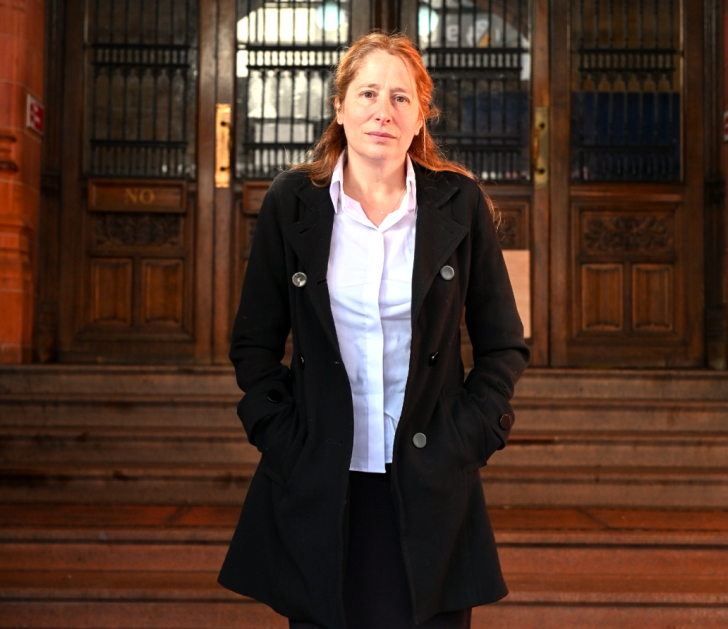
A judge in England on Wednesday (Nov. 25) ordered a second criminal trial to proceed for a Catholic woman previously acquitted after police arrested her for praying silently near an abortion clinic in Birmingham.
Deputy Senior District Judge Tan Ikram ruled Isabel Vaughan-Spruce, co-director of March for Life UK, must stand trial. Ikram issued the decision during a hearing at Birmingham Magistrates’ Court and scheduled the trial for Jan. 25-29.
“Silent prayer can never be a crime in the U.K.,” Vaughan-Spruce said in a press statement after the hearing. “My criminal prosecution for alleged ‘thoughtcrime’ is clear evidence of the U.K.’s censorship crisis. I sincerely hope and pray the court will uphold my fundamental human rights to freedom of thought and religion, and rule in my favor following my trial in January.”
Alliance Defending Freedom International, which is defending Vaughan-Spruce, argued at a preliminary hearing at the same court Oct. 7 that the case constitutes an “abuse of process.” Attorneys stated that the prosecution violates her fundamental human rights to freedom of thought and religion.
They argued that authorities singled out the pro-life activist for her publicly known beliefs, amounting to discrimination and a violation of Article 14 of the European Convention on Human Rights.
The legal team also contended that merely standing and praying silently near the clinic does not meet the requirements of national “buffer zone” legislation – specifically Section 9 of the Public Order Act 2023. Prosecutors charged Vaughan-Spruce under this section, making her the first person to face prosecution under the national law.
Her attorneys argued that the U.K. Parliament never intended to criminalize such conduct or allow the law to interfere with freedom of belief.
At the preliminary hearing, Vaughan-Spruce pleaded not guilty to five criminal charges that the Crown Prosecution Service brought against her, one for each occasion she allegedly stood and prayed silently within the buffer zone.
Ikram ruled that the case will proceed with the charges recorded under Section 9 of the Public Order Act 2023. The charges read, “Isabel Vaughan-Spruce…when within a safe access zone for an abortion clinic, namely The Robert Clinic, did an act, namely stood outside of the Robert Clinic… intending that, or being reckless as to whether, it had the effect of: influencing any person’s decision to access, provide or facilitate the provision of abortion services at an abortion clinic…or causing harassment, alarm or distress to any person in connection with a decision to access, provide, or facilitate the provision of abortion services at an abortion clinic…”
The Crown Prosecution Service altered the wording of the charges last month by adding “or causing harassment, alarm or distress,” ADF International noted. Initial charges from December alleged only “influencing,” and prosecutors amended the text after Ikram ruled that the agency had improperly drafted the original charges.
Jeremiah Igunnubole, legal counsel for ADF International and a former senior crown prosecutor at the Crown Prosecution Service, said a two-tier system exists in the U.K. in which authorities grant privileges to some groups while disfavoring others.
“Isabel’s case is yet another example that shows how Christians and pro-lifers are being targeted in a discriminatory manner and facing censorship by the U.K. authorities,” Igunnubole said. “Isabel’s prosecution clearly illustrates the reality of this two-tier system. Silent prayer is not a crime, and it is absurd that Isabel is facing a second trial for her thoughts even though she was acquitted on a previous occasion and won a financial settlement from the police for her unjust arrests.”
Equality under the law and freedom of speech, thought and religion are core British values, Igunnubole added.
“The case against Isabel undermines all of these, highlighting the vital importance for our society that she is vindicated in court. It is my hope that, following Isabel’s trial in January, the court will uphold her right to silently pray on a public street, and reaffirm that this can never be a crime in a free society.”
The upcoming trial marks the second time Vaughan-Spruce has faced criminal charges for silent prayer.
A court acquitted her in 2023 of praying in a local buffer zone under a Public Spaces Protection Order that banned protesting, which the order defined as engaging in “expressions of approval or disapproval” of abortion. The abortion clinic had closed for the day when she prayed.
Police arrested her again for praying silently in the same location in March 2023, though investigators dropped the inquiry several months later. Vaughan-Spruce successfully challenged both arrests as unlawful in August 2024 and won a £13,000 ($17,038) settlement from West Midlands Police.