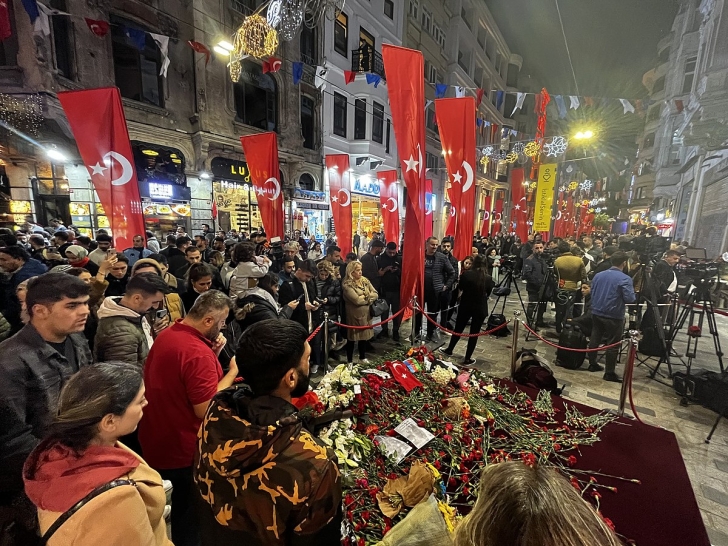
A rights group highlighted violence against Christians by Türkiye in a report timed with Pope Leo IV’s visit to commemorate the 1,700th anniversary of the First Council of Nicaea.
The European Centre for Law and Justice (ECLJ) pointed out the irony of Turkish authorities welcoming the pope on Nov. 27-30 as the ECLJ report documented the country’s “normalized hate” against Christians.
“Direct violence against Christians remains a reality in Turkey, marked by armed attacks, targeted assaults and explicit threats,” stated the 52-page report titled, “The Persecution of Christians in Turkey.”
Recent violence includes last year’s New Year’s Eve church attack in Istanbul. A gunman opened fire on premises of the Kurtuluş Protestant Church in Istanbul’s Çekmeköy District.
“We will not allow you to brainwash our Muslim youth!” the assailant reportedly shouted. “You infidels will be defeated and driven into hell!”
In an incident on Jan. 28, 2024, two masked gunmen from Islamic State (IS) opened fire at the Santa Maria Roman Catholic Church in Istanbul during Sunday Mass, killing a visitor. The victim was reportedly identified as Tuncer Cihan, 52, a Turkish national with a mental disability and no connection to politics.
“The January 2024 attack at Santa Maria Church, the repeated assaults on the Çekmeköy Protestant Church, and the killing of members of the Syriac community illustrate a worrying climate of insecurity,” the report stated. “Pastors have been physically attacked in their places of worship, while hostile graffiti regularly targets churches. These incidents are rarely acknowledged as hate crimes, reinforcing the Christian communities’ sense of vulnerability.”
Other concerns included widespread hate speech against Christians, compared with the Turkish school system’s tying Islam to Turkish identity.
Christians who have converted from Islam are particularly exposed to violence within their own families, according to the report.
Turkish authorities continue to officially deny the 1915 Armenian genocide, which the European Parliament, France and the United States recognize, it stated.
Explaining the historical and legal framework for marginalizing Turkish Christians, over the past century, the report stated conditions have steadily deteriorated.
“A deliberate, multilayered policy of elimination – carried out through violence, forced displacement, legal exclusion and institutional repression – is the result of the dramatic demographic collapse of Turkey’s Christian population over the past century,” the report stated.
Turkish Christians decreased from 20 percent of the population at the beginning of the 20th century to only 0.3 percent today, or 257,000 Christians, the report stated.
“Communities that were once integral to the cultural, religious and historical fabric of Anatolia have been reduced to a fragile remnant,” the report stated. “Their disappearance is not the product of a single event but the cumulative result of restrictive legislation, administrative obstruction, property confiscations, denial of legal personality and – more recently – arbitrary expulsions of clergy, missionaries and converts.”
The ECLJ asserted that Sunni Islam shadows Christianity in Türkiye as the “primary marker” of national identity, a “narrow interpretation” of the modern state that the Treaty of Lausanne formed on July 24, 1923.
“Today, Christianity in Turkey survives in a legal and political environment shaped by a narrow interpretation of the Treaty of Lausanne, a model of State supervision over religious life, and a national narrative that presents Sunni Islam as the primary marker of Turkish identity,” it stated. “This framework continues to marginalize all Christian communities – whether they are recognized under Lausanne or not – by denying them the institutional, demographic and legal conditions necessary for their continuity.”
Türkiye ranks 45th on the Open Doors 2025 World Watch List of the countries where it is most difficult to be a Christian.
The ECLJ highlighted concerns about Türkiye at the Warsaw Human Dimension Conference on Oct. 16, which the Organization for Security and Co-operation in Europe (OSCE) held. Thibault van den Bossche, ECLJ advocacy officer, gave a wide-ranging oral statement, saying that Christians of all denominations “live in a hostile climate” in the country.
“Political, media and social narratives frequently portray Christians as foreign, suspect, or destabilizing – in short, as a threat to national security,” Van den Bossche said. “Such rhetoric fuels direct violence, including attacks on churches and cemeteries, and intimidation of clergy and believers.”
Van den Bossche added that Protestants and Christian converts from Islam form an “especially vulnerable and closely monitored group.”
He said 132 foreign Christians suffered entry bans between 2019 and 2024, affecting 303 persons, including spouses and children. He touched on the ongoing impact of the Armenian genocide.
“The denial of the Armenian genocide continues to shape public discourse and adds stigma to ancient Christian communities,” Van den Bossche said.
The ECLJ urged Turkey to recognize the legal personality of Christian communities and associations and protect their property rights. A recent example of anti-Christian discrimination about property is a refusal by the authority in Istanbul’s Üsküdar District to register a land title for the historic St. Savior Armenian Hospital Foundation.
The legal rights firm also called for Türkiye to guarantee free, regular elections for Christian-foundation boards and fully implement judgments of the European Court of Human Rights.