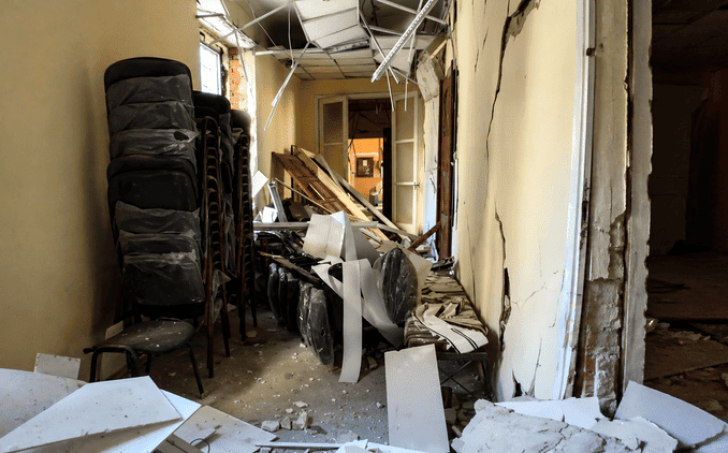
A Russian bomb on April 25 damaged a church building in eastern Ukraine for the second time, the same location where the pastor’s two sons were kidnapped during a service, tortured and killed in 2014.
A guided bomb thought to be a KAB-500S-E carrying between 500 and 1,500 kg of explosives, exploded very close to the Transfiguration of the Lord Pentecostal Church in Sloviansk, Donbas region at 6 a.m., collapsing half of the roof alongside 80 percent of the doors and all windows.
“The blast was so powerful that it folded a large section of the roof and blew out all the windows and doors,” Mikhail Pavenko told Christian Daily International. His uncle, Alexander Pavenko, serves as pastor at the Sloviansk church. “It was one of those guided glide bombs they can launch from tens of kilometers away. It hit just near the church, and the wave from the blast and the shrapnel did a fair amount of damage.”
Mikhail Pavenko, born in Ukraine and living in Seattle, U.S. since 1996 and a volunteer chaplain in his home country, had not yet spoken to his uncle, but other relatives confirmed what happened.
There were no reported injuries. The same building sustained damage in 2014 when artillery shelling blew out windows on one side at the same location.
The bombing follows another recent bombing of a Baptist church building in Zaporizhzhia.
After the bombing in Sloviansk, some 170 churchgoers arrived later that day to clear debris and hold a worship service the next day, a Sunday.
The strikes add to the grievances of the church pastor. Pastor Alexander Pavenko lost two sons, Ruvim and Albert, also pastors, after Russian-backed paramilitaries called the Russian Orthodox Army abducted them from the building during a Pentecostal service on June 8, 2014. Reports at the time said the perpetrators tortured and killed them and left their charred remains in a mass grave alongside church deacons Viktor Brodarsky and Volodymyr Velychko.
Alexander Pavenko, who has preached a message of forgiveness towards the Russians, also lost a third son, Yaroslav Pavenko, a chaplain for the 26th Artillery Brigade, who died from artillery fire while delivering aid to soldiers defending Ukraine in February 2023. He left a wife and young daughter.
Mikhail Pavenko has three uncles serving as pastors in Slavyansk and Kramatorsk, dangerously close to the battle front line.
“My uncles are pastors at large churches,” he said. “If the Russians get close, they [the pastors] need to go for their own safety. But they’re saying, ‘We’re going to be with our people till the end.’”
Mikhail Pavenko said Russians had launched bombs on churches “practically daily,” adding, “there’s nothing holy for those guys. It’s a truly barbaric army that Putin’s put together.”
According to the chaplain, every Protestant preacher or chaplain is a threat to the Russians.
“I know they have a list of ministers. One of the first things they do when they enter a city is go after the Protestants because the church did not flee; the church stayed and took a side for freedom and democracy.”
His face clearly showing grief, Mikhail Pavenko recalled the gruesome deaths of his cousins in 2014.
“They killed two of my relatives, tortured them, and two deacons,” he said. “I think there were 11 children left orphans and two widows.”
Pavenko said he knew the need to forgive the Russian state-sanctioned warlords who killed his cousins but said, “they did a horrific thing, a really painful thing.” He thought some of the murderers had died since in the conflict but added “some I’m sure are still out there.”
Pavenko said April had been “specifically difficult” for Ukrainian evangelicals and other Protestants. He recalled Russian invaders burning a church building in the city of Druzhkivka at Easter, “a church I visited once,” and then killing a minister and wounding a woman with a strike on April 16 against a church in Zaporizhia.
“And those are just the Protestant churches,” he said. “I follow blogs and Telegram channels and speak with chaplains and pastors regularly; it seems like every single day.”
In April, Russian military strikes hit two Orthodox church buildings, one in Kherson and one in the Donetsk region, he said.
“Since 2022, upwards of 800 places of worship and over 80 ministers from a variety of confessions have been killed,” he said. “Those are staggering numbers.”
Mikhail Pavenko said churches are deliberately targeted more than before. Luhansk, which is 99 percent Russian occupied, had 150 Protestant church buildings of Baptists, Pentecostals and other charismatics prior to 2014, he said, adding that none remained by 2024.
“The only faith that the Russians accept is the Moscow Orthodoxy faith of their patriarch, or a church that’s completely lower than them,” he said. “As a result, a large portion of the Christian population fled those occupied areas. Today they are all over Ukraine.”
Some have left the country, but many found refuge in the free part of the Donbas region.
“So I would say, absolutely, it’s deliberate,” Mikhail Pavenoko said. “Russians have a goal called the ‘Russian World,’ where only their faith will be practiced. In fact, when they killed two of my cousins in 2014, they accused them of spreading ‘American faith’ and being American spies. That’s an old trick the Soviets used in the ‘50s and ‘60s.”
Ukrainians are resilient and the church is serving both people and the military, he said.
“They’re doing really what a church should do. It’s an incredible time, but it’s a difficult time” he said. “I go there every six months, and I see them – it’s almost like they’re withering away in my eyes. It’s the distress, the fear, and they’re just doing all that they can to help their nation and they’re praying and waiting for a miracle.”
The international community risks becoming desensitized to the horrors of the invasion as the war goes on, he said, “but the reality is the war is still raging, and the Russians are hitting hospitals and schools.”
Russian propaganda had infiltrated conservative circles in the United States and had spread false narratives that people too readily believed “through guys like Tucker Carlson and other influencers,” he said. “There’s been a lot of deliberate Russian misinformation to paint Ukraine as the nation that is killing Protestants, which isn’t true at all. I’ve served in frontline positions with Protestant chaplains, Orthodox chaplains, and Catholics. We have the same goal.”
Pavenko has joined meetings at the White House with the Faith Office to share statistics, photos and personal stories of “what Russia is doing to believers.” He believes false narratives about the war have started to “lose their grip.”
“I told them, ‘Speak with President Trump. These are the facts.’ It’s the Russians doing the genocide, not the other way around.”
Pavenoko fears the war is having a traumatic effect on children that will affect an entire generation.
“The war has impacted children in a very powerful way. PTSD [Post Traumatic Stress Disorder], obviously. Imagine you’re sleeping and at two o’clock in the morning the air raid siren goes off and you have to wake your children and run to the basement. And you do that for four years. Just that cycle of fear.
“That’s not just in the front lines – that’s Kyiv, Dnipro and Zaporizhzhia. Russia’s hits are made to make life unbearable. It’s a generational thing, and I don’t think we have even scratched the surface of that trauma yet.”
Colby Barrett, producer of A Faith Under Siege about the suffering of Ukrainian Christians in the conflict, previously filmed at the church building before the second bombing and interviewed the pastor. He is heading fundraising efforts to help alleviate the estimated cost of repairs at $500,000.
The latest bombing showed an increased hostility by the Kremlin towards Pentecostal Christians, having declared a so-called “Holy War,” Barrett told Christian Daily International. He called it a “real uptick of Russia going after churches.”
The film producer said the attack is a good example of Russia increasing its targeting of churches throughout the country, both close to the front and in the capital city Kyiv.
Barrett explained that the church building had been a Soviet-era Ministry of Culture facility, “a kind of monument to atheism,” and that it helps the local community by providing food, clean water and supplies. The building feels more like “an aid distribution point than a church,” serving needs in the community.
“They’re not a big church, but they had 170 people worshiping there on Sunday,” he said. “So like [there’s] still glass on the ground, and they’re coming to worship. I’ve already seen videos of them putting new roof structure on, putting plywood up and those kinds of things.”
Barrett said baptisms are happening en masse in Ukrainian churches despite the conflict. He admired how hundreds of baptisms still took place at Spasinnya [Salvation] Evangelical Church in Vyshneve, Kyiv Region, after two Shahed missiles struck a nearby car parking lot during a pastors’ conference dedicating a 4,500-person worship hall on Sept. 28.
“It just shows the resilience these bombings are kind of having, the opposite effect on faith,” he said.
Russia struck a Baptist church building in the southeastern Ukrainian city of Zaporizhzhia during a prayer meeting last week, killing at least one person, a minister, and injuring at least eight others.
Barrett said that churchgoers there, after the attack, “put up plywood, they spray painted some awesome Bible verses on the plywood and got back to worshiping. The faith of the Ukrainian believers and the resilience there is just it’s kind of hard to fathom.”
The bombing of the Sloviansk church was so intense that it blew out interior windows, he added.
Barrett said Pastor Alexander Pavenko had been so “bright and shiny” when he met him for the documentary, and “now he’s cleaning up broken glass” and wondering how to remove bomb debris plaster from clothes intended for the homeless.
Pastor Alexander Pavenko is “a big pillar of the community,” according to Barrett, who said Ukrainian soldiers guarding Sloviansk have decided not to leave unless the church leaves in the face of Russian attacks. In the occupied territories, authorities have shut down churches not directly or indirectly controlled by the Kremlin.
“There’s some token churches that are allowed to re-register, but they have to have a leader that’s loyal to the regime,” said Barrett. “Every one of their members needs to be registered with the government. They have to register their building, and they can’t hold services unless they have 30 Russian passports present. Presumably, if you have 30 Russian passport holders, at least one of them would rat out anti-regime preaching to the authorities.”
The U.S. Congress has introduced a bipartisan, bicameral Russia’s War on Faith Act, which would sanction Russian officials responsible for targeting religious sites.
The planned law requires the secretaries of State and Defense to jointly report on Russian efforts to “persecute, suppress, and violate the religious freedoms of faith communities in Ukraine and Russian-occupied territories.” It also requires the president to impose sanctions on foreigners involved in such actions.
“Russia targets and kills persons of faith as a matter of policy wherever it invades,” said Rep. Joe Wilson, Co-Chair of the Congressional Ukraine Caucus, said in a press statement. “War criminal Putin seeks to prevent free worship of all believers and crushes any faith not subservient to its state-run church and corrupt former KGB agent Patriarch Kirill or otherwise submit itself to repressive state control. Believers in the temporarily occupied territories of Ukraine are targeted with particular ferocity. It is critical that we counter Russia’s war on faith.”
(Corrected on May 5, 2026 to reflect that Mikhail Pavenko is a volunteer chaplain, not “The Rev.,” and that the third son that Alexander Pavenko lost was named Yaroslav Pavenko and died while delivering aid to soldiers defending Ukraine in February 2023.)