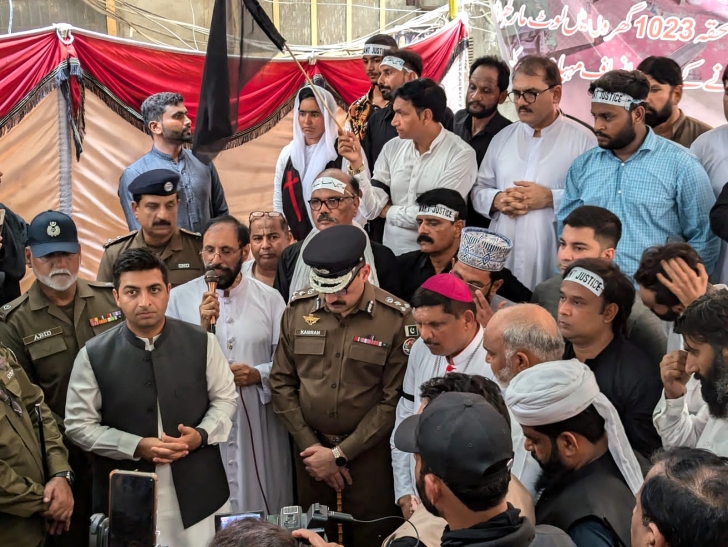
Pakistan’s Supreme Court on Tuesday (March 31) ordered a trial court to conclude within six months the case against assailants in the 2023 anti-Christian attacks in Jaranwala, according to media reports.
A two-judge bench headed by Chief Justice of Pakistan Yahya Afridi also directed police to immediately arrest all absconding suspects. The bench issued the directives while hearing petitions filed by the Punjab Province government seeking cancellation of bail granted to suspects in 22 cases linked to the Aug. 16, 2023 Islamist violence against Christians in Jaranwala, in Faisalabad District.
At the outset of the hearing, Punjab Additional Prosecutor General Ahmad Raza Gilani stressed the need for expediting the trial, citing delays in proceedings before a special anti-terrorism court in Faisalabad. The provincial government’s legal team urged the court to set a clear timeline for the cases, ARY news channel reported.
The bench then ordered that all trials be completed within six months and instructed the inspector general of Punjab Police to ensure the immediate arrest of all absconding suspects. The chief justice emphasized that suspects must be taken into custody without delay to uphold the rule of law.
The court’s intervention follows earlier criticism by the Supreme Court over the pace and quality of investigations into the attacks, which saw Islamist mobs target churches and Christian homes after allegations of blasphemy against two Christians.
In February 2024, a three-judge bench led by then-Chief Justice Qazi Faez Isa strongly rebuked the Punjab government’s progress report on the incident, calling it inadequate and ordering a revised submission within 10 days.
“I am feeling ashamed that only 18 charge sheets were submitted in the case in the last six months,” Isa told a provincial law officer during the hearing.
He also questioned Pakistan’s commitment to minority rights, contrasting domestic realities with its criticism of Islamophobia abroad. Figures presented at the time showed 22 cases had been registered, with 304 arrests made and charge sheets filed in 18 cases. The court, however, noted significant gaps in the report, including missing details on suspects, case status and progress in prosecutions.
Isa further criticized law enforcement agencies for their lack of resolve in identifying and prosecuting those responsible. He warned that such shortcomings risked damaging the credibility of the police and suggested that authorities appeared reluctant to act against perpetrators of mob violence.
The court subsequently ordered a fresh and thorough investigation, directing authorities to ensure effective prosecution and warning of disciplinary action against officials who failed to do so. It also sought updates on compensation for victims and reconstruction of damaged churches.
Separately, the Lahore High Court in October dismissed petitions filed by individuals and Christian groups seeking a judicial inquiry into the attacks.
Justice Asim Hafeez ruled that the court lacked jurisdiction to order the formation of a judicial commission, noting that multiple Joint Investigation Teams (JITs) had already submitted reports.
The Jaranwala violence erupted after two Christians were accused of desecrating the Quran and insulting the Muhammad, the prophet of Islam – allegations that were later found to be false. A trial court subsequently acquitted the men, concluding that they had been framed following a personal dispute.
Despite official assurances of accountability, rights groups say progress has been limited. According to Amnesty International, of more than 5,200 individuals allegedly involved in the attacks, only 380 were arrested, with the vast majority remaining at large.
“Of the arrested suspects, 228 were released on bail and 77 others had the charges against them dropped,” said Babu Ram Pant, Amnesty International’s deputy regional director for South Asia, in a statement marking the first anniversary of the incident. He warned that weak investigations and prosecutions had fostered “a climate of impunity.”
Blasphemy allegations in Pakistan frequently trigger mob violence, particularly against religious minorities. While the law prescribes severe penalties, including death, for insulting the Muhammad, executions have not been carried out. Even unproven accusations, however, can incite unrest and vigilantism.
International advocacy groups continue to highlight systemic challenges faced by religious minorities in Pakistan. In its 2026 World Watch List, Open Doors ranked Pakistan eighth among the 50 countries where it is most difficult to be a Christian, underscoring ongoing concerns about legal protections and enforcement.